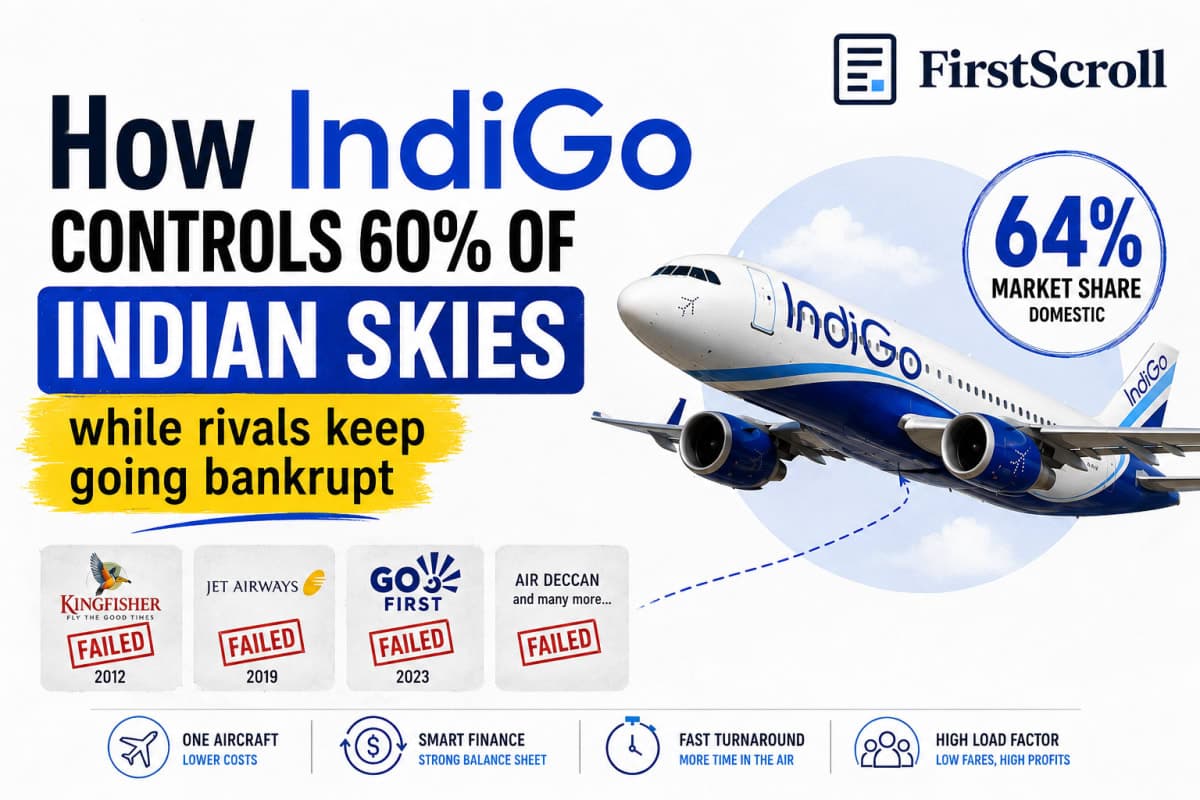
In today's FirstScroll, we figure out how one airline quietly ate the Indian sky. While famous, glamorous, deep-pocketed rivals crashed one after another, this plain little airline with no frills just kept winning. The reason is almost boringly brilliant.
The Story
Indian aviation is basically a graveyard with a few survivors.
Kingfisher, the "King of Good Times", with flatbeds, gourmet meals, and Vijay Mallya's swagger? Grounded in 2012. Jet Airways, once India's premier private airline? Ran out of cash and stopped flying in 2019, owing creditors around ₹18,000 crore. Go First? Filed for bankruptcy in 2023 and was ordered into liquidation in 2025. Air Deccan, Air Costa, Air Pegasus, TruJet. All gone.
And standing in the middle of this wreckage, bigger than ever, is a plain blue-and-white airline that gives you no free meals, no business class, and no fancy lounge.
IndiGo. Which, as of early 2026, flies around 64% of every domestic passenger in India. Six out of every ten people you see at an Indian airport gate are flying IndiGo.
So here's the puzzle. Aviation in India killed almost everyone who tried it, including richer, flashier, more famous airlines. How did the boring one not just survive, but basically take over the entire sky?
To get it, you first have to understand why airlines die here in the first place.
Why running an airline in India is a near-death sport.
Airlines everywhere are brutal businesses, but India is on hard mode. Three killers show up again and again.
One, fuel. Jet fuel (ATF) is taxed heavily in India and priced in dollars. It can eat up 40% or more of an airline's costs. When oil spikes or the rupee weakens, costs explode overnight, and you can't just raise ticket prices because, killer number two.
Two, price-sensitive flyers. Indians love cheap flights. The moment you charge a premium, people switch to whoever's ₹500 cheaper. So airlines are trapped: costs shoot up in dollars, but customers refuse to pay more in rupees. That gap is where airlines bleed to death.
Three, debt and over-ambition. Most failed airlines died the same way. They expanded too fast, leased too many planes, added routes optimistically, and piled up debt quietly in the background. One bad year, lenders got nervous, funding dried up, and the whole thing collapsed.
Kingfisher is the perfect cautionary tale. It tried to be a luxury airline in a country that wanted cheap seats, bought the low-cost Air Deccan and inherited its losses, and racked up accumulated losses of over ₹7,000 crore. It tried to be everything for everyone, and became nothing.
Now here's where IndiGo did the opposite of everything.
The boring genius: do one thing, ruthlessly.
While rivals chased glamour, IndiGo chased cost. Its entire existence is built around being the cheapest airline to operate, not just the cheapest to fly. And it engineered that obsession into every tiny decision.
Start with the planes. IndiGo flies basically one type of aircraft, the Airbus A320 family. Sounds trivial. It's a superpower. One aircraft type means one set of spare parts, one kind of pilot training, one maintenance playbook. Compare that to an airline juggling five different plane models, each needing its own parts, mechanics, and certified crew. IndiGo stripped out a mountain of complexity and cost that rivals carried.
Then the famous trick: sale and leaseback. IndiGo orders planes in gigantic bulk, hundreds at a time, which gets it massive discounts from Airbus. Then it often sells those brand-new planes to leasing companies and leases them right back. This keeps its fleet young, fuel-efficient, and crucially, keeps huge debt off its books. It turned plane-buying, the thing that bankrupted others, into a money-spinner.
Add no free meals (you pay if you want food), fast 30-minute turnarounds so planes spend more time earning in the air, and high occupancy. The result is the lowest costs in the industry, which lets IndiGo offer cheap fares and still make a profit on them, the exact thing Kingfisher and Jet never managed.
Then the masterstroke: surviving long enough to feast.
Here's the part most people miss. IndiGo didn't only win by being good. It won by being the last one standing, and then gobbling up everything the dead left behind.
Look at the pattern. When Kingfisher collapsed, its passengers and slots needed a new home. When Jet Airways died in 2019, a huge chunk of the market suddenly opened up. When Go First grounded its flights in 2023, IndiGo immediately posted its highest-ever market share. Every time a rival died, IndiGo was sitting right there, financially healthy, with planes ready to absorb the orphaned passengers.
It's almost cruel. The same brutal market that killed everyone else became IndiGo's feeding ground, precisely because IndiGo had built itself to survive the brutality.
And here's the kicker that proves the point. IndiGo faced the exact same shocks that killed its rivals. The Pratt & Whitney engine defect that pushed Go First into bankruptcy? It hit IndiGo too, grounding 60 to 70 of its aircraft at points in FY26. Same engine problem. Same fuel spikes. One airline died. The other had a strong enough balance sheet and lean enough costs to absorb the blow, lease replacement planes, and keep flying.
That's the whole story in one comparison. Same poison, different bodies. The lean one lived.
So is IndiGo unbeatable now?
Not quite, and this is where it gets interesting. Dominance has its own dangers.
Being this big means when IndiGo stumbles, the whole country feels it. In December 2025, IndiGo cancelled over 1,000 flights in just a few days, citing crew shortages tied to new pilot rest rules, triggering a government inquiry. When you run 60% of the sky, your problems become national news.
And a real challenger is finally emerging. The revived, deep-pocketed Tata-owned Air India now holds around 25 to 27% of the market and is gunning for the premium flyer. IndiGo's answer? Stop being purely boring. It's pushing hard into international routes, targeting 200 million passengers by FY30 and raising its international capacity share toward 40%, even adding business-class seats. The no-frills king is cautiously trying on a crown.
So, how does IndiGo control 60% of Indian skies while rivals keep going bankrupt?
By understanding something its glamorous competitors never did. In India, aviation isn't a race to be the fanciest. It's a war of survival, and the winner is whoever keeps their costs lowest and their balance sheet strongest when the storms hit. Rivals chased prestige, luxury, and fast growth, and the brutal economics swallowed them. IndiGo chased one boring thing, low cost, with religious discipline, and that discipline let it outlast every storm that sank the others.
It turns out the most thrilling way to win in Indian aviation was to be utterly, ruthlessly boring.
Until next time...
By understanding something its glamorous competitors never did. In India, aviation isn't a race to be the fanciest. It's a war of survival, and the winner is whoever keeps their costs lowest and their balance sheet strongest when the storms hit. Rivals chased prestige, luxury, and fast growth, and the brutal economics swallowed them. IndiGo chased one boring thing, low cost, with religious discipline, and that discipline let it outlast every storm that sank the others.
It turns out the most thrilling way to win in Indian aviation was to be utterly, ruthlessly boring.
Until next time...