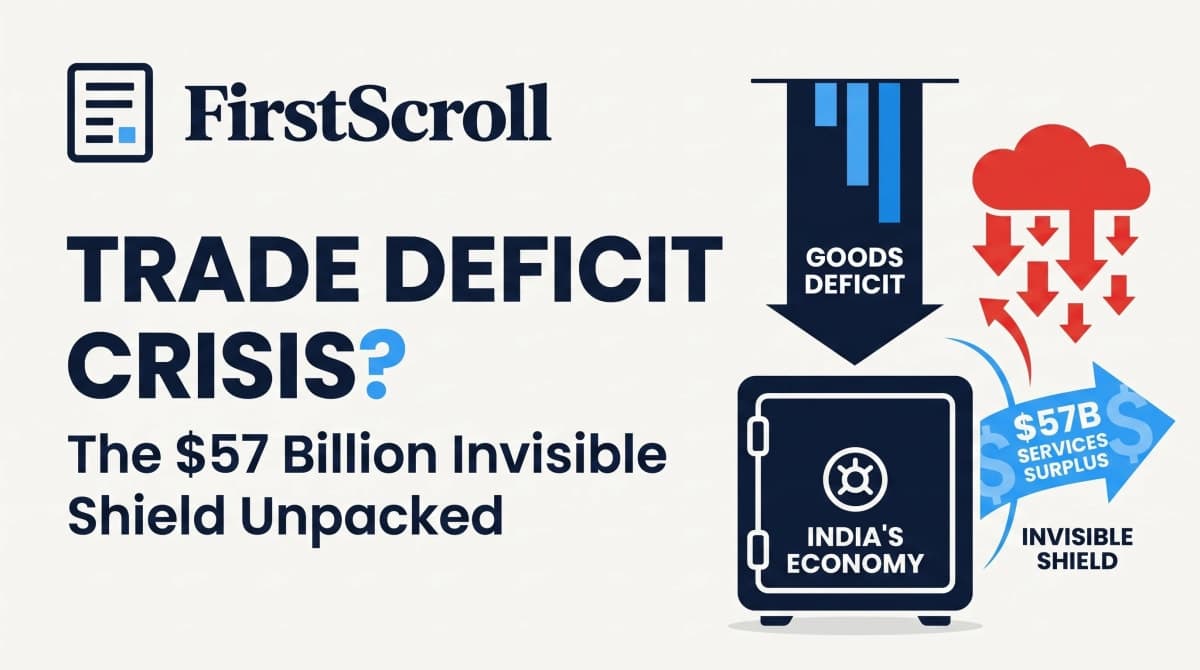
India buys far more goods from the world than it sells. On paper, that should be a crisis. It isn't. The reason is a quiet $57 billion cushion most people never hear about.
In today's FirstScroll, we unpack India's current account, the goods deficit, and the invisible export engine that keeps the whole thing balanced.
The Story
Here is a fact that sounds alarming on its own. In the October to December quarter of 2025, India's goods trade deficit, the gap between what India imports and exports in physical products, stood at $93.6 billion. That is a wider gap than the same quarter a year earlier, when it was $79.3 billion.
If that were the whole story, you would expect India to be in serious external trouble. A country that buys $93 billion more in goods than it sells, every three months, sounds like a household spending far beyond its income.
But the headline number that actually measures India's external health, the current account deficit, came in at just $13.2 billion, or 1.3% of GDP. That is a manageable, almost comfortable, figure for an economy of India's size.
So how does a $93 billion goods deficit shrink down to a $13 billion overall deficit? Where did the other $80 billion go?
The answer is the most important and most underappreciated story in India's economy. To understand it, you need to understand what the current account actually is.
For the uninitiated, the current account is the full scorecard of money flowing in and out of a country through trade and income, in a given period. It has four main parts.
The first part is goods, also called merchandise trade. This is physical stuff. Crude oil, gold, electronics, machinery, chemicals coming in. Smartphones, textiles, pharmaceuticals, engineering goods going out. India runs a large and persistent deficit here, because it imports enormous quantities of oil and gold, and there is no realistic way to stop.
The second part is services. This is the invisible trade. Software exports, IT consulting, business process work, design, finance, research done in India for clients abroad. India runs a large and growing surplus here.
The third part is primary income. This is mostly investment income, the interest and dividends that flow out to foreign investors who own Indian assets, minus what Indians earn on assets abroad.
The fourth part is secondary income. This is dominated by remittances, the money that Indians working abroad send home to their families.
Add up all four, and you get the current account balance. India runs a deficit, but a small one, because three of these four parts work to offset the big goods deficit.
So let's follow the actual money for that December quarter.
The goods deficit was a heavy $93.6 billion outflow. That is the hole that needs filling.
Now the services surplus steps in. India's services exports brought in a net surplus of $57.5 billion, up from $51.2 billion a year earlier. This is the IT and business services engine, the Infosyses and TCSes and Wipros and global capability centres, earning dollars from clients worldwide. In one quarter, services alone filled more than 60% of the goods hole.
Then remittances step in. Indians working in the Gulf, the US, the UK, Singapore, and elsewhere send tens of billions of dollars home every quarter through the secondary income account. India is consistently among the largest recipients of remittances in the world.
Between the services surplus and remittances, the vast majority of that scary $93 billion goods deficit gets quietly absorbed. What is left over is the $13.2 billion current account deficit.
Think of it like a household with an unusual income structure. One earner has a big, lumpy expense every month, the goods bill. But the household also has two other earners, a steady high-paying job, which is services exports, and regular money sent by a relative working abroad, which is remittances. The big expense looks frightening in isolation. Seen against the full household income, it is easily covered, with only a small shortfall at the end of the month.
This is why economists who understand India do not panic at the goods deficit. They look at the current account deficit, and 1.3% of GDP is well within the range considered safe and sustainable.
So why did the deficit widen at all in that quarter, from 1.1% to 1.3% of GDP?
Two specific reasons, and both are worth understanding.
The first was US trade tariffs. The October to December quarter saw the Indian economy face the brunt of US tariffs of up to 50%, which dampened the growth of Indian exports. Fewer exports means a wider goods gap. India has since seen those tariffs reduced after a trade agreement with Washington and a US Supreme Court ruling, so this particular pressure has eased.
The second reason was a shift in oil sourcing. According to RBI data, the goods deficit widened in part because pressure from the US government drove Indian refiners to limit their purchases of cheap Russian oil and switch to more expensive alternatives. Same volume of oil, higher dollar bill, wider deficit. Rising gold imports added to the pressure.
There is a useful detail in the data that softens the picture. The net outgo on primary income, the investment income paid out to foreign investors, actually fell to $12.2 billion from $16.4 billion a year earlier, which helped limit the overall deficit. And for the first nine months of the fiscal year, April to December 2025, the cumulative current account deficit actually moderated to $30.1 billion, or 1.0% of GDP, compared with $36.6 billion in the prior year. On a nine-month view, India's external position improved.
So why does any of this matter to you right now?
Because the current account is the deep structural reason behind a story you have been hearing about constantly, the weak rupee.
Here is the link. The current account deficit means India, as a country, has a net need for dollars from trade and income. That need has to be financed by the capital account, which is foreign investment flowing in, both into stocks and bonds and as direct investment. When foreign investors are happily pouring money into India, the dollars they bring in finance the current account deficit comfortably, and the rupee stays stable. When foreign investors turn cautious and start pulling money out, the current account deficit still has to be financed, but the dollars are no longer arriving, and the rupee weakens to close the gap.
IDFC First Bank chief economist Gaura Sen Gupta made exactly this point, noting that the pressure on the rupee continues to stem from the capital account, the investment flows, rather than from a runaway current account deficit.
This is the crucial nuance. India's current account is not in crisis. A 1.3% deficit is genuinely fine. The rupee's recent weakness is being driven more by foreign investors selling Indian equities than by a collapse in India's trade position.
So how should you read all this as an investor or an observer of the economy?
Three takeaways.
One, watch oil, because oil is the swing factor. Sen Gupta noted that because the starting point of the current account deficit is low, it would take a sustained 12-month period of crude oil at $80 per barrel to push the deficit meaningfully wider. With the West Asia conflict keeping crude elevated well above that, this is the single biggest risk to watch. A short oil spike is absorbable. A sustained one is not.
Two, respect the services surplus. India's $50 to $57 billion per quarter services surplus is the country's best defence against external shocks. It is the reason India can import all the oil and gold it wants and still keep its current account deficit small. Anything that threatens India's IT and business services exports, whether automation, global slowdowns, or protectionism, is a far bigger long-term risk to India's external stability than the goods deficit itself.
Three, separate the two stories in your head. The current account story, which is about trade and is currently healthy, is different from the capital account story, which is about foreign investment flows and is currently under pressure. The rupee sits at the intersection of both. Confusing the two leads people to think India has a trade crisis when it actually has a capital flows wobble.
But let's be clear about what this does not mean.
It does not mean India can ignore its goods deficit forever. A structural dependence on imported oil and gold is a genuine vulnerability, and every external shock, every Middle East war, every gold price surge, lands on that import bill. The services surplus covers it today, but a prudent economy works to reduce the import dependence over time, through domestic energy, renewables, and reducing the cultural pull toward gold.
And it does not mean the rupee will simply bounce back. Even with a healthy current account, if foreign investors keep selling Indian equities, the rupee stays under pressure. The trade picture sets the backdrop. The investment flows decide the day-to-day.
Step back, and there is a genuinely reassuring insight here. India's economy is often described, fairly, as vulnerable because it imports most of its oil. That is true. But the same economy has quietly built one of the world's most powerful invisible export machines, selling its software, its services, and its skilled labour to the entire world. That machine does not show up when you fill petrol or buy gold, but it is working in the background every single quarter, turning a frightening $93 billion goods deficit into a very manageable $13 billion one.
The goods deficit is the headline. The services surplus is the quiet hero.
Until next time…