In today's FirstScroll, we break down OYO's refiled IPO and explain why a company that once offered its early investors an exit now refuses to sell them a single share.
With that out of the way, let's dive into today's story.
The Story
If you have been reading FirstScroll for a while, you have met OYO before. Back then, the interesting part of its IPO was the escape hatch. Early investors, the venture funds who had poured money in during the good years, were lined up to sell a chunk of their shares to the public and walk away with cash. There is a name for that arrangement, an [Offer for Sale](INTERNAL: what is an offer for sale), and it is exactly what it sounds like. Existing shareholders sell, the money goes to them, and the company itself gets nothing.
That was the old plan. The one that kept getting delayed.
OYO first tried to list in October 2021, aiming for roughly ₹8,430 crore at a valuation near $12 billion. Then global tech stocks fell, sentiment soured, and the plan was pulled. A second attempt through a confidential route in 2023 was withdrawn too. A third was pushed back when SoftBank, its largest shareholder, asked the company to show stronger numbers first. Four attempts in five years, and the market kept saying not yet.
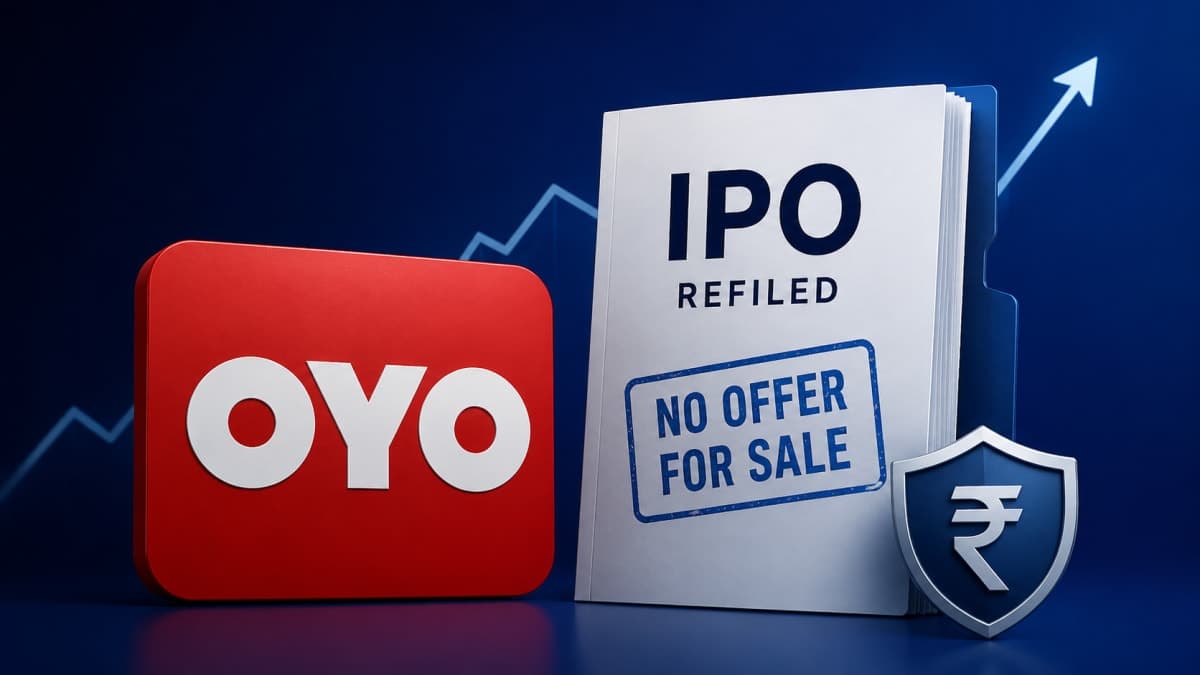
Then, on 30 June 2026, the parent company refiled. Same company, new name. Oravel Stays is now called Prism. And this time, something in the structure had quietly changed.
The new filing is a ₹6,650 crore fresh issue, with no Offer for Sale at all.
So the question is, why would a company that once built its whole listing around letting early investors cash out now refile with zero exit for any of them?
To answer that, you first need to see what "no Offer for Sale" actually means for the people who own OYO.
You see, an IPO can raise money in two ways. A fresh issue creates brand-new shares and sells them, so the money lands in the company's bank account. An Offer for Sale takes shares that already exist, owned by founders and funds, and sells those instead, so the money lands in the sellers' pockets. Most big IPOs mix the two.
OYO's refile is a fresh issue and nothing else. That means SoftBank, Ritesh Agarwal, Microsoft, Airbnb and the rest are not selling a single share into this listing. Every rupee raised goes into the business, and every early investor keeps their entire stake.
Now, that can mean one of two very different things.
The generous reading is conviction. If SoftBank believes OYO is worth far more than the market will pay today, the smart move is to hold, let the listing establish a floor, and sell later at a better price. Not selling is a vote of confidence.
The other reading is simpler. Sometimes investors do not sell because the market will not pay the price they want. An exit only happens if a buyer meets your number. After four postponements and two valuation cuts, from $12 billion down toward $7 billion, it is fair to ask whether the absence of an exit is belief, or just a price nobody will accept yet.
And the money itself tells you where the pressure is. Of the ₹6,650 crore, about ₹4,987.5 crore is going to repay debt at an overseas subsidiary. This is not a war chest for aggressive expansion. Three-quarters of the raise is cleaning up the balance sheet. The company is not going public to grow. It is going public to deleverage.
But here's the twist, and it is the same trap we flagged in [our earlier OYO breakdown](INTERNAL: oyo ipo explained). Look hard at the profit.
Prism reported a profit of ₹748 crore for the nine months to December 2025, a big jump from ₹245 crore for all of the previous year. On the surface, a company that finally makes money. But a section-by-section read of the filing notes that part of that profitability leans on deferred tax credits, an accounting entry, not cash walking through the door. Strip the makeup off, and the operating story is better than before but not quite the clean turnaround the headline profit suggests.
Now, why should you care about a footnote in a prospectus? Because the whole IPO rests on it. Investors are being asked to price a company on the strength of its first real profit, and if a chunk of that profit is a one-off tax entry, the price they should pay is lower than the headline invites.
There is more sitting in the risk factors. The filing lists 174 pending legal proceedings, a promoter stake that is partly pledged, and an unresolved overhang from the long-running Zostel dispute. None of these is fatal. All of them are the kind of thing that gets glossed over when a stock is hot and remembered painfully when it is not.
So here is where it all lands. The old OYO IPO was an exit story, early money looking for the door. The new one is a repair story, a company raising cash mostly to pay down debt, with its investors staying put whether out of faith or a lack of better options. The single detail that changed, the missing Offer for Sale, quietly rewrote what this listing is for.
Whether that is a company too confident to sell or a company the market still will not fully price is something only the final valuation will tell us.
Until then…
If this story helped you make sense of OYO's IPO, share it with a friend on WhatsApp, LinkedIn or X. You might also enjoy our earlier breakdown of Horizon Industrial Parks.