In today's FirstScroll, we break down why Donald Trump's threat of a 200% tariff on Indian medicines barely moved Indian pharma stocks, and why the answer is hiding in a question most people get wrong: who actually pays a tariff?
With that out of the way, let's dive into today's story.
The Story
On paper, this should have been a disaster.
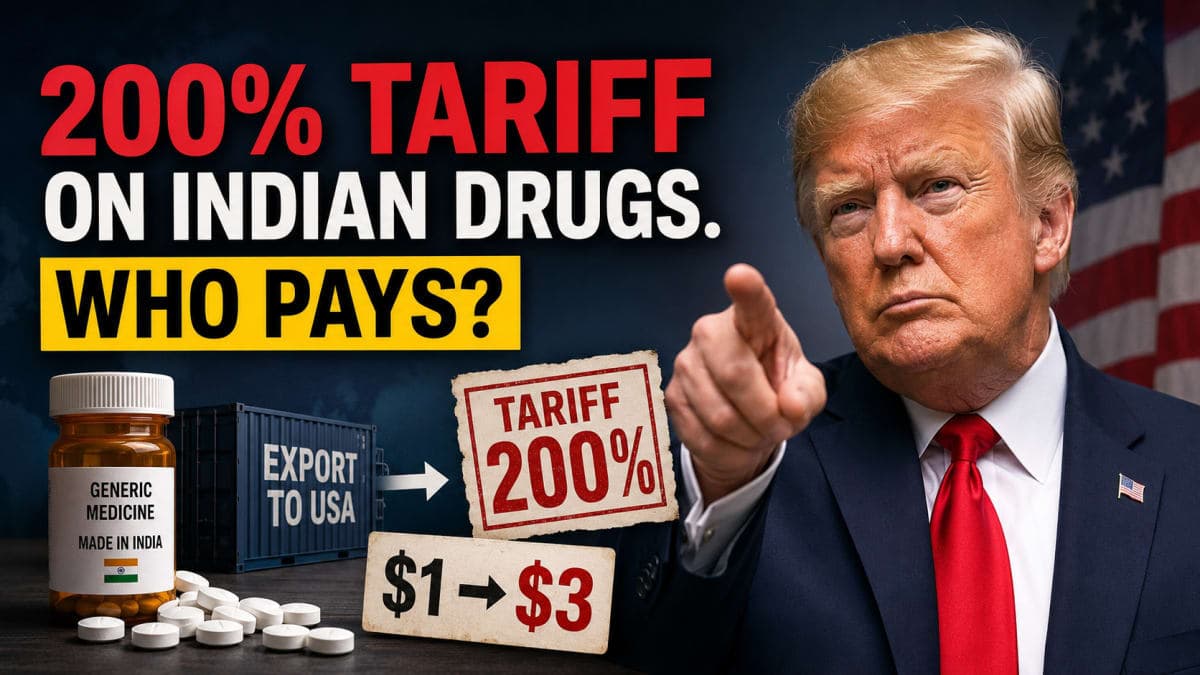
The United States is the single biggest export market for India's drugmakers. India supplies roughly 35% of all generic medicines consumed in America, and for many Indian pharma companies the US generates a large slice of revenue. So when Donald Trump announced a plan to tax imported generic drugs, ramping from zero up to 100%, and eventually 200%, the obvious expectation was carnage. A 200% tariff means a medicine that sold for one dollar now costs three.
And yet, when the news broke, the Nifty Pharma index fell by under 2%, clawed back half of even that within the hour, and analysts came out telling investors to stay calm. The threatened number was enormous. The reaction was a shrug.
So the question is, how does the biggest market on earth threaten a triple-price tariff, and the companies most exposed to it barely blink?
The answer starts with a question almost everyone gets backwards: when a country slaps a tariff on an imported good, who actually pays it?
The instinct is to say the exporter, the Indian company. But a tariff is a tax collected at the border of the importing country, paid by the importer, and then almost always passed along in the final price to the end customer. Whether the exporter eats it or the customer pays it comes down to one thing: who has the power to walk away.
And this is where generic drugs are a very strange product. They are already sold on wafer-thin margins, cents on the dollar. The head of Dr Reddy's, one of India's largest drugmakers, said the quiet part out loud: a tariff at this level simply cannot be absorbed by the company, so prices will rise "in the magnitude of the tariff." Translation: we won't pay this. American patients will.
Now, why can Indian firms be so blunt about refusing to eat the cost? Because of the second thing the tariff runs into: the buyer has nowhere else to go. The whole reason America imports these pills from India is that nobody makes them cheaper. Manufacturing generics inside the US would, by industry estimates, raise costs five to six times over. You cannot tariff your way to a domestic industry that does not exist and would be far more expensive if it did. So a tariff meant to punish the exporter mostly ends up as a price hike on American medicine cabinets.
There is a neat irony buried in here. The very thing that looks like Indian pharma's weakness, the low-margin, unglamorous generics business, is exactly what makes it so hard to tariff. When your product is cheap, essential, and irreplaceable, the pricing power quietly sits with you, not the buyer.
But here's the twist, and it is why the stocks dipped at all rather than not moving. The market wasn't reacting to the tariff. It was reacting to the timeline.
Look closely at the plan and the scary numbers are all in the future. Generic imports stay at zero tariff for two years from August 2026. The 100% and 200% levels only arrive years later. That two-year window is the whole story, because it hands Indian companies time to do exactly what a smart exporter does when one buyer turns hostile: diversify. Sell more to Europe, to emerging markets, lean harder into higher-value specialty drugs. A brokerage note made the point plainly, the delay gives the industry room to adjust, which is why the sell-off was profit-booking, not panic.
Now, why should you care about a tariff on medicines you may never buy? Because this is a clean lesson in reading any tariff headline, and there will be many. The size of the tariff tells you almost nothing on its own. What tells you the real impact is three quieter questions: How thin are the seller's margins, so can they absorb it or must they pass it on? Does the buyer have an alternative, or are they stuck? And when does it actually start, versus when was it announced? Answer those three and you understand the trade, long after the headline number has done its job of scaring people.
None of this means Indian pharma is untouched. Companies with the heaviest US exposure and the thinnest cushions, the ones without a specialty portfolio or a foreign spread of customers, are genuinely more at risk than the giants. The Dr Reddy's boss also noted the US now makes up a shrinking share of the company's sales, down toward a quarter from half a few years ago, which is itself a quiet story about companies preparing for exactly this kind of shock.
So the paradox dissolves once you ask the right question. A giant tariff on an essential, dirt-cheap product that the buyer can't source anywhere else isn't mainly a tax on the seller. It is a tax the buyer's own citizens end up paying, delayed by two years, and softened by the seller's freedom to look elsewhere. The headline was built to shock. The mechanism was built to be absorbed by someone else entirely.
Whether Washington follows through when it realises who actually foots the bill is the part only time will tell.
Until then…
If this helped you read past a scary tariff headline, share it with a friend on WhatsApp, LinkedIn or X.