In today's FirstScroll, we break down India's new Closing Auction Session and explain why the "200-point Nifty jump after the market closed" wasn't a glitch. It was the whole point.
With that out of the way, let's dive into today's story.
The Story
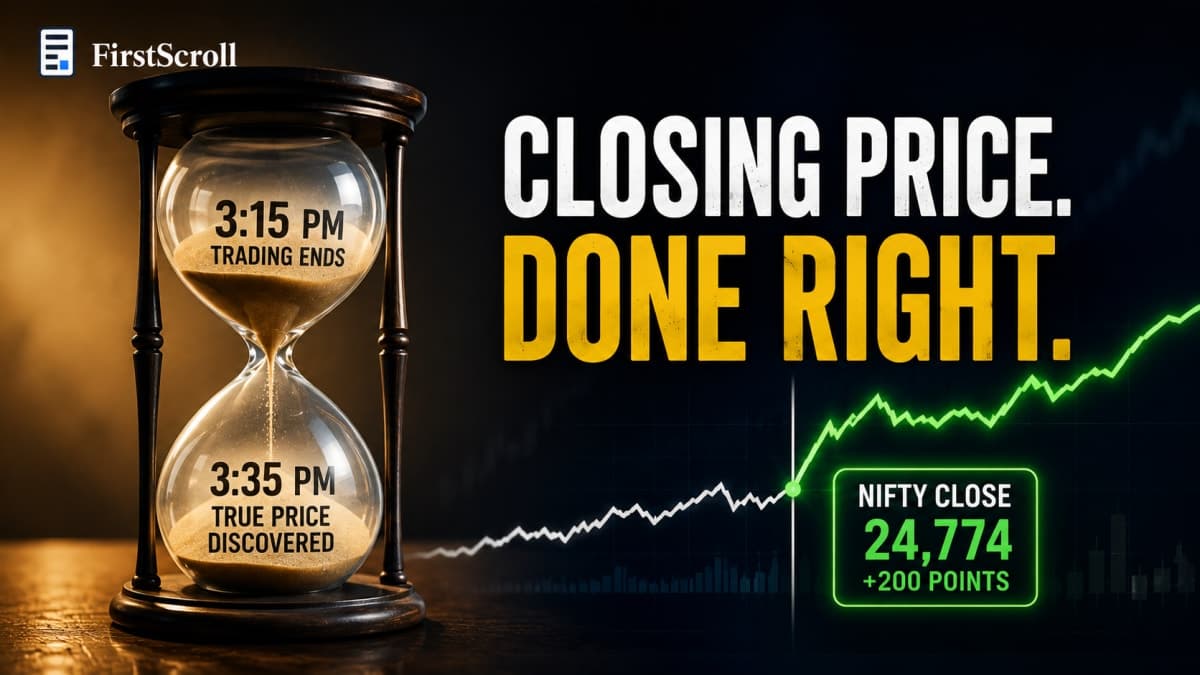
It's 3:15 PM on Monday, 3rd August 2026. Trading screens across India go quiet. The Nifty is sitting at around 24,573, up a respectable 190-odd points for the day. Traders start packing up.
And then, fifteen minutes later, something strange happens. The official closing number flashes: 24,774. A gain of 390 points, or 1.6% for the day.
Nearly 200 points of that move appeared after trading had supposedly ended. WhatsApp groups lit up. Was it a glitch? Did someone fat-finger an order? Had the exchange broken?
None of the above. What everyone had just witnessed was the debut of the Closing Auction Session, or CAS, SEBI's new way of deciding what a stock is actually worth at the end of the day.
So here's the question. Why would SEBI rip out a closing price system that worked for decades and replace it with an auction that, on day one, looked like pure chaos?
You see, the closing price is not just a number that scrolls across the ticker at 3:30. It is arguably the single most important price in the entire market. It decides the level of the Nifty and Sensex. It sets the NAV of every mutual fund and ETF you own. It determines how F&O contracts get settled and what your pledged shares are worth as collateral. Trillions of rupees hang off this one number, every single day.
And until last week, that number was calculated in a slightly odd way. India used something called VWAP, the volume-weighted average price, essentially an average of all trades in the last 30 minutes of the session, where bigger trades count for more.
Now, VWAP wasn't stupid. It existed so that one small, rogue trade at 3:29 couldn't distort the close. But it had a deeper flaw. The closing price was an average of the past, not a price anyone could actually trade at.
Think about who suffers from that. Index funds and ETFs are contractually obliged to buy and sell at the closing price to track their benchmark. But under VWAP, that exact price never existed as a real trade. So passive funds spent the last half hour guessing, spraying orders and hoping their average landed close to the official one. Every miss showed up as tracking error, a cost quietly passed on to you, the investor. We unpacked that in our piece on [tracking error](INTERNAL: index fund tracking error explained).
The averaging window also created a target. If you knew the close was built from 30 minutes of trades, you knew exactly which 30 minutes to lean on. "Marking the close" is one of the oldest games in any market.
This is where the auction comes in. Instead of averaging the past, CAS collects every buy and sell order into one giant pool and finds the single price at which the maximum number of shares can trade. That equilibrium price becomes the official close. Not an average. An actual price, where real buyers met real sellers.
The mechanics are almost paranoid by design. The session runs from 3:15 to 3:35 for stocks with F&O contracts, in four phases. A reference price is computed first, then orders flow in, and then, and this is the clever bit, the order window slams shut at a random moment between 3:28 and 3:30. Nobody knows the exact second, so nobody can time a last-tick ambush. A 3% price band around the reference price keeps the auction from running wild.
For each player, the logic is simple. Passive funds finally get to transact at the close instead of chasing it, which shrinks tracking error. Institutions get a deep pool of liquidity to execute large orders without moving the price all afternoon. And SEBI gets to say India now closes its market the way the NYSE and the London Stock Exchange have for years, which matters when you're courting global index flows.
Retail investors? Mostly spectators, with one catch. Stop-loss orders on CAS stocks get auto-cancelled at 3:15, right when the closing price is being decided. Your safety net now clocks out early.
But here's the twist. The reform meant to reduce closing volatility spent its first week doing the opposite. The Nifty swung an average of 0.42% between 3:15 and 3:30 in early sessions, and the first week was turbulent enough that SEBI had to publicly defend the system, urging brokers to upgrade their tech while flatly refusing to roll it back.
Now to be clear, this is roughly what every market that adopted closing auctions went through. An auction is only as smooth as the liquidity inside it, and liquidity takes time to migrate. Analysts watching the rollout argue the early swings reflect an adjustment period, not a broken design. The day-one "200-point jump" wasn't the market moving after hours. It was the auction revealing where demand and supply actually met, once all the orders were on the table.
So, is CAS a mess or an upgrade? Well, zoom out and the trade-off becomes clear. India swapped a familiar, gameable average for an honest but unfamiliar auction. If liquidity builds the way it did in London and New York, the noisy first week will be a footnote, and the close will become the most trustworthy price of the day. Whether Indian markets get there before traders lose patience is something only time will tell.
Until then…
If this story helped you make sense of the Closing Auction Session, share it with a friend on WhatsApp, LinkedIn or X. You might also enjoy our story on zepto.