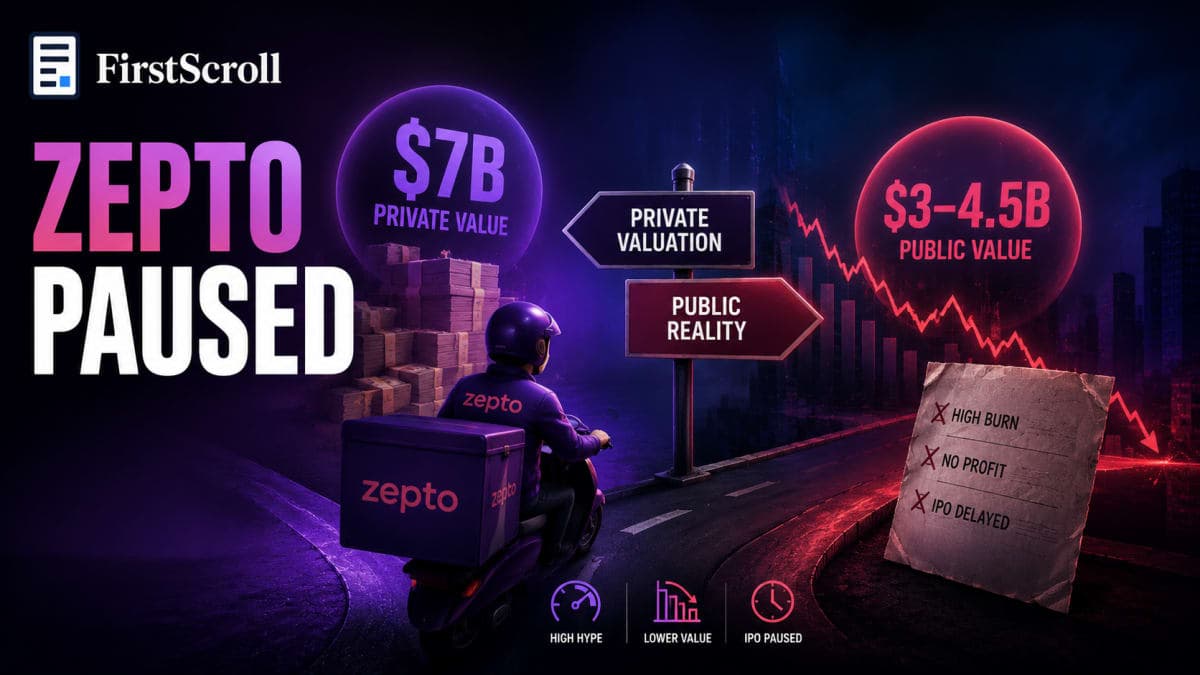
In today's FirstScroll, we break down why Zepto stopped its IPO days before it was due, and explain why the same company can be worth $7 billion to one investor and less than half of that to another.
A quick note before we start. This one is a sequel. If you read our earlier piece on why Zepto's losses grew as fast as its revenue, this is the part where the market finally puts a price on that question.
With that out of the way, let's dive into today's story.
The Story
In October 2025, Aadit Palicha sounded like a founder who had already won.
His company had just closed a large round led by an American pension fund, he told reporters there was close to $900 million of net cash sitting in the bank, and Indian shareholding was climbing fast. The listing, he said, would follow soon.
The number everyone wrote down that day was $7 billion.
It felt settled, the way big private numbers usually do. A price had been agreed, a marquee investor had signed the cheque, and the only thing left was to let the public buy in at something higher.
Nine months later, the public still has not bought in.
Zepto filed its updated draft prospectus with SEBI in June, planning a fresh issue of ₹8,010 crore alongside an offer for sale by early backers, and aimed for a July debut. That debut has not happened. Instead the company has paused the listing and started work on a smaller private round.
And the price on that round is roughly $4.5 billion, well below the $7 billion of nine months ago. Some institutional investors were reportedly talking numbers closer to $2.5 billion to $3 billion, which is less than half of the last private mark.
Here is the strange part. In the same window, the business got better, not worse.
So the question is, how does a company lose half its value when nothing inside it broke?
You see, a private valuation is not a market price. It is arithmetic.
When an investor buys a small slice of a startup, they usually buy preference shares, which sit ahead of everyone else if the company is ever sold. That protection means the buyer can accept a high headline number, because they are not really exposed to it. Multiply the price of that sliver by all the shares and you get a "valuation" that no one has ever actually paid for the whole company.
A public listing removes every one of those cushions. The shares on offer are ordinary shares with no preference, no protection, and no promise. The buyer is a fund manager who has to justify the price to a retail investor who can sell at 9:16 am tomorrow morning.
So the two sides were never valuing the same thing. One was pricing an option, the other was pricing an asset.
Then there is the comparison problem. Fund managers reportedly refused to benchmark Zepto against Eternal and Swiggy, because both of those carry a food delivery business that funds the quick commerce burn. Zepto has only the burn.
Now, look at who wanted what, because that is where the pause makes sense.
The founders were not selling a single share in the offer. The sellers named in the filing were early investors like Nexus, Contrary and the Kaiser funds, who were looking for a partial exit through the offer for sale component. Domestic mutual funds, meanwhile, wanted a price low enough to leave something on the table for their own unitholders.
When the sellers and the buyers are that far apart, somebody has to blink, or everybody has to wait.
Zepto chose to wait, and here is the twist buried in the paperwork.
The pre-IPO placement it is now raising is not free money. Under SEBI's rules a company can raise up to 20% of its proposed fresh issue this way, and the amount is deducted from the fresh issue whenever the IPO finally arrives. The company's own filing flagged a placement of up to ₹1,602 crore.
So every rupee raised privately today is a rupee subtracted from the public raise tomorrow. The pause does not add capital to the plan. It only changes who provides it, and at what price.
Now to be clear, this is not a business in free fall.
Revenue for FY26 more than doubled to ₹22,624 crore from ₹11,110 crore, and the full year loss widened to ₹5,905 crore from ₹4,700 crore. But in the March quarter alone, revenue grew about 75% while the quarterly loss actually narrowed to ₹1,539 crore from ₹1,832 crore a year earlier.
That is the uncomfortable lesson in this story. The operating numbers improved and the valuation fell anyway, because valuation was never a scoreboard for operations. It is a scoreboard for who is willing to buy, and on what terms.
There is a counterpoint worth holding on to. A company with that much cash in the bank can afford to wait for a better window, and waiting is a choice, not a rescue. The ₹1,000 crore round is also being raised largely from domestic investors, which lifts Indian ownership ahead of a listing that will eventually be sold to Indian savers.
Still, something quietly changed this month.
For four years, the price of Zepto was set by a small circle of people who could each afford to be wrong. Now it has to be set by a market that includes your neighbour's SIP. The gap between those two prices was always going to show up somewhere.
Whether Zepto lists at $4.5 billion, at $3 billion, or at a number nobody has printed yet is something only the next window will tell us. The more interesting question is the one the pause leaves behind, and it applies to every startup still carrying a headline number from 2021.
If a valuation can halve without a single store closing, what exactly was it measuring?
Until then…
If this story helped you make sense of how startup valuations actually get set, share it with a friend on WhatsApp, LinkedIn or X. You might also enjoy our story on Maruti.