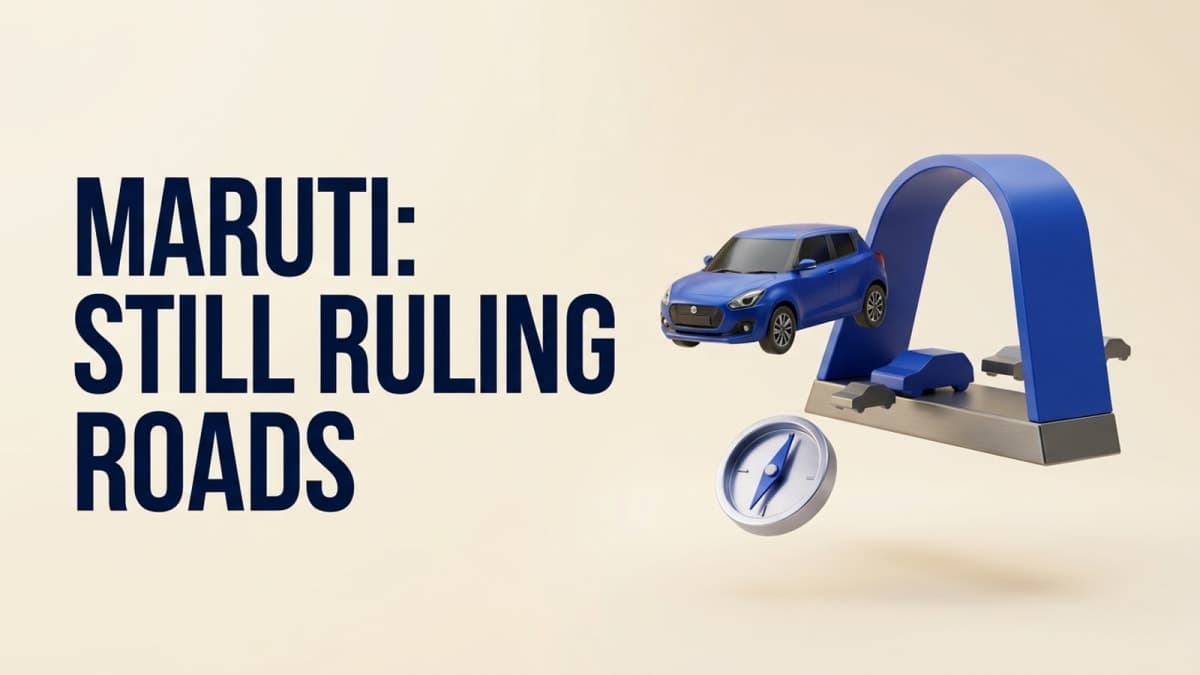
In today's FirstScroll, we look at India's most misunderstood giant. Every year, headlines declare Maruti Suzuki is losing its grip: SUVs are killing it, EVs are passing it by, rivals are eating its lunch. All of that is true. And yet Maruti is still, by a mile, the king of Indian cars. How can a company be "falling" and dominant at the same time? The answer is more interesting than either story alone.
The Story
For decades, Maruti was India's default car.
If your family owned a car, odds are it was a Maruti, an 800, an Alto, a WagonR, a Swift. The brand was so dominant it was basically a synonym for "car". At its peak around 2020, Maruti sold roughly half of every car sold in India. One company, half the market. That's almost unheard of.
So here's the tension. In FY26, Maruti's market share fell to a 13-year low of about 39%, its third straight year of decline, down nearly 12 percentage points from that ~51% peak. Every year now, the obituaries roll in: Maruti missed the SUV wave, it's late to EVs, Tata and Mahindra are storming its castle.
And yet. Maruti still sells more cars in India than anyone else, by a huge margin. In FY26 it hit its highest-ever production of 23.4 lakh units, and clocked record monthly sales. So which is it, dying or winning?
The honest answer: both. And untangling that paradox tells you exactly how Maruti actually rules.
First, the real reason its "share" is falling (it's not what you think).
Here's the counterintuitive bit. Maruti's share is shrinking, but its sales are growing. How?
Because the whole Indian car market is exploding. India bought a record 4.7 million cars in FY26. When the pie grows this fast, you can sell more slices than ever and still own a smaller percentage of a bigger pie. Maruti is selling more cars to more Indians than at any point in its history. It's just that everyone else is growing faster.
And the reason everyone else is growing faster comes down to one word: SUVs.
The one wave Maruti genuinely missed.
For years, Maruti mastered small, cheap, fuel-efficient hatchbacks, the Alto, WagonR, Swift, the cars that put a middle-class India on wheels. It owned that world completely.
But Indian tastes changed. Buyers fell in love with SUVs, those tall, muscular, road-commanding machines. SUVs now make up nearly 67% of the market. And Maruti, the small-car king, was slow to react. Its own former CEO admitted the company had underestimated how fast SUVs would grow.
Rivals pounced on that opening. Mahindra, with an "SUV-only" strategy and hits like the Thar and Scorpio, more than doubled its market share in five years to around 14%, overtaking Maruti's own second spot. Tata, riding SUVs and EVs, climbed to roughly 13%. In the segment that now defines the market, Maruti's share sits below 25%, well behind where its brand power should put it.
So the criticism is fair. Maruti misjudged the single biggest shift in its industry. That's the "falling" story, and it's real.
But now flip the coin, because the "still king" story is just as real, and far less understood.
Why Maruti is almost impossible to actually dethrone.
Losing share is not the same as losing the crown. Maruti still holds around 39-41% of the entire market, which is more than the next two rivals combined. To understand why that lead is so sticky, you have to look past the shiny cars at three boring, powerful moats.
Moat 1: The service network nobody can copy quickly. Maruti has spent 40 years building the largest sales and service network in India, reaching deep into small towns and villages where rivals simply aren't present. For a huge chunk of India, buying a car isn't about the flashiest model, it's about "can I get it serviced cheaply and easily near my town?" And for that question, the answer is almost always Maruti. That trust and reach took decades to build and can't be bought overnight.
Moat 2: It owns the parts of the market everyone forgets. While rivals fight over glamorous SUVs, Maruti quietly dominates the unsexy foundations: it still commands around 67% of small cars and a majority of the mass-market. These are lower-margin cars, but they're bought in enormous volumes, especially in a price-sensitive, first-time-buyer country like India.
Moat 3: The export machine. Here's the stat almost nobody talks about. Maruti isn't just selling in India, it has quietly become India's largest car exporter, accounting for about 45% of India's car exports, roughly double the next competitor. Models like the Fronx and Jimny ship to dozens of countries. So even as domestic competition heats up, a whole second engine hums abroad, and India's role as a global small-car factory plays straight to Maruti's strengths.
Put together, this is why Maruti stays profitable and dominant even while "losing". In Q3 FY26, it still posted a net profit of ₹3,727 crore, up 8%. Its market cap sits above ₹4 lakh crore. This is not a company in collapse. It's a champion that got complacent in one round, and is now swinging back.
The counter-attack.
Because Maruti isn't just defending. It has announced a massive ₹70,000 crore plan through FY31, with eight new SUVs planned to reclaim the segment it fumbled, plus its first electric SUV, the e-Vitara, and a big bet on hybrids. It has openly reset its goal of 50% market share from 2026 to 2031, an honest admission that it slipped, paired with a serious plan to climb back.
To be fair, the risks are genuine. Its EV strategy has been slow while Tesla eyes India and rivals race ahead. Rural demand, its bread and butter, has been dented by inflation. And the stock has fallen sharply from its highs as investors price in these worries. Winning back the SUV crowd is not guaranteed.
So, how does Maruti still rule Indian roads while everyone predicts its fall?
Because "market share" and "market power" are two different things. Maruti did lose share, it genuinely misread the SUV boom, and that failure is real. But underneath the headline number sits a fortress most people can't see: an unmatchable service network, total dominance of the volume segments, and a booming export business, all built over 40 years and impossible to replicate in a few.
The lesson is one that applies far beyond cars: losing a trend is not the same as losing the war. Flashy rivals can win the segment of the moment. But the company with the deepest roots, the widest reach, and the most patient moats is the hardest to actually kill. Maruti stumbled on SUVs. It did not stumble on India.
And in the long, boring game of who can serve the most Indians the most reliably, the king is still very much on the throne, dented crown and all.
Until next time...