In today's FirstScroll, we break down India's biggest IPO of 2026 and explain why the company at the centre of it did not receive a single rupee.
This one's about a listing you probably scrolled past. Stay with us, because the structure behind it shows up in almost every big Indian IPO now. With that out of the way, let's dive into today's story.
The Story
In 1987, if you had told an Indian household to hand its savings to a fund manager, you would have got a strange look. Bank deposits were safe. Gold was real. Everything else felt like a bet.
That year, SBI Mutual Fund became the first non-UTI mutual fund in the country. The entire industry it was walking into managed around ₹6,700 crore in 1988, which is less than what a single mid-sized fund handles today.
Nearly four decades later, that same fund house sits on ₹12.51 lakh crore in assets and a 15.3% market share, the largest slice of a pool that has crossed ₹80 lakh crore. Roughly one in every seven rupees Indians have put into mutual funds is managed by it.
So when it finally decided to go public, it was always going to be a big day.
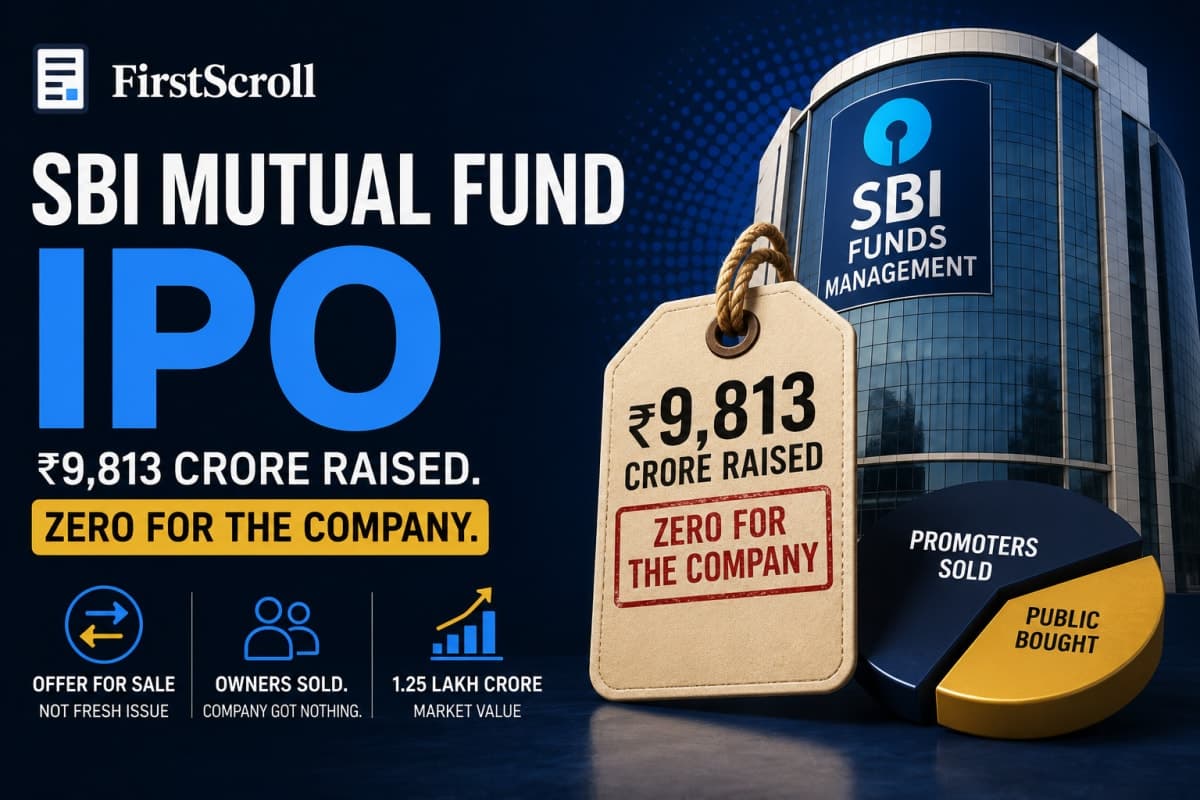
And on 21 July 2026, it was. Shares of SBI Funds Management listed at ₹613.30 on the NSE, a 6.85% premium over the issue price of ₹574, taking the company's market value to about ₹1.25 lakh crore. The chairman of State Bank of India called it the largest issue of the year.
Except the company itself got nothing out of it. Not one rupee.
So here's the question. Why would a company run the entire IPO circus, the bankers, the roadshows, the disclosures, when none of the ₹9,813 crore raised lands in its own bank account?
You see, when shares are sold in an IPO, they come from one of two places.
One is a fresh issue. The company creates brand new shares, sells them to the public, and the money flows into the company to build a plant, repay debt, or fund expansion. That is the version most people picture when they hear "raising money".
The other is an Offer for Sale, or OFS. No new shares are created. Existing owners simply sell part of what they already hold, and the money goes straight to them. The company is the stage, not the beneficiary.
SBI Funds Management's IPO was entirely an Offer for Sale of 17,09,56,631 shares by State Bank of India and Amundi India Holding, with no fresh issue at all.
Now, before this sounds like a scam, ask a simpler question. What would an asset manager even do with the cash?
It does not build factories or buy trucks. It manages other people's money and charges a small annual fee for it. That is why brokerages flagged an operating margin above 81% and a return on net worth of 43% on the business. Handing it more capital would have diluted existing shareholders to fund nothing in particular.
This is where the sellers come in. For State Bank of India, which held 61.98% of the AMC, the logic is simple. A subsidiary buried inside a bank's balance sheet carries no visible price tag. List it, and suddenly the market puts a number on it, while the parent pockets real cash. SBI has run this playbook before, with SBI Life in 2017.
And for Amundi, the French asset manager holding 36.40%? A partial exit at a price it could never have negotiated privately. According to one analysis of the offer documents, the two promoters had originally acquired shares at ₹0.15 and ₹4.35 apiece. They sold at ₹574.
The market did not seem to mind. The issue drew bids worth ₹2.97 trillion and was oversubscribed 41.6 times, which is a lot of enthusiasm for a sale where the company gets nothing.
But here's the twist. All that demand produced a debut of just 6.85%, against a grey market that had been signalling closer to 17%.
Part of that is simply the market. For Indian IPOs in the year to March 2026, the average listing premium was 8%, down from 28% a year earlier. Investors are paying up less for a first day pop than they used to.
The bigger part is timing. From 1 April 2026, SEBI's new mutual fund regulations replaced a framework that had stood since 1996, unbundling the expense ratio and squeezing what fund houses can charge. Cash market brokerage caps were halved from 12 basis points to 6, with derivatives cut from 5 to 2.
We have seen what fee cuts do to this sector. When SEBI last capped expense ratios in 2018, listed AMC stocks fell 8.5% to 11% the next day, and CLSA estimated a 25% hit to sector earnings.
Put plainly, the owners sold a business valued at about 38 times FY26 earnings into a regime designed to shrink exactly the fee that produces those earnings.
Now to be clear, none of this makes an OFS a red flag. Fee compression has been this industry's constant companion for a decade, and every previous round ended the same way: the asset base grew faster than the fee fell. Sticky monthly SIPs and a distribution network of over 1.32 lakh partners are not undone by a few basis points.
So, was this really an IPO? Technically yes, though it was less a fundraise than a handover. The public did not fund the company's next chapter. It bought a seat from the people who financed the last one, at roughly 3,800 times what one of them originally paid.
Whether India's savers can keep growing the pot faster than the regulator shrinks the fee is something only time will tell.
Until then…
If this story helped you make sense of why some IPOs raise nothing for the company, share it with a friend on WhatsApp, LinkedIn, or X. You might also enjoy our story on Credit Card.