In today's FirstScroll, we break down why the NSE, the exchange that lists everyone else, still can't list itself, and why "decade-long delay" is the polite version of the story.
This one runs a little longer than usual. With that out of the way, let's dive into today's story.
The Story
Picture the busiest trading floor on earth. Not a floor really, just rows of humming servers in a building in Mumbai. Every day, the National Stock Exchange matches trades worth staggering sums, and by one common measure it is the world's largest derivatives exchange by trading volume. India's markets, quite literally, do not open without it.
Now here is the strange part. This same NSE has spent close to ten years trying to do the one thing it helps thousands of other companies do every year: go public.
It first told the world it would list back in 2016. Its board said the draft papers would be filed by January 2017. That was nine years ago. The exchange that hosts India's IPO party has been stuck outside its own venue ever since.
So the question is, why would the country's biggest stock exchange, which knows the listing process better than anyone, take almost a decade to list itself?
To answer that, you need to know what an NSE actually is in the eyes of the law. It isn't just a company. It's what regulators call a Market Infrastructure Institution, or MII. Think of it as a referee. It sets the rules of the game, watches the players, and is supposed to guarantee everyone a fair shot. And referees are held to a much higher standard than the teams. Unlike an ordinary company, an exchange must first get a no-objection certificate from SEBI, the market regulator, before it can even file to list. No clean chit, no IPO.
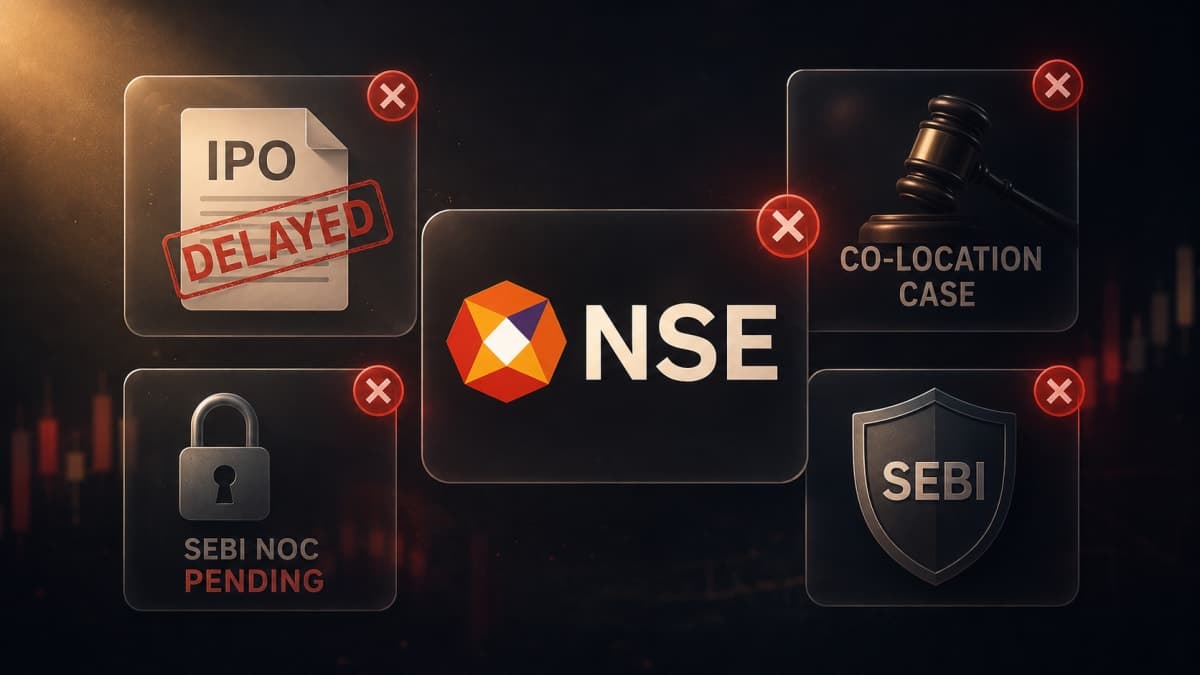
And this is where NSE's ghost comes in. It's called the co-location case.
Back in 2015, a whistleblower flagged something troubling. NSE rented out space for traders to place their servers physically inside the exchange's premises, a legitimate service called co-location that gives faster access to market data. The problem was fairness. A SEBI committee later found that some brokers got preferential access to those servers between 2012 and 2014, through early logins and "dark fibre" connections, gaining a split-second edge over everyone else.
In high-frequency trading, a split second is a fortune. This wasn't a small crack, it was the referee accused of quietly tilting the field.
What followed was a years-long grind. SEBI ran a three-year probe, roped in forensic auditors like EY and Deloitte, and eventually fined the exchange. In 2019 SEBI imposed penalties and, crucially, barred NSE from raising money publicly for six months. NSE's own lawyer told a tribunal the exchange would voluntarily pause its listing efforts. The referee had been sent off the pitch, and the IPO went into cold storage.
Every attempt to move on hit the same wall. NSE tried to settle the case through a consent mechanism, essentially paying a penalty without admitting guilt, and SEBI returned the plea because the investigation was still live. Different departments inside SEBI kept raising fresh governance concerns. And the regulator's stance stayed blunt: SEBI's chairman said it prioritised public interest over commercial considerations. Translation: your IPO can wait, the market's trust cannot.
So the delay was never really about paperwork or a sleepy bureaucracy. It was about one uncomfortable idea. How do you let the referee sell tickets to itself while it's still under investigation for cheating?
Then, in 2026, the logjam finally broke. SEBI granted the long-awaited no-objection certificate on 30 January, and importantly, delinked the IPO from the settlement of the old co-location cases, letting the listing move ahead separately. NSE filed its draft prospectus in June, and by August the exchange said it had received SEBI's go-ahead, with a listing targeted around September 2026.
But here's the twist. Even this IPO comes with an asterisk.
The entire offering is an Offer for Sale, or OFS, which means existing shareholders sell their shares and NSE itself receives none of the money. This isn't a company raising fresh capital to grow. It's an exit door for early backers like SBI, LIC and others who have waited years to cash out.
And there's a delicious irony in where it will trade. Since SEBI rules bar an exchange from listing on itself, NSE's shares will list on the BSE, its arch-rival, just as BSE's own shares trade on the NSE. The two biggest exchanges in India will keep score on each other.
Now to be clear, the path still isn't fully clear. A fresh writ petition in the Delhi High Court challenged the whole process earlier this year, and while the court dismissed it, many analysts still think a 2027 listing is more realistic than 2026 if anything slips.
So, why did the exchange that lists everyone else take a decade to list itself? Because being the referee is the whole problem. NSE's delay wasn't a bug in the system. It was the system working exactly as designed, forcing the institution that guards market fairness to prove its own house was clean before it could profit from going public. Whether it finally crosses the line in 2026 is something only time will tell.
Until then…
If this story helped you make sense of why the NSE IPO took so long, share it with a friend on WhatsApp, LinkedIn or X. You might also enjoy our explainer on SriLanka richer than India.