For generations, the Indian household was the world's model saver. Put a quarter of your income aside, borrow only for a home or a child's education, and never live beyond your means. The data now tells a different story.
In today's FirstScroll, we unpack the steady rise in Indian household debt, why the RBI is watching it closely, and what it means for your own balance sheet.
The Story
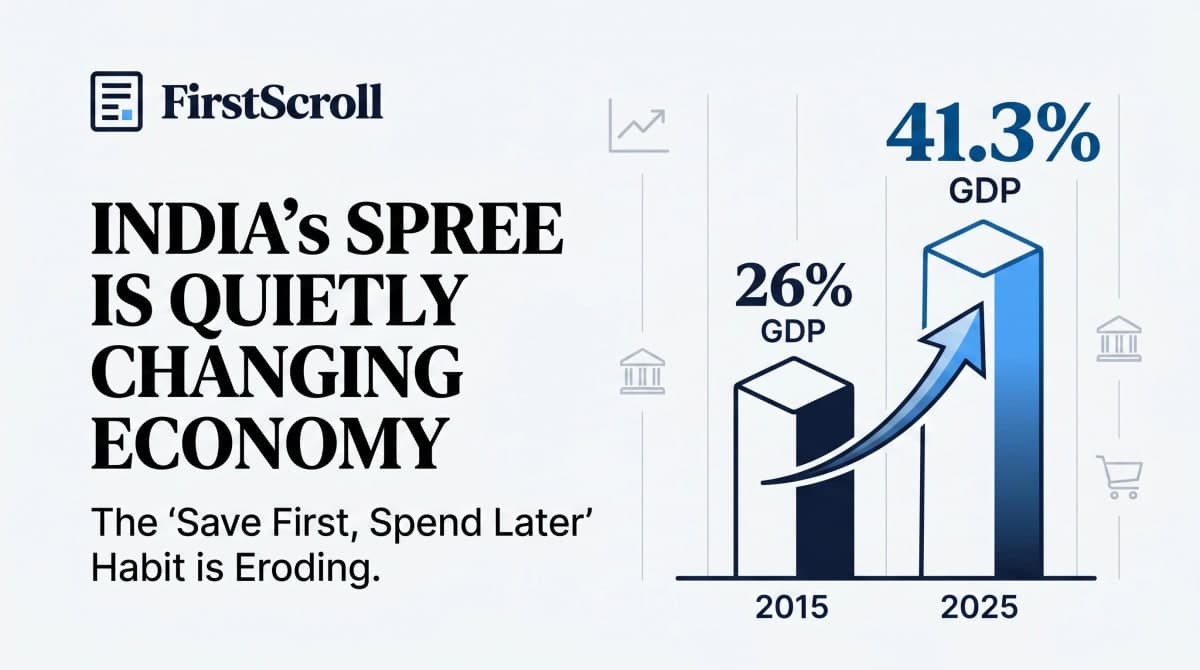
Here is a number from the Reserve Bank of India that deserves more attention than it has received. India's household debt climbed to 41.3% of GDP at the end of March 2025, according to the RBI's Financial Stability Report. That is up from a five-year average of 38.3%.
On its own, that jump might sound modest. The real story is in the trend and the texture.
Go back further and the picture sharpens. Household debt was just 26% of GDP in 2015. It is now in the low 40s. In other words, in about a decade, the total debt that Indian households carry has nearly tripled in absolute terms. The average debt per individual rose from ₹3.9 lakh in 2023 to ₹4.8 lakh in March 2025, a 23% jump in just two years.
This is happening to a country that the world long held up as a nation of disciplined savers.
The conventional wisdom about the Indian household goes like this. Indians save. They are cautious. They borrow reluctantly, and when they do borrow, it is for something lasting, a house, a small business, a child's education. They keep an emergency fund. They distrust debt.
That wisdom is now only half true. And the half that has changed is the important half.
To understand why, you need to look not just at how much Indians are borrowing, but at what they are borrowing for.
For the uninitiated, household debt can be broadly split by purpose. Some loans create an asset. A home loan buys a house, which is something you own and which usually appreciates. An education loan builds earning capacity. A business loan funds something productive that can generate income. Other loans simply fund consumption. A personal loan to cover a wedding, a credit card balance for everyday spending, a loan to buy a phone or a television, financing for a holiday.
The first kind of borrowing builds your future. The second kind spends it.
And here is the RBI's central concern. The fastest-growing slice of Indian household debt is the second kind.
According to the RBI, non-housing retail loans, which are largely consumption loans, accounted for 55.3% of total household borrowings from financial institutions as of September 2025. Home loans, the classic asset-building borrowing, made up only about 28.6%. Agriculture and business loans accounted for the rest.
Let that sink in. More than half of what Indian households now owe is not for a house, not for a farm, not for a business. It is for consumption. Credit card dues, personal loans, vehicle finance, consumer durable loans.
This share has been climbing steadily, with consumption credit consistently outgrowing housing loans for several years running. Personal and retail lending expanded at a 17.6% compound annual growth rate from FY2016 to FY2025, nearly twice the pace of nominal GDP growth. Credit cards grew fastest of all, at over 25% a year.
So why is this happening? Two forces, working together.
The first is the easy availability of credit. A decade ago, getting an unsecured personal loan in India meant paperwork, branch visits, and waiting. Today, a personal loan or a credit limit can be approved on a phone app in minutes. Fintech lenders have made borrowing frictionless. The fintech lending sector alone grew 36.1% between September 2024 and September 2025, with unsecured loans making up more than 70% of fintech firms' loan books.
The second force is the gap between aspirations and income. Indian incomes have grown, but lifestyle aspirations, fuelled by social media, advertising, and the visible spending of others, have grown faster. When the gap between what you earn and what you want to spend widens, credit fills it.
Think of borrowing like water. Borrowing to build an asset is like channelling water into a tank. You can draw on it later. Borrowing to consume is like channelling water onto the ground. It serves you for a moment, then it is gone, and you still have to pay for it.
Now, here is the other side of the same coin, and it is just as important. As borrowing rises, saving falls.
India's net household financial savings, the money households actually have left over to invest after accounting for what they borrow, fell sharply to around 5.1% of GDP in a recent year, described as the lowest level in nearly five decades. Other estimates place net financial savings around 5.2% of GDP, down from nearly 7.7% in the pre-pandemic years.
This is the quiet shift. India is moving, gradually, from a savings-led economy to a credit-driven consumption economy. The CoinSwitch cofounder Ashish Singhal captured it bluntly, saying the India that "saved first, spent later" is going away.
So why does this matter, both for the country and for you personally?
At the national level, it matters because household savings have historically been the fuel for India's growth. When Indians save, that money flows, through banks and financial institutions, into government borrowing and corporate investment. It funds roads, factories, and expansion. If household savings keep shrinking while debt keeps rising, the country has less of its own capital to fund its own long-term growth, and becomes more reliant on foreign capital, which, as recent FPI outflows have shown, can be fickle.
There is also a growth threshold worth knowing. A study across 54 countries by the Bank for International Settlements found that household debt initially boosts consumption and growth, but beyond a threshold of around 60% of GDP, it begins to drag growth down. India at 41% is still below that line, but it is moving toward it, not away from it.
At the personal level, it matters because consumption debt is fragile debt. A home loan is backed by a house. If times get hard, the asset still exists. An unsecured personal loan or a credit card balance is backed by nothing except your next paycheck. If your income is disrupted, the debt does not shrink, but your ability to service it does. That is exactly why the RBI keeps flagging unsecured retail lending and has previously tightened rules and raised risk weights for banks lending in these categories.
So how should you think about your own borrowing?
Three takeaways.
One, separate your loans into asset-building and consumption, honestly. A home loan, an education loan, a loan for a business or a productive asset, these can be sensible uses of credit, because they build something. A personal loan for a vacation, EMIs on a phone you could have saved for, a revolving credit card balance, these are consumption loans, and they are the ones to be most cautious about. If the majority of your debt is in the second bucket, that is a signal worth taking seriously.
Two, respect the credit card balance specifically. Credit cards are the fastest-growing debt category in India, and they are also among the most expensive forms of borrowing, with interest rates that can run very high when a balance is carried month to month. A credit card paid in full every month is a convenience. A credit card balance rolled over month after month is one of the most expensive financial habits you can have.
Three, watch your own savings rate, not just your income. It is easy to feel financially fine because your salary is rising. But if your borrowing is rising faster, your actual financial cushion, the money that is truly yours, can be shrinking even as your income grows. The healthier measure of financial progress is not what you earn, it is what you keep.
But let's be clear about what this trend is not.
It is not a crisis, and the RBI has been careful to say so. The central bank has explicitly noted that, relative to most peer emerging market economies, India's household debt remains lower. India is not the United States before the 2008 subprime crisis, and it is not facing a China-style property debt problem. At 41% of GDP, the aggregate number is still manageable. The RBI has flagged a need for close monitoring, not sounded an alarm.
And it is not, by itself, a sign that borrowing is bad. Credit is one of the most powerful tools a household has. Used to build an asset or earning capacity, debt can genuinely improve a family's future. The concern in the data is not borrowing as such. It is the steady tilt of that borrowing away from building and toward spending.
Step back, and there is a genuine cultural shift visible in these RBI numbers. For decades, India's high household savings rate was one of its quiet economic strengths, a deep domestic pool of capital that helped fund the country's development and cushioned it against external shocks. That pool is now being drawn down faster than it is being refilled, one personal loan, one credit card swipe, one financed purchase at a time.
The country is not in danger today. But the habit that made the Indian household financially resilient, saving first and spending later, is genuinely eroding. And habits, once changed at a national scale, are very hard to change back.
The most useful response is not to fear credit. It is to be deliberate about it. Borrow to build. Be cautious when you borrow merely to spend. And measure your progress by what you keep, not just by what you earn.
Until next time…