Last week, I was digging through my grandmother’s Godrej almirah. You know the heavy steel one that smells like mothballs and old secrets. I was hunting for a document, but instead I found a dusty velvet box with a set of silver dinner plates she got for her wedding in the 70 s.
She used to call them "poor man’s gold." She’d say, "Beta, if we ever go broke, we sell the gold first. We eat off the silver until the very end."
For decades, silver was the uncool younger sibling of precious metals. It tarnished. It felt heavy. It didn’t feel expensive enough to brag about. If gold was a Rolex, silver was a Casio. Reliable, functional, but not exactly a flex.
Well, I hope you held onto those Casios.
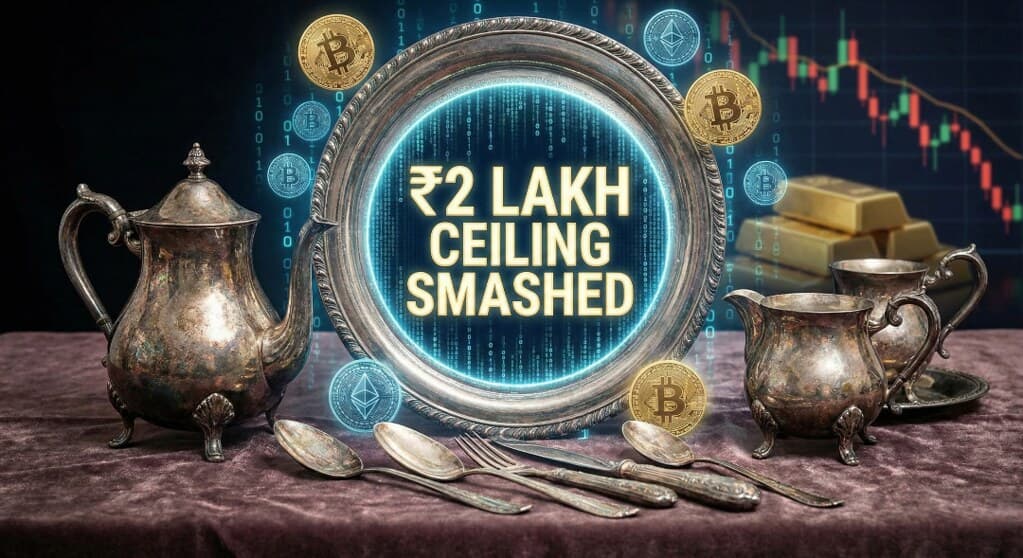
While you were busy checking crypto charts or watching the Nifty flirt with 26,000, something historic happened in the quiet corner of commodities. Silver in India just crossed ₹2,00,000 per kg.
Let that sink in. Two. Lakh. Rupees.
For context, in early 2024, silver was around ₹75,000. In 2025 alone, it is up roughly 130%. It hasn’t just beaten inflation. It has beaten the Nifty. It has beaten gold. It has beaten almost everything, except maybe some random meme coin created yesterday.
The "poor man’s gold" is now the "smart man’s hedge." The question is why. Why is the metal we associate with anklets and idols suddenly trading like a tech stock on steroids.
If you bought 1 kg of silver on Jan 1, 2025, you are up about 130% today. If you bought the Nifty 50, you are up roughly 15 to 18%. Silver did not just win. It lapped the field.
Here’s the secret to silver’s rally. It has a split personality, and right now both sides are winning.
Most people think of silver as a precious metal, like gold. When people get nervous about inflation or governments printing money, they buy precious metals. With the US Fed finally cutting rates and the dollar weakening, money is flowing into hard assets. That is the safe haven demand.
But silver is also an industrial metal, like copper. And that is where the real fire is coming from.
Silver is the most conductive metal on Earth. You cannot build the future without it. It shows up in solar panels. It is used in EVs. It sits inside 5 G equipment. And it matters in the chips and hardware powering the AI boom everyone is obsessed with.
So while gold sits in a vault doing nothing, silver is out there clocking shifts in the green transition. The global push for solar has created a supply deficit. In simple terms, we are using silver faster than we can mine it.
Think of gold like a wealthy landlord. It does not do anything. It just sits there, looking expensive. People pay for it because it is scarce and trusted. Think of silver like a highly skilled gig worker. It has value because it works. It is literally inside solar panels, electronics, and EVs. The catch. If the economy crashes, the landlord (gold) is still fine because people run to safety. But the gig worker (silver) can get hit because industrial demand slows down. Silver is high reward, but also higher risk.
Now, before you run to the nearest jeweller to melt down cutlery, put on skeptical glasses. We have seen this movie before.
In 1980, the Hunt Brothers tried to corner silver, prices went wild, and then it crashed hard. Today’s rally is not the same story, it is driven more by real industrial demand. But a 130% jump in one year is rarely sustainable.
1. The Green Bubble Risk
If governments slow subsidies for solar or EV adoption, silver demand can cool quickly. Policy risk is real.
2. The Substitution Problem
When something gets too expensive, engineers get creative. Solar manufacturers are already trying to use less silver or replace parts with copper. If that succeeds at scale, silver’s industrial story takes a hit.
3. The FOMO Factor
At ₹2 lakh per kg, part of the buying is retail FOMO. When your cab driver starts giving silver tips, it is usually a sign the trade is crowded.
There is one more layer the mainstream headlines often miss. The price you see on screen is shaped by the paper market, futures contracts traded in places like New York and London.
But the physical market is tighter. Actual bars you can hold have been in shortage. For the last few years, the world has consumed more silver than mines produced. That drains stockpiles.
If this deficit continues, paper traders who are short can get squeezed, which can push prices even higher. But markets can stay irrational longer than most people can stay patient or solvent.
If you are buying silver at these levels, you are not just betting on a metal. You are betting the world keeps building solar, the dollar stays weak, and supply does not suddenly surge.
The bottom line: Silver has graduated from budget jewelry metal to a critical industrial asset powering the AI and green revolutions. But at ₹2 lakh per kg, the easy money has likely been made. If you are entering now, do it with caution.
Fun fact: Silver is anti bacterial. Ancient Phoenicians stored water, wine, and vinegar in silver bottles to prevent spoiling. It was the original refrigerator.
If market noise stresses you out, you are not alone. That is exactly why we built First Scroll.
It is a daily, five minute, mobile first finance read that explains what happened, why it matters, and what to remember without hype or panic.
If this article helped you think clearly today, you will enjoy reading First Scroll every morning.
Subscribe to First ScrollSources: Business Standa