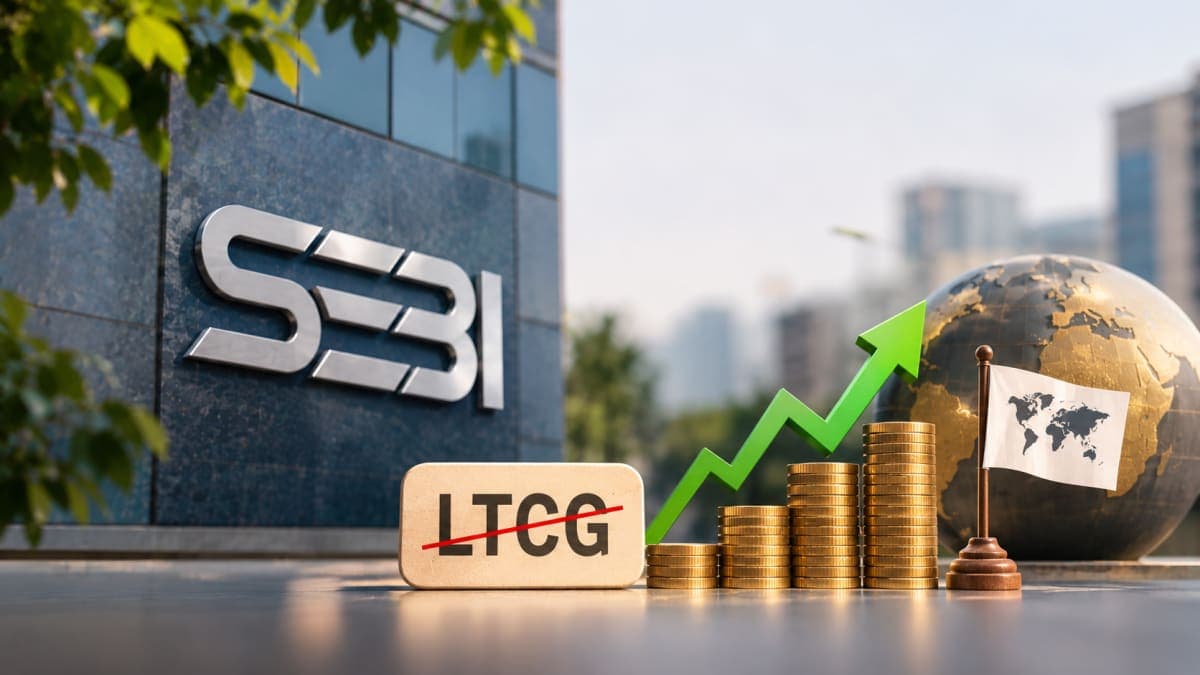
India is learning a hard lesson in global finance: you can have the fastest-growing economy in the world, but if the taxman takes too large a cut, the world's biggest investors will simply shop elsewhere.
The short answer: SEBI is proposing to scrap the 12.5% long-term capital gains tax for foreign investors to halt a massive exit of capital, as their ownership of Indian stocks hit a 15-year low of 14.02%. For Indian retail investors, the regulator is pitching a tax-free switch between mutual fund schemes to keep domestic money in the market.
The Story
For the last decade, the narrative on Dalal Street was simple: foreign investors could not afford to ignore India. But by late 2026, the numbers are telling a very different story.
Foreign portfolio investors (FPIs), the massive global funds that move markets, have been packing their bags. After a long retreat, their share of the Indian stock market has shriveled to its lowest level since December 2011. To put that in perspective, their ownership is now more than six percentage points below the 20.09% peak seen in late 2020.
The exodus has been brutal. So far in 2026, foreign investors have pulled out a net ₹2.9 trillion from Indian stocks. When you look at the broader picture since 2025, they have sold shares worth more than $50 billion.
Then, the markets regulator decided to make a move. Reports emerged that SEBI has recommended a radical change to the government: scrap the Long-Term Capital Gains (LTCG) tax for foreign investors entirely.
And here is the strange part. While the regulator is asking for a total tax holiday for global billionaires, it is only asking for a small tweak for the average Indian household. Under the proposal, domestic mutual fund investors would only get a break when they move money from one fund to another.
So here's the question: if foreign investors are the ones leaving, why is SEBI proposing to scrap their taxes entirely while Indian retail investors are still paying the full bill?
Why is India suddenly desperate for foreign capital?
You see, the problem is not that India's companies are doing poorly. It is that India has become an expensive "club" to stay in, and the neighbors are offering a much better deal.
Think of the Indian market as a premium hotel. For years, the views were so good that guests did not mind the high room service rates. But now, other hotels in the "Emerging Markets" neighborhood have renovated their views, and they are not charging for room service at all.
Most major global markets, from the United States and Britain to Singapore and the UAE, do not levy capital gains tax on foreign portfolio investors. They want to make it as easy as possible for global money to flow in and out. India, however, is an outlier. It currently charges a 12.5% tax on long-term gains and 20% on short-term gains.
Now add the second ingredient: poor performance. Over the last two years, the Nifty 50 has declined 4.8%. In that same period, the MSCI Emerging Markets index, which tracks India's peers, has jumped by about 40%. This performance gap makes the tax burden feel even heavier.
Now, you might wonder why you should care about taxes for foreign funds. Because when they sell, the rupee feels the pressure. To keep the currency stable and the markets afloat, India needs a constant flow of dollars. This is why you might feel the impact even if you don't own a single foreign stock: it is part of why FPIs are selling Indian stocks in 2026.
So who wants what here? The foreign investor wants the same tax-free deals they get in Singapore or Dubai. The Indian regulator wants to stop the bleeding and bring back the $31 billion that fled the country this year.
And the local investor? They are the ones who have been holding up the fort. Domestic mutual funds have seen their share of the market rise to a new high of 11.59%, absorbing much of the foreign selling. But even their patience is wearing thin as average returns from large-cap equity funds have dipped by 1.6% recently.
Can the government actually afford to lose this tax?
But here's the twist. While SEBI is making these recommendations to improve India's appeal, the government is staring at a massive hole in its pocket.
According to SBI Research, the central government's fiscal deficit for 2026 to 2027 is expected to exceed its budget target by ₹1.2 lakh crore. This is mainly due to rising costs for subsidies on fertilizer and fuel. When the government is already over budget, giving away a major source of tax revenue is a very tough pill to swallow.
There is also the question of fairness. If an Indian retail investor pays tax on their hard-earned savings, seeing a multi-billion dollar foreign fund pay zero tax could trigger a political backlash. This might explain why the stock market crashed earlier this year as investors struggled to balance growth hopes with tax realities.
Now to be clear, the proposal for domestic investors is a significant "quality of life" improvement. Currently, if you move your money from an underperforming mutual fund to a better one, the taxman treats it as a sale and charges you LTCG. SEBI wants to make this switch tax-free for units held for over a year, which would encourage investors to stay in the system rather than cashing out.
So, is this tax proposal about helping the rich? Not really. It is about a desperate need for equity capital to sustain India's growth. Without foreign dollars, the burden of supporting the market falls entirely on the Indian household, and even that capital has its limits.
The next big date to watch is the federal budget in February 2027. That is when we will see if the government chooses to protect its tax revenue or sacrifices it to win back the global investors who are currently voting with their feet.
If this helped the debate over capital gains tax make sense, share it with a friend on WhatsApp, LinkedIn, or X. You might also enjoy our look at how IPO inflows affect the Indian rupee.