In today's FirstScroll, we break down the OpenAI–Tata deal everyone filed under "AI news," and why the part that actually made Tata a supplier to the world's hottest AI company has almost nothing to do with artificial intelligence.
With that out of the way, let's dive into today's story.
The Story
When OpenAI and the Tata Group announced their partnership at the India AI Impact Summit in Delhi, the headlines wrote themselves. The maker of ChatGPT, teaming up with India's most storied conglomerate. It sounded like the beginning of some grand collaboration to build Indian AI, two giants joining forces at the frontier.
And there is an AI-shaped layer to it. Tata plans to roll out ChatGPT Enterprise across its workforce, starting with hundreds of thousands of TCS employees, which would be one of the largest corporate AI deployments anywhere. That part is real, and it is genuinely big.
But it is not the part that matters most for Tata's business. Buried under the AI language is a plainer, older kind of deal, and it is the one worth understanding.
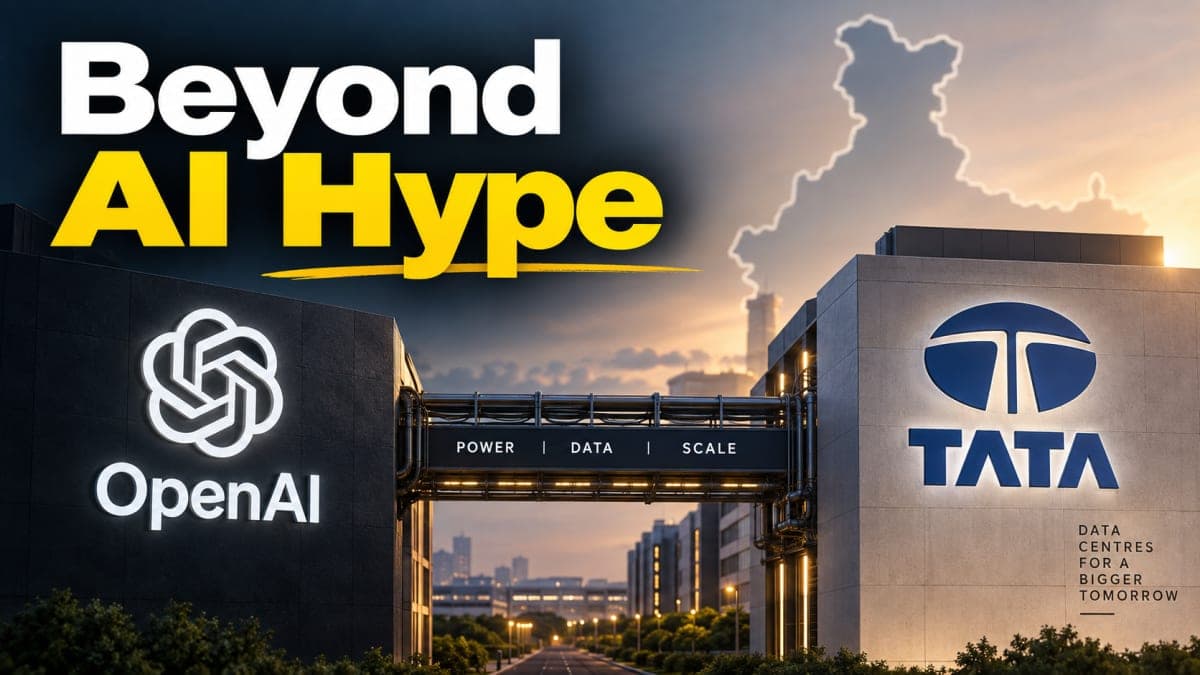
The centrepiece is this: OpenAI has agreed to become the first customer of TCS's HyperVault data centre business, starting with 100 megawatts of capacity and potentially scaling to a full gigawatt over time.
Read that again, because the direction of the money is the whole story. OpenAI is not giving Tata AI. OpenAI is buying something from Tata. And what it is buying is not intelligence. It is buildings, power, and cooling.
So the question is, why is the world's most famous artificial-intelligence company paying an Indian conglomerate, and what is it actually paying for?
Let's strip the jargon off, because "data centre" makes it sound more exotic than it is.
An AI model like ChatGPT does not live in the cloud in any misty sense. It runs on tens of thousands of specialised computer chips, called GPUs, and those chips have to sit somewhere physical. They need a warehouse-sized building. They need vast, uninterrupted electricity to run. And because they generate enormous heat, they need industrial-scale cooling so they do not melt. A data centre is, underneath the branding, real estate with extreme amounts of power and air conditioning.
That is the thing OpenAI is buying from Tata. Not algorithms. Floor space, a power connection, and cooling, at massive scale.
There is an old line about gold rushes: the people who reliably got rich were not the miners, but the ones selling picks and shovels. In the AI gold rush, the model-makers like OpenAI are the miners, betting fortunes on striking gold. The data centres are the picks and shovels. And in this deal, Tata is not trying to out-mine OpenAI. It is selling the shovels.
Now, why would Tata want that role rather than the glamorous one? Because the shovel business is, in some ways, the better business. Building AI models is brutally expensive and wildly uncertain. OpenAI itself is reportedly sitting on something like $1.4 trillion in data centre commitments over the coming years, an almost unimaginable spend, with profits still far from certain. Tata, by contrast, gets to be the landlord. It builds the infrastructure once and collects payment for the capacity, regardless of whether OpenAI's models turn out to be the winners. It is a bet on AI in general, without having to pick which AI wins.
And there is a second reason the deal is shaped this way, one that is distinctly Indian. India has been steadily tightening its rules on where sensitive data is allowed to physically sit, pushing for data residency, especially for government and regulated sectors like finance and healthcare. If OpenAI wants to serve Indian companies and government workloads, running its models on servers physically located in India is not a nice-to-have, it is close to a legal requirement. Tata, with the land, the relationships, and the government trust, is precisely the local partner that makes that possible.
But here's the twist, and it is the part that reframes what you just read. This is not really OpenAI's project at all, in the sense of standing alone. It sits under something called Stargate, OpenAI's global infrastructure programme, and it lands in the same week that the Adani Group committed a reported $100 billion to AI infrastructure and Microsoft pledged $50 billion for AI in developing markets. Look at those numbers and notice what they have in common. Almost none of that money is being spent on making AI smarter. It is being spent on land, power, and buildings to house it.
So the quiet story underneath the AI summit is a real-estate and energy boom wearing an AI costume. The companies making the loudest AI headlines are, with their actual chequebooks, buying the least glamorous things in the economy: property and electricity. And the firms positioned to sell those things, the Tatas and Adanis of the world, may capture a large and steadier share of the AI wave than the model-makers grabbing the headlines.
Now, why should you care about who builds the sheds rather than who builds the models? Because it tells you where the durable money in a hype cycle actually flows. When everyone is dazzled by the miners, the calmer question is who sells them their supplies, who owns the land they dig on, and who gets paid whether or not any single miner strikes gold. In India's AI story, that answer increasingly reads Tata, Adani, and whoever controls the power grid.
None of this means the AI itself is fake or that OpenAI's ambitions are small. The point is narrower and more useful: the deal that made Tata a supplier to OpenAI was won not with algorithms but with acreage, megawatts, and cooling towers. The AI was the headline. The infrastructure was the business.
Whether the miners strike gold is still unknown. The shovel-sellers, meanwhile, are already getting paid.
Until then…
If this helped you see the business behind the AI headline, share it with a friend on WhatsApp, LinkedIn or X. You might also enjoy our breakdown of why a Danish fund is buying Indian electric buses.