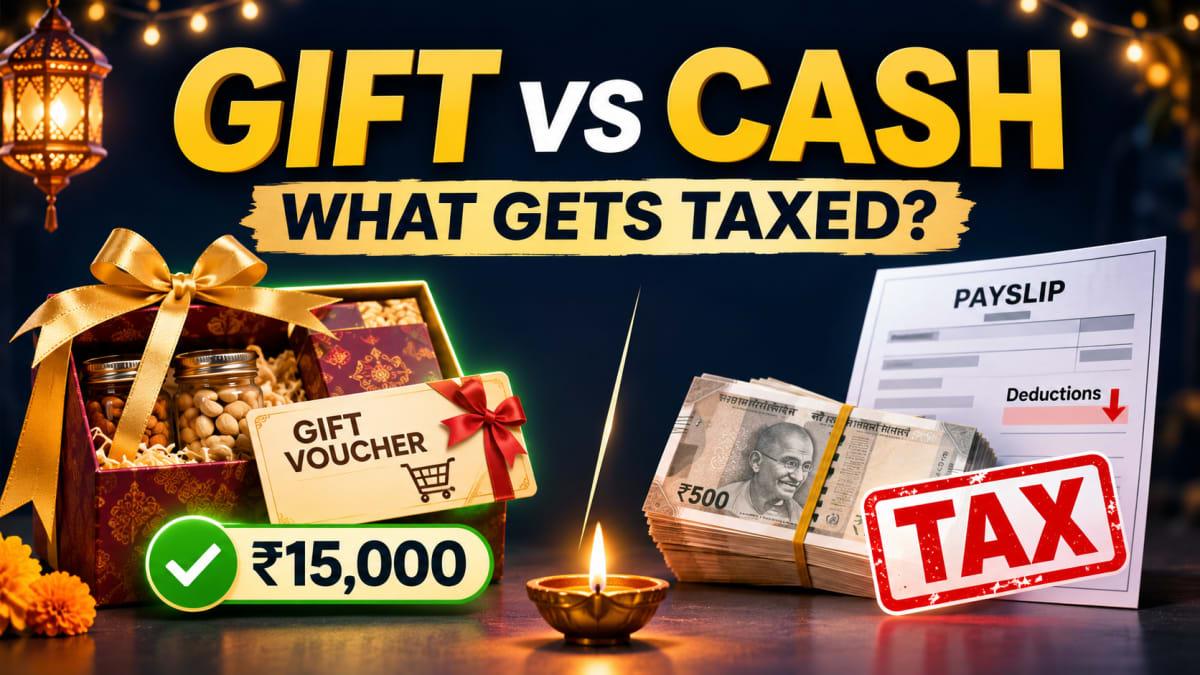
You might find it strange that a designer watch from your boss worth less than ₹15,000 costs you nothing in tax, while a cash bonus of the same value leaves you with a smaller paycheck.
The short answer: Under the 2026 tax rules, employer gifts like vouchers or hampers are tax-free as long as their total value stays below ₹15,000 for the year. However, the taxman treats a cash bonus as regular salary income, meaning it is taxed from the first rupee at your normal slab rate.
The Story
It is the week of Diwali, and the office atmosphere is shifting. In the breakroom, people are comparing the weight of their festive hampers, while at their desks, they are refreshing their banking apps to see if the annual bonus has hit.
If you are lucky, you might have received both: a box of premium dry fruits or a shopping voucher, and a crisp credit notification for a cash bonus. On the surface, they both feel like rewards for a year of hard work. But when you look at your next pay slip, you might notice something annoying.
The gift hamper is nowhere to be found in the tax deductions column, but that cash bonus has been sliced by your tax slab before it even reached your account. For many, this is more than just a minor deduction. It is the difference between staying in a low tax bracket or losing a major government rebate.
The rules changed recently. Under the Income-tax Rules, 2026, which started on 1 April 2026, the tax-free limit for employer gifts rose from ₹5,000 to less than ₹15,000. It sounds like a win, but it only applies if your boss gives you a gift in kind.
Then, there is the reality of the cash bonus. Unlike the voucher, a Diwali cash bonus is taxable as salary from the very first rupee. It does not matter if it is meant for sweets or crackers: the tax office sees it as additional remuneration for your services.
So here's the question: if both are rewards from my employer, why does the taxman treat my gift voucher as a "perk" and my cash bonus as "salary"?
Why does the tax office love vouchers but hate cash?
You see, the problem is not what you receive, but the form it takes. In the eyes of the law, cash is fungible, meaning you can spend it on anything from rent to stocks. Gifts and vouchers, however, are seen as "perquisites," which are non-monetary benefits given for ceremonial occasions.
Think of it like the difference between your parents giving you a new bicycle for your birthday versus giving you the cash to buy one. The bike is a specific gesture, while the cash is just more pocket money. The tax office follows this logic: gifts in kind are a festive "treat" up to a certain value, but cash is just extra pay.
The mechanics are explained in Rule 15 of the Income-tax Rules, 2026. If the aggregate value of gifts, vouchers, or tokens stays below ₹15,000 in a year, the value is treated as nil for tax purposes. If an employee gets an ₹8,000 hamper and a ₹5,000 voucher, the total of ₹13,000 remains tax-free.
But cash has no such shield. If you receive a ₹50,000 bonus, it is added straight to your taxable income. This is why you might be wondering Why Is My October Salary Lower? if your employer has already started deducting tax on that festive payout.
So who wants what here? The employee wants the flexibility of cash to pay off loans or invest. The employer often prefers vouchers because they are simpler to account for as business expenses without complicating the payroll tax for every staff member.
This is where the new tax regime's rebate limit comes in. Under Section 156 of the Income-tax Act, 2025, you can claim a rebate of up to ₹60,000 if your total taxable income does not exceed ₹12 lakh. A cash bonus could be the very thing that pushes you over that edge.
Why can't the gift exemption save my bonus?
But here's the twist. The gift exemption is an all or nothing deal. If your employer gets generous and gives you a gift worth exactly ₹15,000, the entire amount becomes taxable. You do not just pay tax on the extra one rupee: the whole ₹15,000 is added to your income as a taxable perquisite.
The impact on your rebate can be even more dramatic. Take an employee with a taxable income of ₹11.85 lakh after the ₹75,000 standard deduction. They are safely under the ₹12 lakh limit for a full rebate. If they receive a ₹50,000 cash bonus, their income hits ₹12.35 lakh. Suddenly, they are ineligible for the full rebate.
While marginal relief helps soften the blow, they still end up paying roughly ₹36,400 in tax and cess because of that bonus. They don't get to keep the whole ₹50,000 as take-home pay. It is a classic case of more money leading to a more complex tax bill.
Now to be clear, not all non-cash gifts are perfectly tax-free forever. If your employer gives you a voucher for a jeweller's gold savings scheme, remember that GST is still charged on the gold and making charges when you eventually buy the jewellery. The voucher might be tax-free at the office, but the taxman still gets his share at the store.
To help visualize the difference, here is how the 2026 rules break down for typical festive payouts:
| Type of Festive Payout | Tax Treatment | The 2026 Rule |
|---|---|---|
| Gift Vouchers or Hampers | Tax-free under limit | Must be less than ₹15,000 total |
| Cash Bonus in Bank | Fully Taxable | Added to salary from ₹1 |
| Gold Savings Scheme | Voucher rules apply | No interest: GST at billing |
So, is the Diwali tax problem about the government being a Grinch? Not really. It is about how the law defines the "nature" of your earnings. Cash is seen as part of the contract for your labor, while a box of sweets is seen as a gesture of goodwill.
As you plan your festive spending, keep an eye on your salary slip and the new Form 130 which replaces Form 16 from this year. The open question for many will be whether that extra bonus is worth the leap into a higher tax bracket, or if they would have been better off with a really, really nice watch.
If this helped the Diwali tax rules make sense, share it with a friend on WhatsApp, LinkedIn, or X. You might also enjoy our look at the Logic of Productivity Linked Bonus vs DA Calculation.