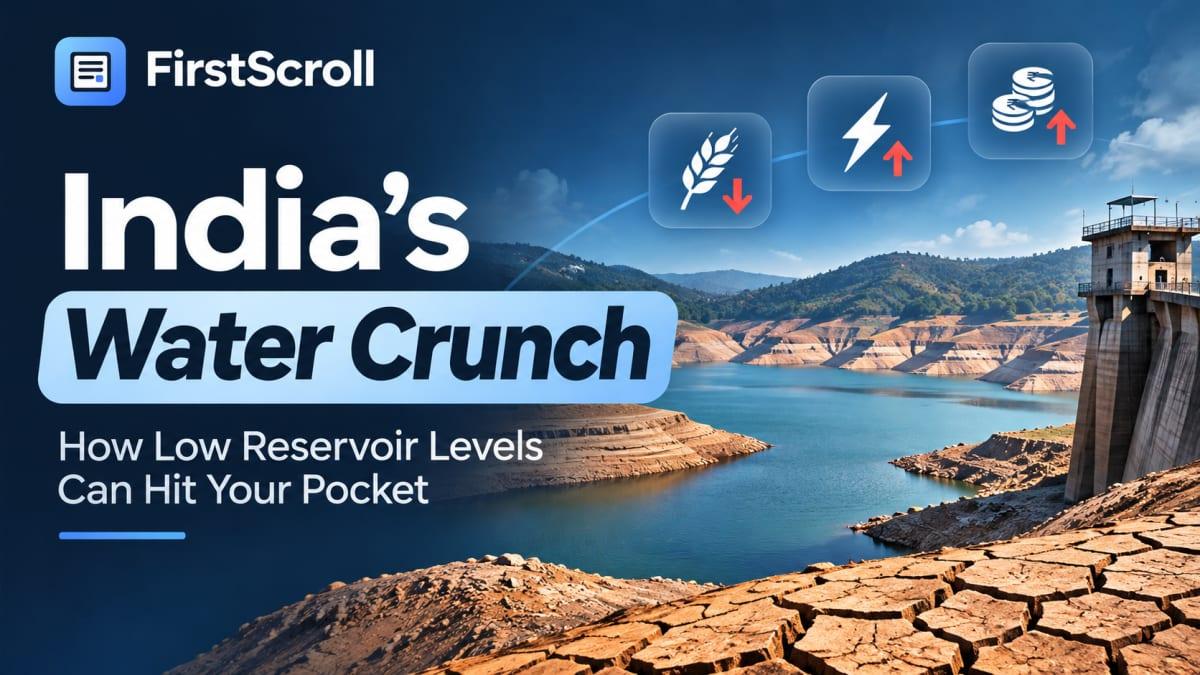
A half empty dam in November might look like a distant rural problem, but it is actually the first domino in a chain reaction that hits your grocery budget and power bill by spring.
The short answer: India’s 178 key reservoirs are 27% emptier than last year because of a weak monsoon. This water shortage has already cut winter crop sowing by 2.43 million hectares and slowed hydropower turbines. Fewer crops and costlier power generation eventually show up as higher prices at the mandi and in your electricity bill.
The Story
If you visited the Gobind Sagar dam in Himachal Pradesh this week, you would see a vast expanse of dry embankment that should normally be underwater. The reservoir, which can generate 1.3GW of power, is currently sitting at 56.87% of its capacity, a steep fall from the 85.09% it held this time last year.
This is not just one unlucky dam. Across the country, the water that is supposed to drink, light, and feed India is missing. Official data shows that water levels in 178 major reservoirs have dropped to 121.9 billion cubic metres, following one of the driest monsoon seasons in decades.
The situation is most critical in the South. While last year the southern reservoirs were nearly 90% full, they are now struggling at 42.6% of their capacity. For a region that relies on these waters for everything from paddy fields to city taps, the margin for error has vanished.
Then, the economic ripples began to surface in the official trade data. By the end of October, government rice procurement was down by 19 lakh tonnes compared to last year. Farmers are bringing less to the market because the yields simply are not there.
And here is the strange part. Even though the monsoon is officially over, the real economic pain is only just starting to sow itself into the ground. As of early November, total winter crop sowing has already fallen by 2.43 million hectares compared to the previous season.
So here's the question: if the rains have already stopped, why do these low water levels act as a ticking time bomb for inflation and the broader economy?
Why does a dry dam matter for your kitchen?
You see, the problem is not just about the rain that falls on a field. It is about the water stored in the "savings account" of our dams to get us through the dry months.
Think of India’s water cycle as a household that gets its entire yearly salary in one big bonus during the monsoon. If that bonus is 13% smaller than usual, as the 2026 monsoon was, you have to be incredibly careful with your spending for the next twelve months. If the tank is not full by October, the winter crops, known as rabi, have nothing to drink.
This is why wheat sowing has already slipped 12% in the early weeks of the season. Wheat, pulses, and oilseeds are the staples of the Indian diet, and they all rely on irrigation from these very reservoirs during the cold, dry months. When farmers see empty canals, they plant less. When they plant less, supply drops, and you see why India is importing sugar and pulses to keep prices stable.
The Central Water Commission data reveals a stark regional divide in how this "water salary" was distributed this year:
| Region | Current Storage (%) | Last Year Storage (%) |
|---|---|---|
| Southern | 42.60% | 89.97% |
| Northern | 56.62% | 86.32% |
| Western | 76.17% | 96.10% |
| Eastern | 75.74% | 81.66% |
| Central | 84.23% | 92.01% |
So who wants what here? The farmer wants enough water to ensure a healthy harvest so they can afford next year's seeds. The government wants high procurement numbers to keep the public distribution system running. But with rice arrivals already falling in states like Tamil Nadu and Haryana, the buffer is thinning. This rural stress is a major reason why tractor sales are falling even while urban luxury demand stays strong.
How does water storage keep the lights on?
But here's the twist. Reservoirs do not just grow food; they also balance our electricity grid. Hydropower acts like a giant battery that can be switched on instantly when solar and wind power drop off.
When dam levels are low, turbines have to slow down. If the water discharge is too weak, we lose that "quick start" capacity. This becomes a massive headache in the winter because of a weather phenomenon: smog. In northern India, heavy pollution and cloud cover often reduce solar power generation. If hydropower cannot step in to fill that gap, the grid has to rely more on expensive thermal power, which eventually shows up in your tariff.
The global outlook is not helping either. The USDA has already cut its projection for India's cotton production by 500,000 bales due to this unfavorable weather. This means that from the clothes you wear to the wheat in your rotis, the lack of water is squeezing the supply chain from multiple angles.
Now to be clear, the impact might be milder in the Northwest. Experts from the Indian Agricultural Research Institute note that regions like Punjab are well irrigated and wheat requires relatively less water than paddy. In fact, Punjab’s rice purchases have stayed nearly at par with last year, showing that some regions can weather the dry spell better than others.
So, is the reservoir crisis just a temporary weather glitch? Not really. It is a preview of the "unprecedented" El Niño strength that the World Meteorological Organization has warned about, which could push temperatures 3.8 degrees Celsius above average through 2027.
The real test for the Indian economy will be the month of December. If the northeast monsoon does not bring heavy rains to the Southern peninsula, and if winter sowing does not recover, the Reserve Bank of India may have a much harder time fighting food inflation in the coming year. For now, the best way to track the health of the economy is to keep an eye on those dam water levels.
If this helped the warning signs in our dams make sense, share it with a friend on WhatsApp, LinkedIn, or X. You might also want to read about why 11 crore farmers are getting a digital ID to better manage these agricultural risks.