The world's most powerful central bank is planning to talk to us less often, and while that sounds like a quiet vacation, it might actually make your portfolio a lot noisier.
The short answer: The US Fed is planning to cut its annual interest-rate meetings from eight to six starting next year to allow more economic data to build up between decisions. While this shift toward strategic silence aims to curb market speculation, it leaves Indian investors facing longer gaps of uncertainty while oil prices and bond yields remain volatile.
The Story
On a Wednesday in Washington, just six days before a high-stakes midterm election, Kevin Warsh stood before a room of reporters to deliver a message that was both expected and surprising.
The Federal Reserve decided to keep interest rates exactly where they were, holding the benchmark range at 3.75% to 4%. It was a 10 to 2 vote, with two officials, Lisa Cook and Beth Hammack, actually dissenting because they wanted to hike rates even further.
The context was tense. Inflation in the US has proven stubborn, climbing to 3.7% in September compared to just 2.4% back in February. President Trump has been openly critical of the bank, and American families are feeling the pinch of gas and groceries.
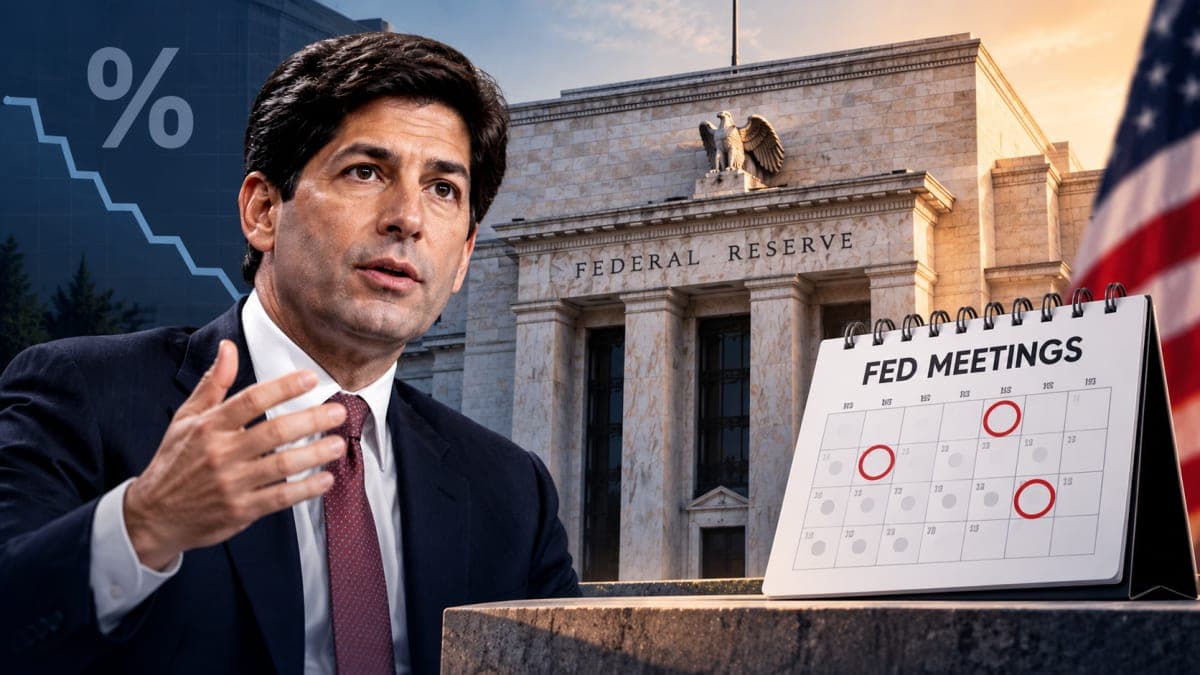
But the real headline was not about what the Fed did with rates today. It was about how often they plan to show up in the future. Warsh signaled a move toward fewer meetings, a pivot away from the era of constant updates and monthly market hand-holding.
And here is the strange part. Even though the Fed took a break from raising rates, US bond yields actually climbed higher, and the dollar showed its teeth, making things uncomfortable for markets thousands of miles away in Mumbai.
So here's the question: if the global economy is this volatile and inflation is still above target, why is the Fed choosing to meet less often?
Why is the Fed choosing strategic silence?
You see, the problem is not that the Fed lacks information. It is that the market reacts to that information too fast, often based on tiny, incomplete slices of data.
Think of the US economy as a giant, slow-moving ocean liner. For decades, the Fed has been acting like a captain who makes a tiny adjustment to the wheel every five minutes. Each time the captain moves the wheel, everyone on the ship screams and runs to one side, thinking the boat is about to flip.
By moving from eight meetings to six, the Fed wants to wait until the ship has actually moved a few miles before touching the wheel again. Warsh argued that cutting the frequency allows more "information and data to accumulate" between decisions. It is an attempt to break the market's addiction to every single decimal point of the consumer price index.
The following table shows the gap between where the US economy is now and where the Fed wants it to be, based on data from the October meeting:
| Metric | Current Level | Fed Target |
|---|---|---|
| Interest Rate Range | 3.75% to 4% | Data Dependent |
| Annual Policy Meetings | 8 meetings | 6 (Starting 2027) |
| Annual Inflation | 3.7% | 2% |
| Unemployment Rate | 4.2% | Stable |
So who wants what here? The Fed wants to protect its independence from daily politics and prove it is not just reacting to the latest tweet or news cycle. It wants to return to being a "quiet" institution that only speaks when it has something definitive to say.
Wall Street, however, wants constant "forward guidance." Investors hate surprises, and they use the Fed's frequent meetings to place bets on what happens next. When you take away those meetings, you take away their roadmap.
Now, this is happening in Washington, so why should you care in India? Because when the Fed goes silent, the "noise" in the Indian market usually gets louder.
What does this mean for Indian portfolios?
But here's the twist. While the Fed is trying to calm things down, the side effects are already hitting Indian stocks and the rupee.
Even with the Fed pausing, the US 10-year bond yield rose to 5.046% from 4.993% in just one session. When US yields go up, it is like a giant magnet pulling money out of emerging markets and back toward the safety of the dollar.
This is a major reason why FPIs are selling Indian stocks at a record pace. They are not just running away from India, they are running toward higher, safer returns in the US. The pressure is doubled because a massive amount of liquidity is moving into the primary market, leaving the secondary market thin and vulnerable.
India is also facing a specific pain point that the Fed cannot fix with interest rates: oil. With Brent crude at $115 per barrel, India's monthly import bill could hit $16 billion. This drains our dollar reserves and puts the rupee on a shaky path, regardless of how many times Kevin Warsh meets his colleagues in DC.
Now to be clear, the Fed is not going away entirely. Traders are still pricing in a 90% chance of a rate increase in December 2026. The "strategic silence" only starts next year.
So, is the move to fewer meetings about making the economy better? Not really. It is about changing how the world digests economic news. The Fed wants to stop the knee-jerk reactions that happen every six weeks, hoping that a longer view will lead to a more stable market.
The open question is whether the Indian market can handle the wait. With bond yields rising and stocks falling, Indian investors may find that the Fed's silence is anything but golden. The next big test arrives with the December meeting, which will be the last of the "old" high-frequency era.
If this helped the Fed's silent treatment make sense, share it with a friend on WhatsApp, LinkedIn, or X. You might also enjoy our story on how IPO inflows affect the Indian rupee.