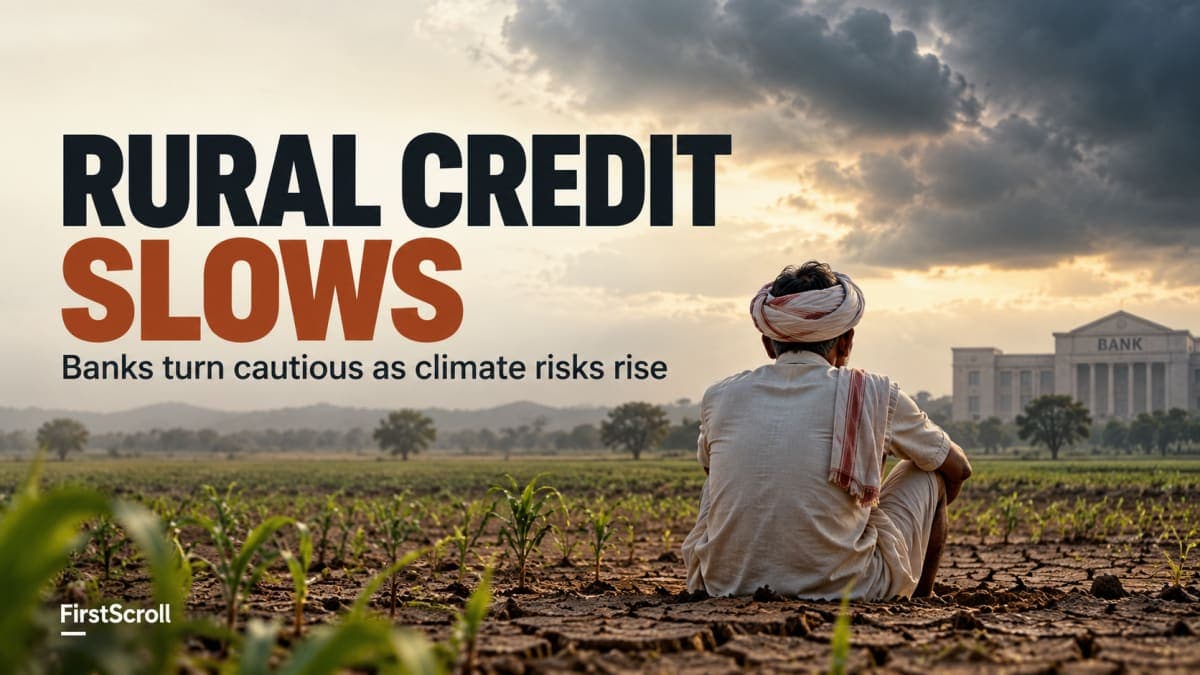
In today's FirstScroll, we break down why rural credit growth slowing in India is making banks nervous, and why climate risk is turning from an environmental worry into a cold math problem for your grocery bills.
The short answer: Rural credit growth slowing in India is the result of banks turning cautious as a "Super El Nino" creates massive climate uncertainty. While the economy grows, major lenders like RBL Bank have seen their agricultural loan books fall by nearly 12 per cent, fearing that erratic rains and rising costs will leave farmers unable to pay.
The Story
Picture a poultry farmer in a drought hit region of Maharashtra. Every morning, he checks two things: the grey clouds that refuse to rain and the price of livestock feed.
This year, the math simply does not add up. The cost of key ingredients for his birds has seen price increases of up to 75 per cent, making it nearly impossible to keep the business running.
He is not alone. Across the country, farmers are currently facing losses of approximately 15 per cent because they cannot pass these surging input costs onto consumers quickly enough.
Then, the banks noticed. In the quarter ended September 2026, the people who lend the money decided to take a step back from the fields.
At Federal Bank, loans to the agricultural sector declined nearly 3 per cent compared to last year. Even at giants like ICICI Bank, the growth in farm lending was a muted 1.7 per cent, which is far slower than the rest of their business.
And here is the strange part. India is growing, consumer demand is strong, and the government has set a massive rabi foodgrain production target of 177.72 million tonnes. Yet, the credit tap is being turned off.
So here's the question: if the Indian economy is booming, why are the banks that fuel it suddenly so afraid of the farm?
You see, the problem is not a lack of money in the banking system. It is a lack of predictability in the weather.
Lending to a farm in 2026 is like trying to play a high stakes game where the rules change every time it clouds over. Banks are watching something called a "Super El Nino," a rare and intense weather phase that happens once every 10 to 15 years.
Think of the farm economy as a house built on two pillars: soil moisture and irrigation reserves. If both pillars are strong, the house stands. If one cracks, the bank gets nervous about the mortgage.
Right now, both pillars are shaky. India's cumulative rainfall deficit stands at 12.6 per cent. This is particularly dangerous for the rabi season, the winter crop cycle that includes essentials like wheat and mustard.
Unlike the monsoon crops that wait for rain, rabi crops depend on the water left over in the soil and reservoirs. If the soil is dry in October, the seeds might not even germinate.
Now add the second ingredient: surging costs. When fodder and feed prices rise by 75 per cent, a farmer's profit margin evaporates. For a bank, a farmer with no profit is a borrower who might not pay back their loan.
So who wants what here? The farmer wants credit to buy seeds and feed to survive a tough season. The banks, however, want to protect their balance sheets from bad loans.
This tension is showing up in the data. Even non banking financial companies (NBFCs), which usually take more risks than banks, are pulling back. For instance, L&T Finance saw its farmer finance disbursements decline 1 per cent this quarter.
You might wonder why we should care about bank ledgers in Mumbai. We should care because when credit dries up, planting slows down. If planting slows down, your grocery bill goes up.
In states like Rajasthan, which saw a 55 per cent rainfall deficit in early October, the sowing of pulses and oilseeds is already off to a slow start. When there is less wheat or mustard in the mandis next year, retail prices will inevitably climb.
This also explains why are tractor sales falling even as luxury car sales hit records. When a farmer is worried about feed costs and bank caution, the last thing they do is buy new machinery.
But here's the twist. Even the banks that are technically "growing" their agri loans are actually reducing their exposure in relative terms.
Take HDFC Bank. Its agriculture portfolio grew to ₹1.3 lakh crore, but its share within the bank's total loan book dropped to 4 per cent from 4.43 per cent a year ago. Axis Bank showed a similar trend.
The banks are effectively saying they will lend to the safest farmers in the best regions, but they are not "pushing the pedal" on the sector as a whole. This creates a situation where the most vulnerable farmers are the first to lose access to money.
It is a classic case of why banks reject first time borrowers or those in high risk zones. When Maharashtra declared drought in 305 sub-districts, lenders in that region naturally hit the brakes to avoid a surge in defaults.
Now to be clear, there is some hope. Recent rains in Punjab and Haryana have given farmers a reprieve, potentially allowing wheat sowing to start on time in November. The government is also banking on winter rains from Western Disturbances to save the rabi harvest.
So, is the rural credit squeeze about greedy banks? Not really. It is about a financial system that is realizing that "normal" weather is no longer something you can bet on.
India is trying to produce record amounts of food while the climate is throwing record breaking tantrums. Whether the banks will find the courage to return to the heartland before the next harvest is something only time will tell.
Until then…
If this story helped you make sense of why rural credit growth slowing in India is happening, share it with a friend on WhatsApp, LinkedIn, or X. You might also enjoy our story on why are tractor sales falling.