You know that very specific kind of frustration when you study consistently all year, submit every assignment, and play by the rules, only to watch the kid who partied all semester pull an all-nighter and score an A.
That is exactly what being an Indian equity investor felt like in 2025.
While we were busy sipping chai and talking about “structural growth,” the rest of the world was at an AI-fueled rave. As we close the books on December 31, 2025, the scoreboard is in.
And it is humbling.
But just before the curtain fell, there was a last-day plot twist that gave Dalal Street something to smile about.
Let’s rip the band-aid off.
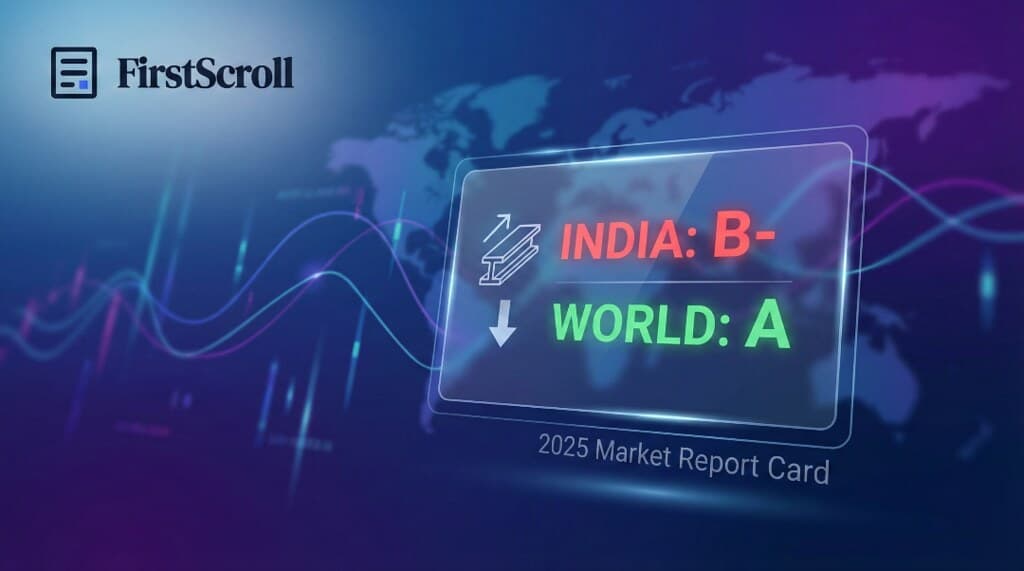
In dollar terms, the Sensex and Nifty returned just 4 to 5 percent in 2025.
Now compare that with the rest of the world.
South Korea’s KOSPI surged nearly 80 percent. Germany’s DAX climbed around 38 percent. Even Japan had a better year.
By comparison, India finished 2025 as the worst-performing major equity market globally.
The reason was simple. There was no FOMO.
The global rally was powered by AI, chips, and software. India does not have a clean, listed AI or semiconductor giant. So foreign investors took their money to markets that did.
To make matters worse, the Rupee had its weakest year in three years, quietly eating into whatever gains domestic investors made.
Just when 2025 looked ready to limp across the finish line, the government stepped in.
On December 30, India announced a 12 percent safeguard duty on select steel imports for the next three years.
The market reacted instantly.
Stocks like Tata Steel and JSW Steel jumped 5 to 7 percent in the final session, pulling the Nifty back above 26,100.
This was not subtle optimism. It was policy-driven relief.
Imagine Indian steel companies run a local restaurant.
Suddenly, a foreign restaurant opens next door selling the same food at half price because their government pays their bills.
Instead of forcing you to cook better overnight, the government charges a heavy entry fee at the new place. That fee is the safeguard duty.
1. Manufacturing gets breathing room
Cheap steel imports have crushed margins for Indian producers. This duty puts a floor under prices and helps balance sheets in early 2026.
2. Inflation risk quietly returns
Steel flows into cars, homes, bridges, and appliances. Blocking cheap imports eventually pushes costs back to consumers.
3. Markets love certainty
The rally was less about steel itself and more about policy support. Investors crave predictability.
That is how much foreign investors pulled out of Indian equities in 2025 - the highest annual outflow ever.

Here is the uncomfortable question.
Is a tariff really a victory, or is it an admission that we are not competitive enough yet?
The world is racing toward AI, automation, and next-generation tech.
Slapping duties on steel feels like upgrading the engine on a steam train while everyone else builds maglevs.
It keeps us moving, yes. But it does not change the destination.
As calendars flip to 2026, three things will matter.
- Whether US rate cuts weaken the dollar and revive foreign flows
- Whether India can finally build a credible tech growth story
- Whether policy support shifts from protection to innovation
Enjoy the steel rally. But keep an eye on your grocery bills and construction costs.
The Bottom Line: 2025 was a gap year for Indian equities. The steel tariffs are a safety net, not a strategy. We cannot tax our way into becoming a global growth leader.
Fun fact: Warren Buffett officially retires today, December 31, 2025, ending a 60-year run. Even legends know when a chapter is over.

That is exactly why we built Firstscroll.
A daily, five-minute, mobile-first finance read explaining what happened, why it matters, and what to remember - without noise.
Subscribe to First Scroll