In today's FirstScroll, we tell the story of the boldest sales pitch in Indian business. In a country where water was free at every tap, shop, and railway platform, one man decided to put it in a bottle and charge for it. Everyone thought he was mad. Today, Indians don't ask for water, they ask for "a Bisleri". Here's how you sell someone something they already have.
The Story
Imagine pitching this business in 1970s India.
"I'm going to take water, the thing every restaurant gives you free, that every home has in a matka, that strangers offer you at the door, put it in a bottle, and sell it for money."
You'd be laughed out of the room. Water wasn't a product. It was hospitality. Charging for it felt almost offensive.
And yet. Bisleri International recorded revenue of ₹2,689 crore with a net profit of ₹316 crore in FY24. The brand became so dominant that Indians say "ek Bisleri dena" when they mean any bottled water, the same linguistic takeover Fevicol pulled off with glue. At its peak, the Tata Group was reportedly ready to buy it for around ₹7,000 crore.
So how do you build an empire selling something people used to get free? The answer is a masterclass in creating a market that didn't exist.
Act 1: The Italians who had the idea, but not the country.
Here's the twist most people don't know. Bisleri isn't Indian. It was originally an Italian brand, founded by Felice Bisleri.
In 1965, an Italian doctor, Cesari Rossi, and an Indian businessman, Khushroo Suntook, brought Bisleri to India, setting up a factory near Thane. But they didn't sell it to ordinary Indians. They sold it only in luxury hotels and restaurants in Bombay, in glass bottles, in two varieties, bubbly and still.
It was a fancy imported novelty. And it flopped. The founders realised a premium-only strategy couldn't sustain the business, tried to reach the mass market, failed, and decided to quit India.
So in 1969, the Chauhan family of Parle bought the struggling brand for ₹4 lakh, roughly $50,000 at the time.
Read that again. A brand later valued at ₹7,000 crore was bought for the price of a used car today. What the Italians couldn't see, Ramesh Chauhan could.
Act 2: Selling the thing nobody knew they wanted.
Chauhan's insight wasn't about water. It was about fear.
Indians weren't going to pay for water. But they would pay for safety. In a country where waterborne illness was a genuine, everyday risk, and where you had no idea whether the glass at a roadside dhaba was safe, Bisleri wasn't selling H2O. It was selling the certainty that you wouldn't fall sick tomorrow.
That reframing changed everything. Suddenly the product made sense for travellers, for weddings, for offices, for anyone away from their own kitchen. The sealed bottle became a promise: nobody has touched this, you can trust it.
And the timing was perfect. As India urbanised, more people travelled, more ate out, more lived far from home, and every one of those shifts multiplied the number of moments where you can't trust the local water. Bisleri didn't create demand out of thin air. It found an anxiety nobody was serving and put a cap on it.
Act 3: The pivot that decided everything.
Now the fork in the road. In 1993, Ramesh Chauhan made one of the most famous decisions in Indian business: he sold his soft drink empire, Thums Up, Gold Spot and Limca, to Coca-Cola for about $60 million.
Why sell brands that were winning? Because Thums Up alone commanded a massive share, but Parle owned only a handful of its 60 bottling plants, and Coca-Cola was buying up bottlers with offers they couldn't refuse. Chauhan realised he could not win a war of deep pockets against a global giant.
So he took the money and put his energy into the one thing the multinationals weren't yet fighting over: water.
That single decision is why Bisleri exists as we know it. He walked away from a glamorous battle he'd lose, and doubled down on a boring category he could own.
Act 4: The moat is the truck, not the bottle.
Here's the thing about bottled water: the product is impossible to differentiate. Water is water. Anyone with a plant can make it. Coca-Cola brought Kinley. PepsiCo brought Aquafina. Parle Agro brought Bailley. So how did Bisleri stay on top?
Distribution. Brutal, boring, expensive distribution.
Bottled water is heavy, low-value, and needed everywhere, the highway dhaba, the railway platform, the wedding hall, the tiny kirana at the end of a village road. Winning means physically getting bottles to lakhs of points across India, cheaply, constantly. Bisleri built exactly that: over 122 plants and 4,500 distributors across India and neighbouring countries, plus a huge fleet of trucks.
A rival can copy your water in a week. Copying a 50-year-old network of plants, trucks, and shopkeepers takes decades and enormous capital. That's the real moat, and it's the same lesson your neighbourhood tells you about Maruti's service network or Pidilite's 800,000 shops: in India, distribution is the product.
Act 5: The ₹7,000 crore deal that didn't happen.
The final chapter is the most human. By 2022, Ramesh Chauhan was in his 80s, in indifferent health, with no obvious successor. He agreed to sell Bisleri to Tata Consumer Products for an estimated ₹6,000 to 7,000 crore, and reportedly wanted the Tatas specifically, because he trusted them to protect the legacy.
Then, in March 2023, it collapsed. Tata Consumer walked away, with reports citing "indecisiveness" rather than any disagreement on price. And in the twist nobody expected, Chauhan announced the family would keep the business after all: "Jayanti will run the company with our professional team and we do not want to sell". His daughter Jayanti, who had earlier been reluctant to join the family business, took the wheel.
To be fair, the road ahead is not simple. The market is crowded with multinationals, plagued by counterfeit bottles and unregulated local bottlers, and increasingly squeezed by plastic-waste regulation and groundwater depletion, existential issues for a company whose raw material is a shrinking public resource.
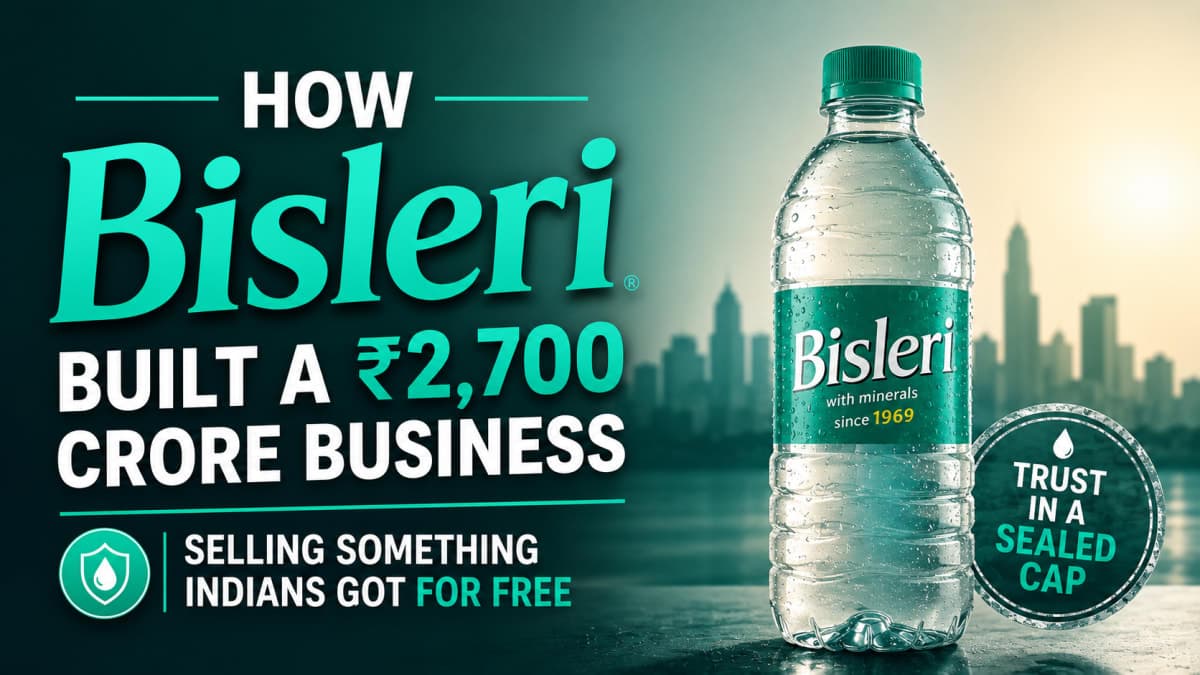
So, how did Bisleri build a ₹2,700 crore business selling something Indians got free?
By understanding that it was never selling water. It was selling trust in a sealed cap. The Italians had the product but read the market wrong, aiming at luxury hotels. The Chauhans bought it for ₹4 lakh, aimed it at an entire anxious, urbanising country, walked away from a soft-drink war they couldn't win, and then spent decades building the unglamorous truck-and-distributor network that no rival could copy.
The lesson is one of the most valuable in business: you don't create a market by inventing a product. You create it by finding a problem people had quietly accepted as normal, and refusing to accept it with them.
Water was free. Safe water, delivered anywhere, at any hour, wasn't. Bisleri sold the difference. And a country that once found the idea absurd now says its name instead of the word for water.
Until next time...