In today's FirstScroll, we tell the story of the most unlikely business empire in India. No investors. No factory. No marketing department. No boss. Just seven housewives on a Mumbai terrace, a borrowed ₹80, and a way of running a business so unusual that management schools still study it. Here's how they built it, and why the "weird" parts of their model were actually the genius parts.
The Story
Picture a terrace in Girgaum, Mumbai. The date is March 15, 1959.
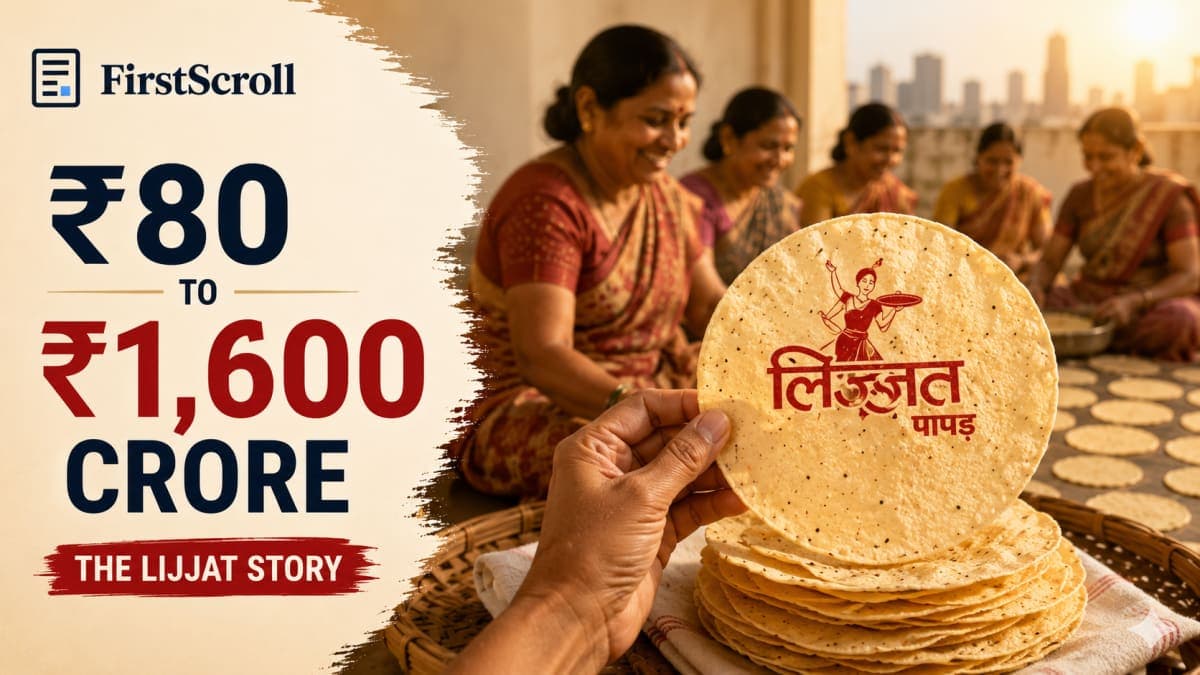
Seven women are up early, rolling out papads and laying them in the sun to dry. In post-independence India, women from traditional households had almost no way to earn outside the home. These seven had one skill the world considered ordinary: cooking. And one asset nobody counted: their spare time.
They had borrowed ₹80 from a social worker named Chhaganlal Karamshi Parekh to buy ingredients and take over a small, loss-making papad venture.
By evening, the papads were dry. The leader of the group, Jaswantiben Jamnadas Popat, packed them into four packets and sold them to a local merchant.
Four packets. That was day one.
Today, that terrace venture, Shri Mahila Griha Udyog Lijjat Papad, has an annual turnover of over ₹1,600 crore, employs around 45,000 women, and exports to more than 25 countries.
From ₹80 to ₹1,600 crore. With no investor money, ever.
How? The answer is a business model that breaks almost every rule you know. So let's open it up, rule by broken rule.
Broken rule #1: There are no employees. Everyone is an owner.
In a normal company, there are owners at the top and workers below. The owners take the profit. The workers take a salary.
Lijjat threw that out completely.
Every woman who rolls papads at Lijjat is called a "sister", and every sister is a co-owner of the organisation, an equal partner in the profits. There is no promoter sitting on top collecting the cream. Profits are shared among all the sisters.
And the ownership is real, not symbolic. Decisions are taken by consensus, and any sister has the right to veto a decision. Meanwhile, men can work at Lijjat, as accountants, drivers, security guards, but only as salaried employees, never as owners.
Why does this matter as business, not just as a nice story? Think about what ownership does to effort. An employee rolling papads has no reason to care about quality beyond keeping her job. An owner rolling papads is protecting her own profit, her own brand, her own future. Lijjat converted 45,000 workers into 45,000 quality inspectors. No supervisor required.
Broken rule #2: There is no factory.
Here's the part that would make any manufacturing consultant faint. A ₹1,600 crore food business, and no giant central factory.
Instead, Lijjat runs a distributed model. The organisation prepares the dough centrally at its branches, using the same recipe and the same quality of ingredients everywhere. Sisters collect the dough, roll the papads, hand-rolled and sun-dried to this day, and return the finished papads for quality checking, packing and sale. The network has grown to 82 branches across 17 states.
Now see the business genius hiding in this arrangement.
The expensive part of any food business is the factory: the land, the machines, the maintenance. Lijjat simply doesn't have that cost. Its "factory" is thousands of homes and branch workspaces. Its "machines" are hands.
But wait, doesn't distributed production ruin consistency? That's where the central dough comes in. By controlling the ingredients centrally and distributing only the rolling, Lijjat gets the best of both worlds: factory-level consistency in taste, with cottage-level costs in production. Same recipe everywhere, made by no machine anywhere.
That is why a Lijjat papad tastes the same in Mumbai, Delhi, or London. Standardise the input, distribute the labour.
Broken rule #3: Money moves daily, not monthly.
In most companies, you work all month and get paid at the end. Lijjat pays its sisters as soon as the papads are delivered, usually within three days of taking the work.
For a woman supporting a household, that daily rhythm is everything. It's not an abstract salary at month-end. It's cash for today's vegetables, this week's school fees. That immediate, visible reward is why the model spread so fast: from 7 women to 25 within three months, and 300 by the third year.
And the discipline runs both ways. If a branch makes a loss, the sisters of that branch bear it themselves, adjusting their own earnings. Every branch has to stand on its own feet. No branch can grow careless expecting a head office to rescue it.
Read that again as a business person. Lijjat accidentally invented what modern companies pay consultants to design: fully accountable profit centres, with instant performance feedback, and skin in the game at every level.
Broken rule #4: Grow without capital.
Startups raise crores to expand. Lijjat expanded across India using an approach that needed almost no money.
A new branch doesn't need a factory or heavy machinery. It needs a workspace, dough, and women willing to roll. The women bring the labour, the organisation brings the brand, the recipe, and the buyers. Each new branch quickly pays for itself because payments are daily and losses are locally owned.
That is why the ₹80 never needed to become a funding round. The model itself was the capital. By the 1990s, Lijjat was a national brand and had begun exporting to the USA, UK and Singapore. Exports alone reached around ₹80 crore.
And through all of this, the marketing budget stayed famously tiny. One TV ad, a laughing bunny and a jingle, "Lijjat Papad!", ran for years and lodged the brand in a generation's memory. The rest was word of mouth, and the simple fact that the product was reliably good, because 45,000 owners were making sure of it.
The proof it worked.
The world eventually noticed the quiet empire. Lijjat won the Best Village Industry Institution award, was named a consumer "Power Brand", and received the Economic Times Businesswomen of the Year award, collectively, for all the sisters. Its model became a case study in business schools, including Harvard.
And in 2021, the government awarded the Padma Shri to Jaswantiben Popat, the woman who sold those first four packets in 1959. She passed away in September 2023, having watched her ₹80 experiment employ more women than most of India's biggest companies.
To be fair, the model has its limits. Hand-rolling caps how fast production can scale compared to machine-made rivals. Consensus decision-making is slow. And a cooperative cannot raise outside capital to fight modern FMCG marketing budgets. Lijjat grew great by refusing shortcuts, and that same refusal means it grows steadily, not explosively.
So, how did seven women turn ₹80 into ₹1,600 crore?
By building a business where every rule-breaking choice solved a real problem. Making workers owners solved quality and motivation without supervisors. Distributing production solved capital without losing consistency. Daily payments solved trust and retention. Branch-level accountability solved discipline without a head office breathing down necks.
None of it was designed in a boardroom. It was designed by women who understood one thing deeply: dignity is the best incentive ever invented. Give a person ownership of their work, pay them fairly and immediately, and trust them with responsibility, and they will build you an empire with their bare hands.
Four packets on day one. ₹1,600 crore today. And every single papad, still rolled by hand, by an owner.
Until next time...