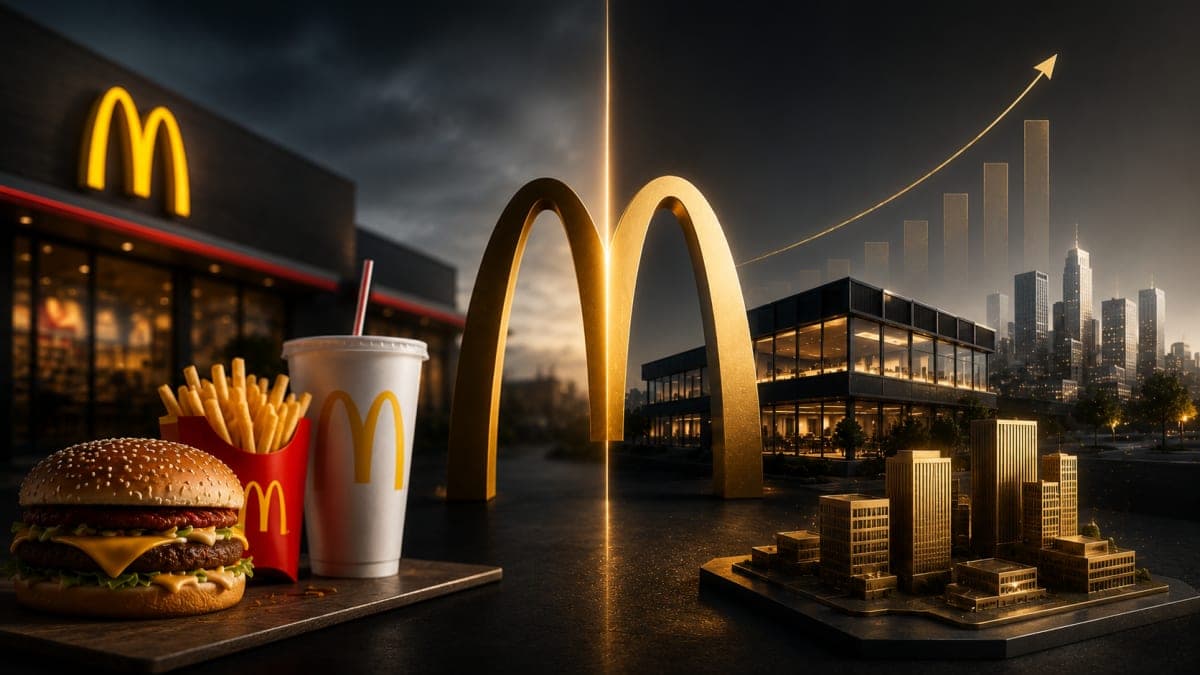
In today's FirstScroll, we bust open the biggest hidden-in-plain-sight secret in global business. You think McDonald's makes its money selling burgers and fries. McDonald's own finance boss said otherwise, decades ago. The real money machine behind the Golden Arches isn't food at all. It's land. Let's unpack the trick.
The Story
Picture McDonald's. You see burgers, fries, the red-and-yellow arches, a Happy Meal toy.
Now here's a quote that'll rearrange your brain. McDonald's own former finance chief, Harry Sonneborn, once said the company is not really in the food business, it's in the real estate business, and the only reason it sells cheap burgers is because they're the best way to generate the sales from which its tenants pay rent.
Read that again. The man who ran McDonald's finances said the burgers are basically a side effect. The actual business is being a landlord.
This sounds like a fun internet myth. It isn't. It's written into how the company makes money, and the numbers prove it. So let's figure out how the world's most famous burger chain is secretly one of the biggest landlords on the planet.
First, the thing most people get wrong about McDonald's.
When you walk into a McDonald's, you assume the company owns and runs it. Mostly, it doesn't.
The vast majority of McDonald's outlets are run by franchisees, independent business owners who pay to operate a McDonald's of their own. McDonald's itself doesn't flip most of the burgers. Other people do, under its brand.
So if McDonald's isn't making most of its money cooking food, how does it earn from these thousands of restaurants? This is where the genius kicks in.
The double-charge: the trick that built an empire.
When someone wants to open a McDonald's, the company doesn't just hand over a logo and a recipe. It does something far cleverer.
McDonald's typically buys or leases the land and the building first. Then it lets the franchisee operate there. And here's the key: that franchisee now pays McDonald's two separate things, every single month.
One, a royalty, a percentage of their sales (the "burger" part). Two, and this is the big one, rent, for sitting on McDonald's land and building.
So McDonald's is wearing two hats at once. It's a brand collecting royalties, and it's a landlord collecting rent. The food is just what happens inside the building it owns.
And rent is a beautiful business to be in. Why? Because it shows up like clockwork no matter what. As McDonald's own filings explain, this model is designed to generate stable, predictable revenue and cash flow. Even if a particular franchisee has a bad month and barely sells anything, the rent is still due. The landlord gets paid first.
This is the quiet engine. Now look at how massive it's become.
The numbers that give away the real game.
McDonald's, through its property arm, now sits on a land-and-building empire valued at over $40 billion. It is, by some measures, one of the largest owners of commercial real estate on Earth, hidden behind a clown mascot.
And here's the stat that settles the whole debate. Rent from franchisees makes up around 75% of revenue from franchised restaurants. Three out of every four rupees McDonald's earns from its franchise empire come from rent, not from royalties on food.
That's the punchline. A "burger company" earns the bulk of its franchise money by being a landlord.
It even has a name for cracking down. Each lease comes with clauses that bump up rent based on inflation and the franchisee's sales. So when a location does well, McDonald's automatically earns more rent from it. It captures the upside of success without flipping a single extra patty.
Why this model is so ridiculously profitable.
Here's why investors love this so much. Running a restaurant is a hard, low-margin grind, you pay for ingredients, cooks, electricity, spoiled food, all of it eating your profit.
But collecting rent and royalties? That's almost pure profit. As one analysis notes, this income has minimal direct costs, because McDonald's isn't buying the burger ingredients or paying the crew wages for franchised stores. The franchisee handles all that messy, expensive stuff. McDonald's just collects rent and a slice of sales from the sidelines.
This is exactly why McDonald's runs at an eye-watering operating margin of over 46%. For comparison, a typical restaurant business would dream of a fraction of that. McDonald's makes restaurant-level revenue with landlord-level profit margins. That's the magic combination.
And the rent gives it a safety net most companies envy. If a franchisee fails, McDonald's still owns the land and building, and can simply swap in a new operator and keep the rent flowing. On top of that, all that property quietly appreciates in value over decades, building a second fortune in the background, completely separate from the food.
So now flip it around and the whole strategy makes sense. McDonald's doesn't pick restaurant locations to sell more burgers. It picks them because they're prime real estate, high-traffic corners that will only grow more valuable. The burgers are simply the most reliable way to make sure rent gets paid on that valuable land, forever.
So, is McDonald's really a real estate company, not a burger company?
The honest answer is: it's both, brilliantly fused into one machine. The burgers are real, the brand is real, the food business genuinely matters. But the financial engine, the thing that makes McDonald's so stable, so profitable, and so hard to kill, is the land beneath the restaurants. The food draws the crowds and pays the rent. The real estate quietly compounds into a fortune.
Ray Kroc, the man who built McDonald's into a giant, understood this better than anyone. He realised that selling burgers was a tough, competitive business, but owning the busiest street corners in every town, and renting them out forever, was one of the safest fortunes you could build.
The next time you bite into a Big Mac, remember: you're not really the customer that matters most. The franchisee paying rent on the ground beneath your feet is. McDonald's just figured out how to sell you a burger and a real estate empire at the same time, and only one of those was ever the point.
Until next time...