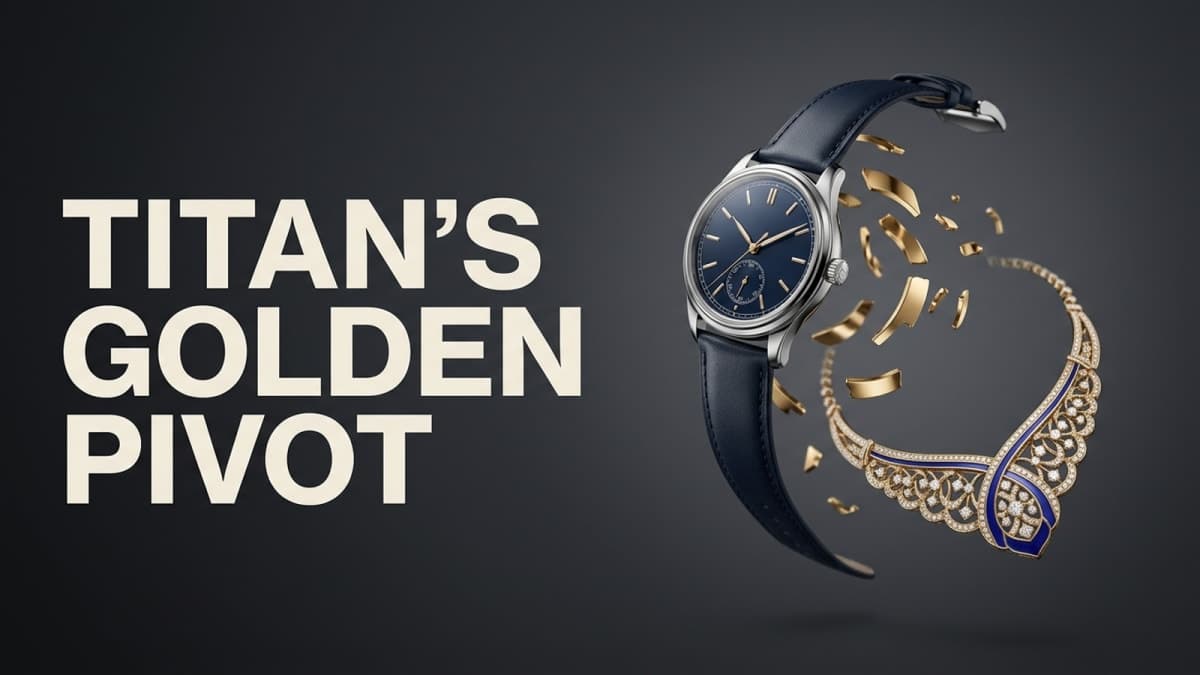
In today's FirstScroll, we tell the story of the greatest side hustle in Indian business. A Tata company built to sell wristwatches made a desperate bet on jewellery in the 90s, nearly fumbled it, then cracked a code no one else had: how to make Indians trust a stranger with their gold. Today, the watches are 6% of the business. The side bet is 90%. And it made one investor the most famous fortune in Indian stock market history.
The Story
Quick quiz. What does Titan sell?
If you said watches, you're technically right and completely wrong. Titan began on July 26, 1984, as a watchmaking company, a joint venture between the Tata Group and Tamil Nadu's TIDCO. For a generation of Indians, a Titan watch was the middle-class milestone gift.
Now look at the FY26 numbers. Titan's total revenue: ₹88,136 crore, nearly $9.3 billion. Jewellery contributed ₹79,660 crore, over 90% of it. Watches? Just ₹5,267 crore, about 6%.
The watch company is barely a watch company anymore. Its "side business", the jewellery brand Tanishq, swallowed the whole enterprise and became India's largest organised jewellery retailer. How did that happen? The answer is a masterclass in spotting the one thing an entire industry was missing.
The 90s bet: walking into a market that didn't want them.
In 1994, Titan diversified into jewellery with Tanishq. On paper, it looked insane. Indian jewellery was, and still largely is, ruled by family jewellers, the neighbourhood shop your grandmother trusted, where relationships went back generations. Why would anyone buy gold from a watch company?
And at first, they didn't. Tanishq's early years were a struggle. It launched with sleek, European-style 18-karat studded jewellery, and Indian customers shrugged. Indians didn't want fashion metal. They wanted 22-karat gold, the traditional stuff that doubles as family wealth. Tanishq had misread its own country, and the business bled.
But instead of quitting, Titan did two things: it pivoted to traditional 22-karat designs, and more importantly, it found the industry's dirty secret, the crack it could drive a truck through.
The dirty secret: India didn't trust its own jewellers.
Here's the uncomfortable truth about the old jewellery trade. Gold purity was a matter of faith. Your family jeweller said the necklace was 22 karat, and you believed him, because what choice did you have? You couldn't test it.
And faith, it turned out, was often misplaced. When Tanishq introduced the Karatmeter around the turn of the millennium, an X-ray machine placed right in its stores that could test any gold item's purity in minutes, for free, the results were explosive. Customers walked in with heirlooms from trusted family jewellers and discovered, again and again, that their "22 karat" gold was actually 18 or 19 karat. They had been quietly shortchanged for generations.
That machine wasn't just a gadget. It was a bomb dropped on the entire industry's business model. And it flipped Tanishq's biggest weakness into its greatest weapon. Being a corporate outsider with no family relationship suddenly didn't matter, because Tanishq offered something better than a relationship: proof. Guaranteed purity, transparent pricing with clearly broken-out making charges, and the Tata name, arguably the most trusted brand in India, stamped on top.
The pitch wrote itself: your family jeweller asks for your faith. We show you the machine.
Why jewellery was a genius market to attack.
Step back and you see why this bet, once fixed, was so powerful. Indian households are the world's biggest hoarders of gold. Weddings alone guarantee gigantic, non-negotiable demand every single year. The market was enormous, but almost entirely unorganised, thousands of small shops with no standard purity, no transparent pricing, no consistent experience.
Tanishq wasn't really competing with those jewellers on design or price. It was selling an upgrade the whole category lacked: certainty. And as India's incomes rose and shoppers moved from bazaars to malls, from cash to cards, from faith to bills-and-guarantees, Tanishq was positioned exactly where the country was heading. Even today, Titan's share of the total jewellery market is only around 8.5%, which sounds small until you realise what it means: it's already the organised leader, and the runway of unorganised share left to capture is enormous. That runway is the whole investment story.
The empire builds out.
Once trust was cracked, Titan stacked brand upon brand for every wallet: Tanishq for the classic buyer, Mia for everyday wear, Zoya for luxury, and CaratLane, acquired 98% in 2023, for the young online shopper. In 2025 it bought a majority of Damas Jewellery, a UAE giant, to chase the Gulf and the Indian diaspora, with over 20 Tanishq stores now abroad.
The momentum is almost silly. Titan took nearly 40 years to cross ₹50,000 crore in annual revenue, then added another ₹25,000 crore in a single year. In FY26, jewellery revenue growth accelerated every quarter: 19%, 21%, 42%, 50%, helped, admittedly, by soaring gold prices that inflate ticket sizes. The company now plans to double jewellery revenue by FY30.
The man who saw it before everyone: the Jhunjhunwala trade.
No Titan story is complete without this. Around 2003-04, Rakesh Jhunjhunwala started buying Titan at ₹30-35 a share, when few believed a watch company could conquer jewellery. He saw what the market didn't: the brand, the Tata governance, and Tanishq's runway into an unorganised market.
That single position became his biggest wealth creator and the most celebrated trade in Indian stock market history, a stake worth thousands of crores. The Big Bull's masterpiece wasn't some obscure small cap. It was a company selling gold and watches in plain sight, whose real product, trust at scale, almost nobody had priced.
To be fair, Titan isn't risk-free. Its stock has almost always traded at eye-watering premium valuations, gold price swings cut both ways on demand, custom duty changes have dented margins before, and the CaratLane buyout costs pinched profits. When you're priced for perfection, execution has to stay perfect.
So, how did Titan turn a watch company into India's jewellery king?
By realising that the jewellery market's biggest gap wasn't design, price, or glamour. It was trust. In a trade run on unverifiable faith, Titan showed up with a purity machine, transparent bills, and the Tata name, and let an entire country discover it had been shortchanged. The watches opened the door. The trust built the empire.
And the lesson travels far beyond gold: in any messy, unorganised market, the biggest brand isn't built by the best product. It's built by whoever makes the customer feel safe. Titan didn't really sell jewellery. It sold certainty, and India, it turned out, would pay almost any price for that.
Until next time...