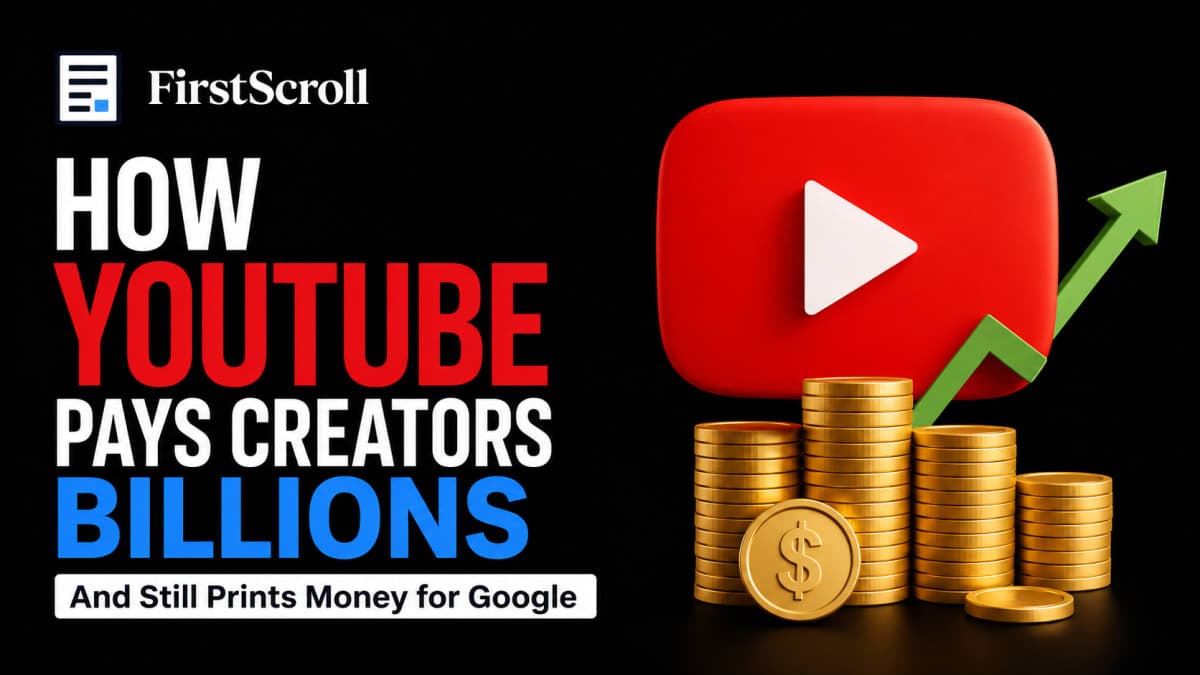
In today's FirstScroll, we crack open the biggest entertainment business on the planet. YouTube hands its creators more than half of the ad money their videos earn, billions upon billions every year. That sounds like terrible business. It's actually the smartest deal in media history. Here's why giving away 55% made YouTube unbeatable.
The Story
In February 2026, Google's parent Alphabet revealed a number it had kept secret for 20 years.
YouTube's total revenue for 2025: over $60 billion. For context, that's bigger than Netflix ($45 billion), bigger than almost every entertainment company on Earth except Disney. The app you use to watch cooking videos and cricket highlights quietly became the largest entertainment business in the world.
Now here's the strange part. YouTube gives away more than half of its main revenue. For every ₹100 of ad money a video earns, the creator keeps ₹55 and YouTube keeps ₹45, the famous 55/45 split. In 2025 alone, roughly $22 billion was available for creator payouts from ads.
Pay out billions, keep less than half, and still end up the biggest? That maths shouldn't work. But it does, brilliantly. And to see why, compare YouTube to the two companies we've already dissected: Netflix and Spotify.
The three ways to run a content platform.
Every content platform faces the same question: where does the content come from? There are three answers, and they create completely different businesses.
Netflix's way: buy the content yourself. Netflix spends upwards of $17 billion a year making and buying shows, before knowing if anyone will watch. Every flop is Netflix's loss. High control, high risk, and the spending never stops.
Spotify's way: rent it from powerful suppliers. Spotify doesn't own its music, and its suppliers are three giant labels that control everything and squeeze it forever, taking roughly two-thirds of revenue. Low risk, but permanently thin margins and zero leverage.
YouTube's way: let millions of people make it for free, and pay them only when it earns. This is the genius. YouTube spends almost nothing upfront on content. Creators invest their own time, money, cameras, and editing. If a video flops, the creator absorbs the loss, YouTube loses nothing. If it's a hit, YouTube takes its 45% cut of the ads. It's an infinite content factory where all the risk sits with the workers and the platform simply takes commission on success.
That's why the 55% payout isn't generosity. It's the world's best outsourcing deal.
Why creators have no leverage (and labels do).
Here's the subtle bit that makes YouTube's position so much stronger than Spotify's.
Spotify's content comes from three suppliers. If Universal walks, Spotify is crippled. Those suppliers negotiate as giants.
YouTube's content comes from over 115 million channels. If any single creator leaves, even a superstar, YouTube barely feels it. No creator, not even the biggest, controls enough content to demand a better split. The suppliers are infinitely fragmented, so the platform holds all the power while looking generous.
And the creators keep coming anyway, because YouTube offers something nobody else can: the biggest audience on Earth and a real shot at earning a living. The 55% share, pioneered back in 2007, created the entire "creator economy". Millions of people now treat YouTube as a career, which means an endless, self-refilling river of free content flowing into Google's servers.
The flywheel that prints the money.
Once you see the structure, the money machine is simple, and beautiful.
More creators make more videos. More videos attract more viewers, YouTube is now the most-watched streaming service on US televisions, ahead of Netflix, per Nielsen. More viewers attract more advertisers. More ad money makes creating more rewarding, which attracts more creators. Around and around, with YouTube skimming 45% of an ever-growing pile.
The 2025 haul shows the machine at full roar: roughly $40 billion from ads, plus a booming second engine, subscriptions, over $15 billion from YouTube Premium (125+ million subscribers) and YouTube TV. That subscription money is the quiet upgrade: predictable, recurring, and not dependent on ad cycles. Google's total paid subscriptions just hit 350 million, with YouTube as a key driver.
And there's a bonus most people never think about. Every video uploaded, every view, every search on YouTube feeds Google's advertising brain, the data that makes all of Google's ads smarter. YouTube isn't just a profit centre. It's a sensor for the world's attention, owned by the world's biggest advertising company. The videos cost Google nothing to make, and even the data about watching them makes Google richer.
The fine print: generous on average, brutal in the details.
Now let's be fair to the creators, because the "billions in payouts" headline hides a harsher reality.
The money follows a steep power law. Only about 4.3% of YouTube's 115+ million channels even qualify for the Partner Program that shares revenue. Earnings vary wildly by niche: a finance channel can earn $25 to $50 per thousand ad views while a gaming channel gets $1 to $4. And Shorts, YouTube's TikTok-style format with over a billion daily views, pays a pittance, creators report $30 to $200 per million Shorts views versus $2,000 to $10,000+ for long-form. The platform's payouts are enormous in total and microscopic for most individuals.
That, too, is part of the design. YouTube pays like a lottery: massive visible winners at the top keep millions of hopefuls uploading at the bottom, and the platform profits from every ticket.
So, how does YouTube pay creators billions and still print money for Google?
Because the payouts are the business model, not a cost fighting against it. Netflix pays upfront and carries the risk. Spotify pays powerful suppliers who squeeze it. YouTube pays millions of fragmented creators a commission only after the money is already earned, meaning it funds nothing, risks nothing, and owns the biggest content library in human history without making a single video.
The 55% share looks like generosity. It's actually the moat. It bought YouTube an infinite workforce, an unbeatable library, the world's largest audience, and a data engine for Google's ad empire, all while every rupee paid out was a rupee YouTube had already collected first.
The creators do the work. The viewers supply the attention. And Google, sitting quietly in the middle, takes its cut of everything.
Until next time...