Imagine opening your mailbox and finding a utility bill for ₹25 lakh when you were expecting ₹2,000.
You would probably spit out your coffee, check the address twice, and then call customer support assuming it is a system error.
Now imagine the utility company calmly replying, “No mistake. We audited your usage from ten years ago, and we think you owe us money for water you expected to use but never actually did.”
That is roughly the mood at Reliance Industries Limited headquarters right now.
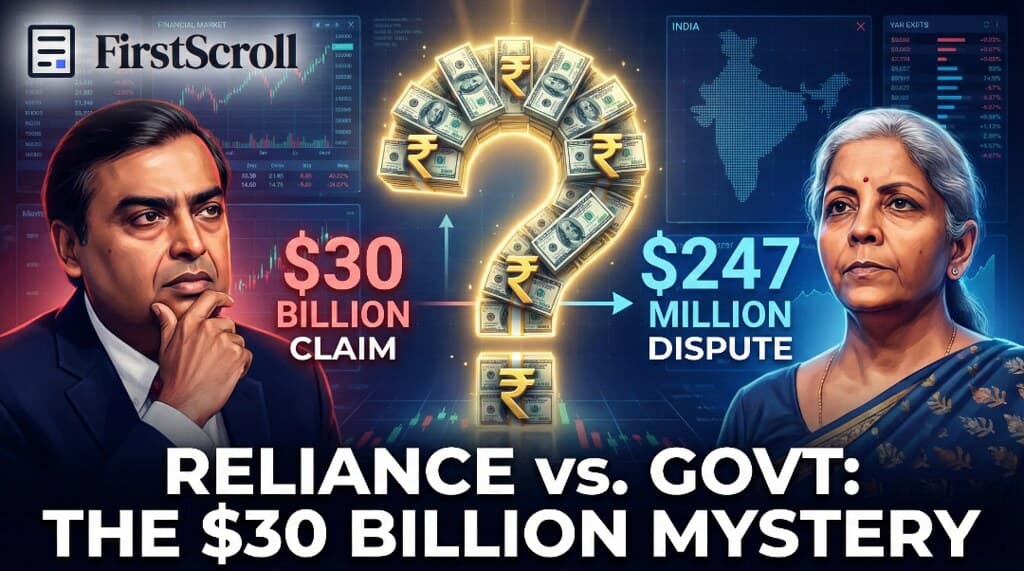
Yesterday, markets were jolted by reports claiming the Indian government is seeking nearly $30 billion (around ₹2.5 lakh crore) from Reliance and its partner BP.
The allegation is simple but explosive: gas production from the KG-D 6 block fell far short of what was originally projected.
Reliance immediately pushed back, calling the reports “factually incorrect” and clarifying that the actual disputed amount is closer to $247 million.
Think of this gas contract like a lemonade stand partnership.
You (Reliance) pay upfront for lemons, sugar, and the stand. Before profits are shared with the landlord (the government), you are allowed to recover your costs.
The dispute is over whether Reliance spent too much building infrastructure for gas that never came out of the ground, and whether those costs should still be allowed.
This is not a minor accounting mismatch.
The difference between the government’s reported claim and Reliance’s admitted exposure is massive. According to initial reports surfaced by Reuters, the government believes mismanagement and under-drilling led to the production shortfall.
Reliance’s response is blunt: geology does not follow spreadsheets. Gas reservoirs behave unpredictably, and production targets cannot be enforced if the gas simply is not there.
The difference is over 12,000 percent. $30 billion is nearly equal to the entire market value of Maruti Suzuki.
1. Market sentiment takes a hit
Reliance is the single largest weight in Indian indices. Any uncertainty around its liabilities rattles markets immediately.
2. Energy security concerns
India imports over 85 percent of its oil and nearly half of its gas. If regulatory risk looks retroactive and unpredictable, future exploration investment could slow down.
3. Arbitration over optics
This dispute has been in arbitration for years. Floating a headline figure this large ahead of a likely award raises questions about negotiation tactics versus real expectations.
Is the government actually expecting $30 billion?
Highly unlikely.
In high-stakes arbitration, opening with the biggest possible number is often strategic. It leaves room for settlement while strengthening negotiating leverage.
Unfortunately, for retail investors, even negotiation headlines cause real damage to portfolios.
The matter remains under arbitration, with an outcome expected sometime next year.
Until clarity emerges, Reliance stock is likely to remain sensitive to headlines rather than fundamentals.
The Bottom Line: Whether the final number is $30 billion or $247 million, this episode is a reminder that regulatory risk in India’s energy sector has not disappeared.
Fun fact: The KG-D 6 block was once India’s largest gas discovery in 2002. It was expected to transform domestic energy production. Instead, it has become one of the longest-running legal battles in Indian corporate history.
If markets stress you out, you are not alone.
That is exactly why we built First Scroll. It is a daily, five minute, mobile first finance read that explains what happened, why it matters, and what to remember without hype or panic.
Subscribe to First ScrollSources: Reuters | Economic Times | Mint | Business Today