The "Ghost" in the ATM
Imagine you are in a village called Mukhwa, nestled high in the Himalayas or tucked away in the dusty plains of Vidarbha. You need ₹2,000 to buy seeds for the next harvest. In the city, this is a 30-second UPI transaction or a quick stroll to a neon-lit ATM.
But in Mukhwa, the nearest "real" bank branch is a three-hour bus ride away. The bus only comes twice a day. The ATM at the bus stand is usually "Out of Cash" or "Under Maintenance." For the 190 million rural households in India, banking isn't a convenience it’s a quest.
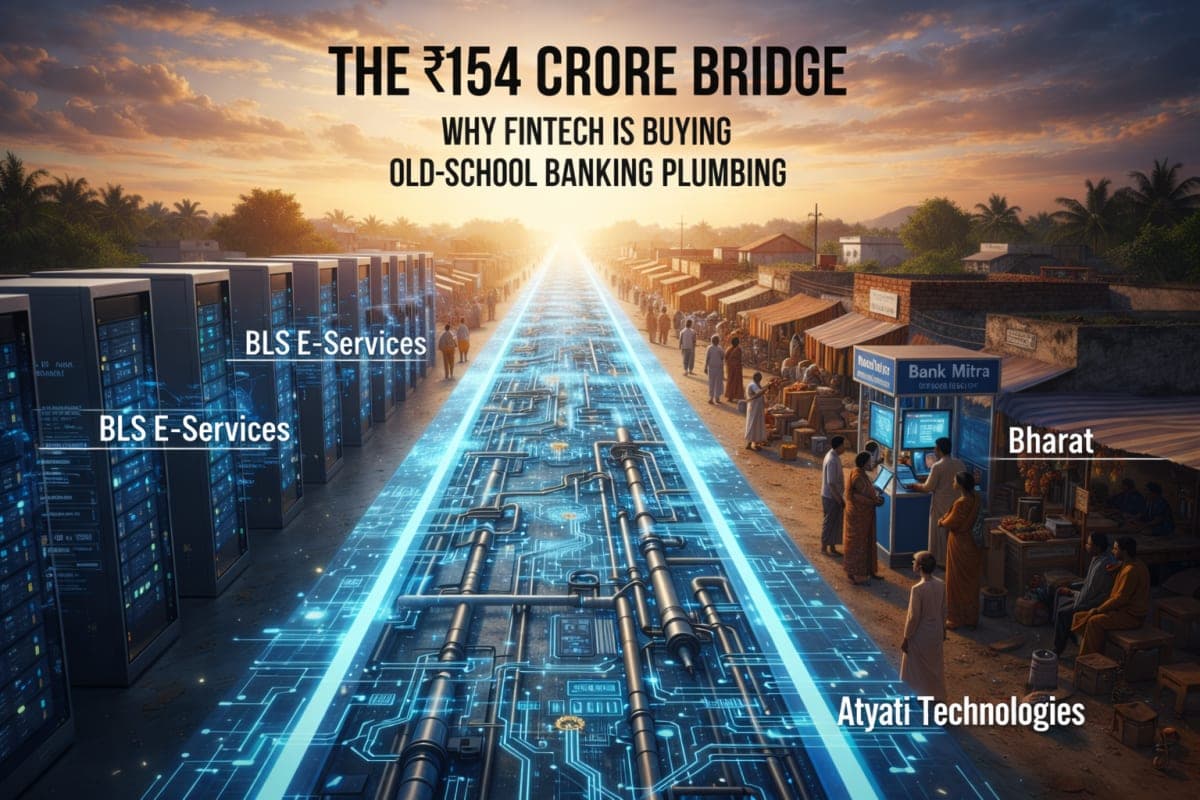
Enter the Bank Mitra (the "Bank Friend"). This is usually a local shopkeeper who holds a small biometric device. You press your thumb on a scanner, and like magic, he hands you cash from his own drawer. Behind that small shopkeeper stands a mountain of technology.
This week, BLS E-Services the digital arm of the massive BLS group spent ₹154 crore to buy a huge chunk of that mountain: Atyati Technologies.
Part 1: The "Unsexy" Business of Plumbing
In the flashy world of fintech, we usually celebrate the "Decorators." These are the apps with smooth animations, celebrity brand ambassadors, and "Scan & Pay" stickers on every street corner.
But BLS E-Services is interested in the "Plumbers."
Atyati Technologies is a veteran in this space. Founded in 2006, it didn't chase the "cool" city crowd. Instead, it went where the internet was patchy and the roads were dirt. They built a platform called Ganaseva.
Think of Ganaseva as a universal translator. On one side, you have the "Old Giants" Public Sector Banks (PSBs) like SBI, Central Bank of India, and UCO Bank. Their systems are massive, secure, and... let's face it, a bit old-fashioned. On the other side, you have millions of villagers who need micro-loans, insurance, and pensions.
Atyati’s tech allows these two worlds to talk to each other in real-time. By acquiring Atyati, BLS didn't just buy a company; they bought the exclusive rights to the conversation.
Part 2: The Math of the Deal (Why ₹154 Crore?)
You might wonder: Is ₹154 crore a lot for a rural tech company?
Let’s look at the numbers. In FY25, Atyati reported a revenue of ₹395.6 crore. This wasn't a one-hit wonder; they’ve been growing steadily from ₹312 crore just two years ago.
But the real value isn't just in the revenue; it’s in the "Boots on the Ground."
- BLS Pre-Acquisition: ~46,000 touchpoints.
- Atyati’s Contribution: 25,900+ Bank Mitras across 27 states.
- The New Reality: A combined force of over 70,000 touchpoints.
In the business of "Financial Inclusion," your strength is measured by how many pin codes you own. With this deal, BLS has effectively "carpet-bombed" rural India with their service points. If a villager wants to interact with a bank, there is now a much higher chance they will have to walk through a BLS-owned portal.
Part 3: From "Delivery Boy" to "Decision Maker"
This is the part that makes investors curious. For years, companies like BLS were just "Business Correspondents." They were essentially the delivery boys for banks. The bank would say, "Go give this guy ₹5,000," and the agent would get a tiny commission.
Atyati changes the game because of its Lending Tech.
Atyati manages an active lending book of over ₹1,000 crore. They don't just hand out cash; they use AI and data analytics (their "Ganak" system) to decide who should get a loan.
- They look at how many times a farmer has withdrawn money.
- They analyze his government subsidy (DBT) history.
- they look at his crop insurance patterns.
The "Aha!" Moment: By owning this tech, BLS moves up the food chain. They are no longer just earning a few rupees for a withdrawal. They are now in the business of "Credit Underwriting." In the financial world, the person who decides who gets the loan always makes more money than the person who just hands it over.
Part 4: The "PSB Alliance" , The Ultimate Fortress
Here is a bit of "insider" knowledge: Atyati is a mandated partner for the PSB Alliance.
What is that? It’s a group of all Public Sector Banks in India that have teamed up to provide "Doorstep Banking." Imagine you are an elderly pensioner in a remote village. You can’t walk to the bank. Under this alliance, the bank comes to you.
By acquiring Atyati, BLS has secured a seat at a very exclusive table. They are now the preferred partner for the biggest banks in India. This isn't just a contract; it’s a moat. It is incredibly difficult for a new startup to walk in and say, "Hey SBI, let us handle your rural banking instead of these guys who have been doing it for 20 years."
Part 5: The "Bharat" vs. "India" Paradox
We often hear that "India is the next superpower." But which India?
- India 1: The top 10% who use iPhones and trade on Nifty 50.
- India 2 (Bharat): The 60% who live in rural areas and are just now getting their first "smart" financial products.
The "India 1" market is saturated. Every bank and fintech app is fighting for the same guy in Bangalore or Mumbai. But "Bharat" is a wide-open ocean.
The RBI’s Financial Inclusion Index has jumped to 67.0 in 2025. More people have bank accounts than ever before, but and here is the kicker most of those accounts are dormant. People have the account, but they don't know how to use it for anything other than withdrawing government cash.
BLS is betting ₹154 crore that they can be the ones to "wake up" these accounts. They want to sell them insurance, give them micro-loans for their tractors, and help them invest their small savings.
Part 6: Is it All Sunshine and Rainbows? (The Risks)
No deep dive is complete without looking at the dark clouds. There are three big risks BLS has to manage:
- The "Margin Squeeze": The RBI is constantly watching commissions. If the regulator decides that brokers and agents are charging too much, the margins could shrink overnight.
- The Provisioning Trap: Rural lending is risky. If a drought hits or a crop cycle fails, those ₹1,000 crore in loans can turn into "Bad Loans" (NPAs) very quickly. In fact, Atyati recently faced some downgrades because of higher-than-expected provisioning.
- The Reputational Shadow: BLS International (the parent group) has faced some hurdles with government contracts recently. While BLS E-Services is a separate entity, in the world of finance, the "Family Name" matters.
The Final Scroll: Why This Matters to You
You might not live in a village. You might never use a Bank Mitra. But this deal matters because it shows where the real money is moving in 2026.
It’s no longer about who has the prettiest app. It’s about who has the hardest-to-build infrastructure. BLS E-Services isn't just buying a company; they are buying a bridge. On one side of the bridge is the massive, untapped wealth of rural India. On the other side is the formal banking system. BLS is now the toll-collector on that bridge.
As they say in the village: "Kuan paas nahi aayega, pyase ko hi kuan tak jaana padega" (The well won't come to you; the thirsty must go to the well).
With Atyati, BLS has just bought the best map to the well.
Fact-Check: The "Knowledge" Nuggets
- The Buyer: BLS E-Services (Listed on NSE/BSE).
- The Target: Atyati Technologies (Bengaluru-based, founded 2006).
- The Price Tag: ₹154 Crore (All-cash).
- The Tech: Ganaseva (Banking) and Ganak (Lending).
- The Impact: Creates one of India's largest rural financial service networks with 70,000+ points.