The return of one man to an office in California just added trillions of dollars to global markets, proving that in the age of AI, a single CEO matters more to your portfolio than any central bank decision.
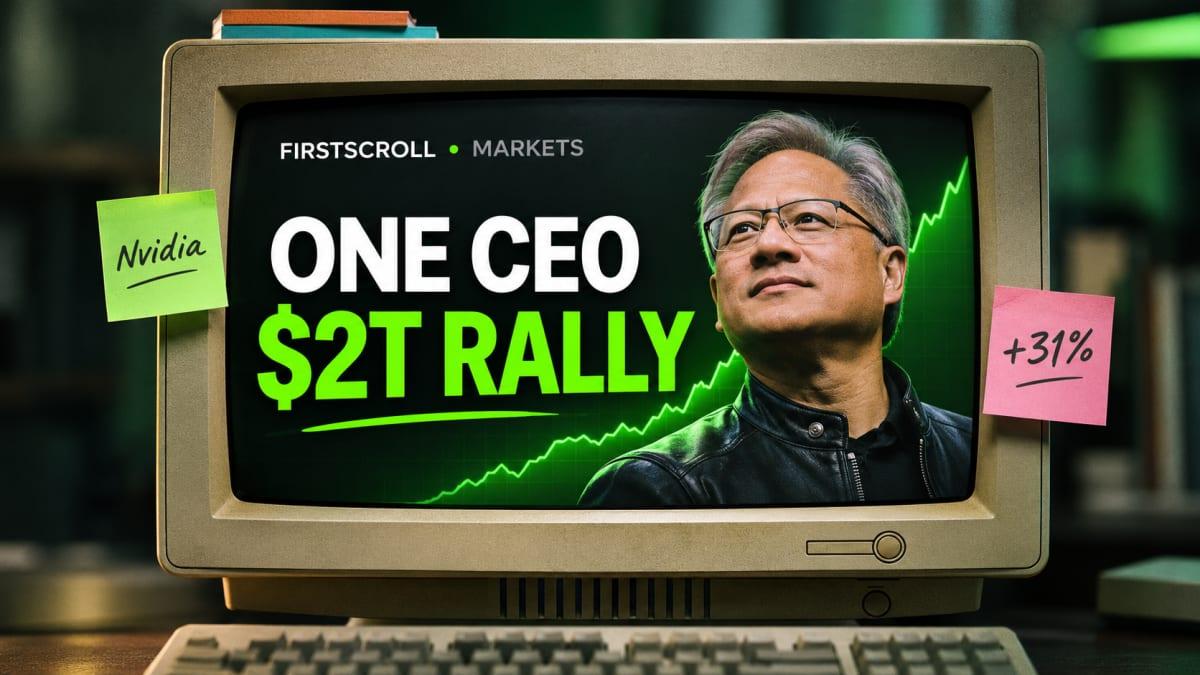
Nvidia’s board reinstated Jensen Huang as CEO on 23 November 2026, causing the company’s shares to surge 31% in a single day. Investors believe his leadership is so essential to the artificial intelligence boom that his return effectively ended a global market crash that had wiped out massive value just a week earlier.
The Story
Last week, the global stock market looked like a building with the foundations ripped out. The Nasdaq 100 had just suffered a 10% drop in value, its worst decline since the pandemic panic of March 2020.
The reason for the chaos was simple. Jensen Huang, the co-founder and face of Nvidia, had resigned on 12 November following reports of personal scandals and potential national security concerns. Without him, the company that provides the chips for the entire AI industry seemed rudderless.
For eleven days, the market held its breath. Nvidia shares had lost 23% of their value in just one week as investors questioned if the AI boom could survive without its chief architect. The fear was so high that a gauge of market volatility rose above 40 for the first time since April 2025.
Then, the White House intervened. President Donald Trump pushed for Huang's return, claiming he was a protector of AI models and that his reinstatement posed no risk to national security. By Monday, the board had reversed its decision, and Huang was back in the corner office.
And here is the strange part. On the news of his return, Nvidia’s stock price jumped so high that it nearly wiped out the entire month's losses in just a few hours of trading. It was as if the market had forgotten every other economic problem, from interest rates to inflation.
So here's the question: if Nvidia is a massive corporation with thousands of engineers, why did the return of one person single-handedly rescue the global stock market?
What happens when the face of AI goes missing?
You see, the problem is not just about who runs a company. It is about a concept professional investors call Key Man Risk, where the value of a giant business is tied almost entirely to the reputation of one individual.
Think of Nvidia as a world famous restaurant where everyone is dining because of one master chef. If that chef leaves the kitchen, the customers do not care how many assistant cooks are left: they stop believing the food will taste the same, and they stop booking tables.
Nvidia has become the primary supplier of chips for every major tech firm. Because of this, it acts as the sun in the center of the technology solar system. If the sun flickers, every other planet: from Microsoft to small startups: starts to freeze. This is why some wonder is the AI boom making index funds too risky given how much depends on just one firm.
When Huang left, it poured petrol on an already volatile market. Traders were already worried about high valuations, and losing the man who moved the dial on sentiment across the sector was the breaking point. His return did not just fix Nvidia; it took the heat out of the entire global market.
So who wants what here? The investors want stability to protect their savings. The Nvidia employees, over 180,000 of whom signed a petition for his return, want the visionary who built the company. And the US government? It wants to ensure the leader of its most critical technology remains at the helm.
This is where the power of a figurehead comes in. In the modern era, a CEO’s "vibe" can be more influential than a bank's balance sheet. According to data from the session on 23 November, the rebound was massive across the board.
| Market Asset | Performance on 23 Nov 2026 | Previous Week Context |
|---|---|---|
| Nvidia Shares | 31% surge | 23% loss |
| Nasdaq 100 | 6.5% rise | 10% drop |
| S&P 500 | 4.7% rise | Global selloff |
| Taiwan ETF (MSCI) | 18% surge | Worst week since 1990 |
Now, you might think this is just a US story, so why should you care? Because Nvidia’s health dictates the mood for global tech. When the "AI bellwether" falls, it triggers a chain reaction that hits everything from European stocks to Asian chipmakers. Earlier this month, we saw why big tech's AI spending is tanking stocks when results don't meet the hype, and Huang’s absence made those fears ten times worse.
Why did the White House step in for a CEO?
But here's the twist. This was not a standard corporate hire. The Nvidia board had actually rejected Huang's offer to return just six days before they finally reinstated him. They only changed their minds after receiving input from senior levels of the US government.
While the board says they are satisfied with Huang’s candour, they are still running an investigation into foreign intelligence efforts targeting him. They are even searching for a chief compliance officer to watch over things. This suggests the "return" is more of a supervised comeback than a complete exoneration.
The speed of the reversal also created a financial wrecking ball for people betting against the company. Investors using leveraged funds that pay out when Nvidia falls saw their investments plunge by 73% to 92% in a single day. In total, those betting against the stock faced a $12.2 billion paper loss.
Now to be clear, the fundamental business of making chips did not change between Friday and Monday. Nvidia still makes the same hardware. The only thing that changed was the name on the CEO's door, which was enough to add over $2 trillion in market value to the Nasdaq-100 index.
So, is the market rally about business growth? Not really. It is about the relief of a market that realized it is not ready to imagine a future without its AI figurehead. The "Key Man Risk" has not gone away; it has just been confirmed.
The next thing to watch will be the internal board investigations. While the stock is soaring today, the company now has a new National Security and Export Control Committee watching its every move. The market got its chef back, but the kitchen has never been under more scrutiny.
If this helped the Nvidia market rally make sense, share it with a friend on WhatsApp, LinkedIn, or X. You might also enjoy our story on is the AI boom making index funds too risky.