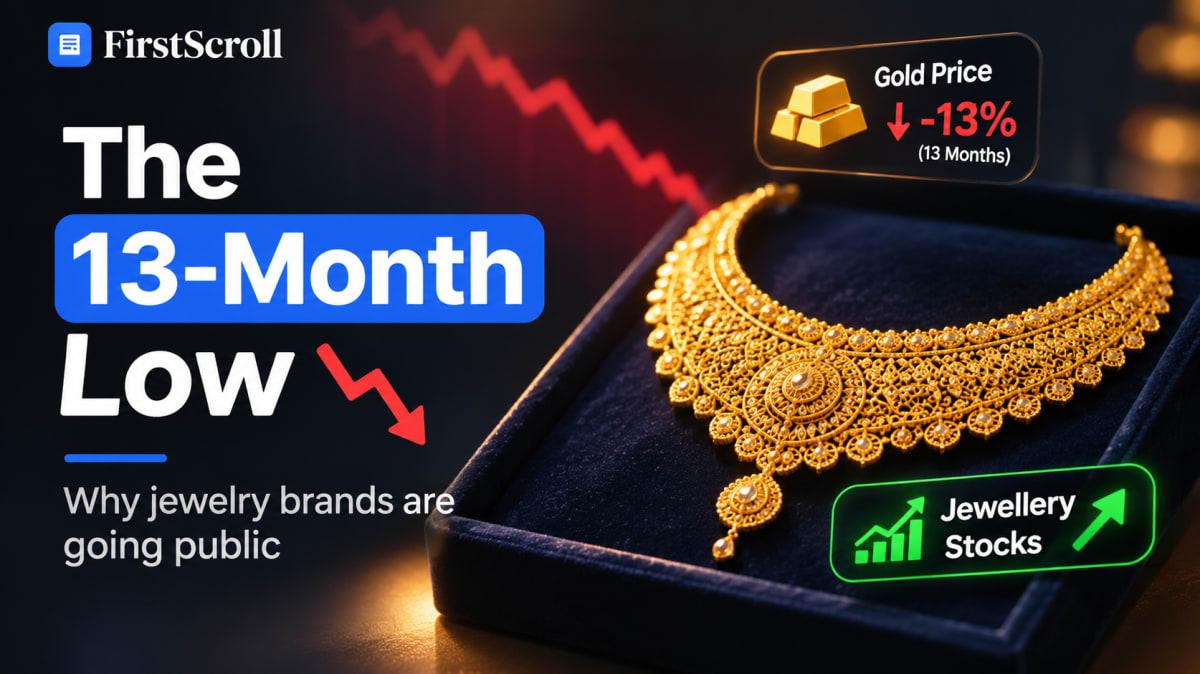
When global gold prices take a tumble, Indian jewellery stores often see their busiest queues of the year, turning a market crash into a retail gold rush.
The short answer: While global gold prices hit a more-than-one-year low this week, Indian jewellery companies are rushing to go public. Lower prices during wedding season trigger a surge in consumer demand, forcing manufacturers to raise growth capital to stock more inventory for a hungry market.
The Story
On Thursday, investors in the global bullion markets hit the exit button. Within a single trading session, gold prices slid by 3% as fears of higher interest rates in the US took hold.
By the time the dust settled, spot gold was trading near $3,879.71 per ounce. For international traders, this looked like a disaster. It was the metal's worst weekly drop since June.
But while the world saw a selloff, Indian jewellery manufacturers saw an opportunity. For these companies, a price crash is not a signal to hide: it is a signal to expand.
In the last two months alone, at least 10 mid-sized jewellery firms have filed their initial papers with SEBI to tap the stock market. The list includes names like Arjun Jewellers, Sunil Gold, and Royal Chains.
And here is the strange part. These companies are reporting growth numbers that look like they belong to tech startups rather than traditional goldsmiths.
For instance, Tanvi Exports registered a revenue compound annual growth rate (CAGR) of 188 per cent between FY24 and FY26. Sunil Gold followed closely with a 106 per cent growth rate in the same period.
So here's the question: if gold prices are falling and the global market is nervous, why are Indian jewellery companies rushing to the stock market to grow?
Why are jewellery stocks rising when gold prices fall?
You see, the relationship between an Indian jeweller and the price of gold is not what you might expect. Most of these companies are not speculators who bet on the price going up: they are manufacturers who earn on volume.
Think of a jewellery company as a massive kitchen. Gold is the flour. When the price of flour drops, the baker can sell more cakes to more people because the final product is suddenly affordable.
In India, gold is what we call price sensitive. As soon as the price dips, families who were waiting for the wedding season rush to lock in their purchases. This creates a massive spike in demand that far outweighs the loss in value of the gold already sitting in the vault.
Now add the second ingredient: the wedding season. In India, demand for 22-karat and 18-karat jewellery is largely non-negotiable for ceremonies.
When global gold prices dropped about 4.5% this week, it acted like a nationwide discount coupon for millions of households. You can learn more about this connection in our look at why US hiring makes gold prices fall.
So who wants what here? The consumer wants the most heavy set of bangles they can get for their budget. The jeweller wants to sell as many grams as possible while the price is low.
But this volume comes with a catch. To sell more gold, you must first buy more gold.
This is where the IPO rush comes in. Jewellery manufacturing is incredibly capital intensive. To keep their stores and wholesale networks stocked with 14-karat and 22-karat chains, these companies need huge amounts of working capital.
Raising money through an IPO allows them to buy bullion, maintain inventory across cities, and expand into tier-II and tier-III towns where demand is currently booming. It is also part of a larger shift as the industry moves from unorganised local shops to branded, formal players.
Now, global prices are one thing, but why should the average investor care? Because the sheer scale of this rush is unprecedented. Between January and October, eight jewellery companies raised about ₹3,547 crore from the secondary market.
Can the boom handle the interest rate pressure?
But here's the twist. The same force that is making gold cheaper is also making borrowing more expensive.
Gold prices are falling because the US Federal Reserve is expected to keep interest rates high. Markets currently see a 91.4% chance of a rate hike in December.
When interest rates go up, gold usually loses its shine because it does not pay any interest or dividends. It makes "safe" investments like US government bonds more attractive by comparison.
For Indian jewellers, this is a double edged sword. While it keeps the raw material price low for consumers, it also means the cost of debt for the companies could stay high. This is precisely why they are looking for equity capital through the stock market instead of taking more bank loans.
Now to be clear, the road is not entirely smooth. While companies like Kataria Dhulchand Pannalal Jewellers have logged a revenue CAGR of 77 per cent, the government often tries to control this demand.
High import duties are a tool the government uses to curb how much gold India buys from abroad. If these duties are hiked to manage the trade deficit, it could make jewellery expensive again, even if global prices stay low.
So, is the jewellery boom about the value of gold? Not really. It is about a massive shift in how Indians buy jewellery and a manufacturing sector that finally has the appetite to go global.
The next thing to watch is how many of these 10 IPO filings get the green light from SEBI. If the trend continues, the jewellery sector might soon become one of the most crowded corners of the Indian stock market. You might also want to read about why the RBI is cracking down on India's gold loan surge to see the other side of the gold economy.
If this helped the gold price paradox make sense, share it with a friend on WhatsApp, LinkedIn, or X. You might also enjoy our story on why Indian mutual funds are blocking bulk gold ETF buys.