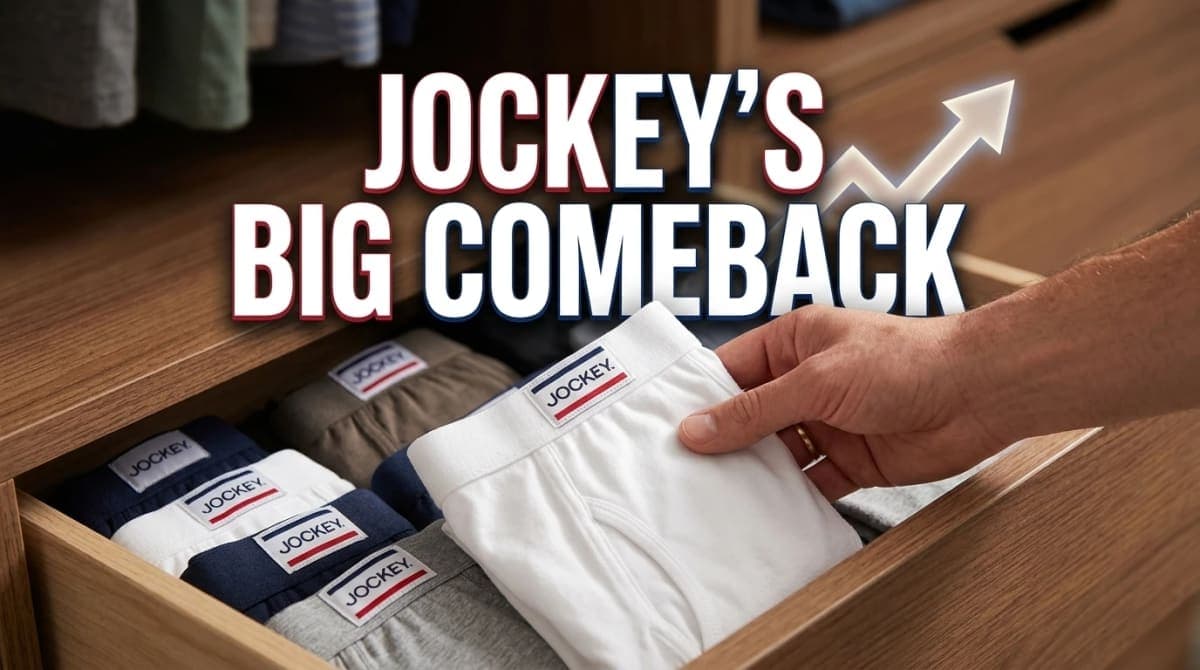
Open your wardrobe. Chances are, there's a Jockey label somewhere in there.
Maybe it's your everyday innerwear. Maybe it's a pair of track pants. Maybe it's what your kid wears to school. You probably didn't overthink the purchase. You just grabbed it because it was Jockey and Jockey is just... what people buy.
That's not a small thing. Getting millions of Indians to reach for your product on instinct, without comparing prices or reading reviews, is one of the hardest things a brand can achieve. It takes years. Sometimes decades.
The company behind Jockey in India is called Page Industries. And for most of its life, it was a dream investment growing fast, dominant in its category, and beloved by the stock market. At its peak, one share of Page Industries cost over ₹50,000.
But lately? The story hasn't been so clean.
Sales growth slowed. Retailers started looking elsewhere. Distributors felt the deal wasn't worth it anymore. The stock fell all the way down to around ₹29,000–₹30,000 at its worst.
So what exactly happened? Why does a brand this strong stumble? And more importantly is it recovering?
Let's find out.
A Quick Lesson: What Is a "Licence Business"?
Before we get into the drama, it helps to understand how Page Industries actually works because it's not your typical company.
Page doesn't own the Jockey brand. It licences it.
Think of it like a franchise. McDonald's lets someone run a restaurant using the McDonald's name, recipes, and systems in exchange for fees and strict rules. Page Industries has a similar arrangement with Jockey International, the American company that owns the brand.
Page has the exclusive licence to make and sell Jockey products across India, Sri Lanka, Bangladesh, Nepal, and parts of the Middle East. It also holds the licence for Speedo the swimwear brand in India.
The Genomal family, which runs Page, has been associated with Jockey International for over 50 years. When Jockey wanted to enter India, they didn't run a big tender or hire consultants. They called the family they'd trusted for decades. That long relationship is the foundation of everything Page Industries is built on.
How Page Built a ₹50,000 Stock
From 2009 to 2019, Page Industries grew its revenues at a compounded rate of 27% every single year. That's extraordinary. Most good companies are happy with 12–15%.
It became the number one brand in men's innerwear in India. Then number one in women's innerwear. Then a top player in athleisure those comfortable, casual clothes you wear both for workouts and for hanging around the house.
By the time the party was in full swing, Page had captured nearly 40% of the organised innerwear market in India. That means out of every ₹100 spent on branded innerwear in the country, ₹40 went to Jockey.
Here's a lesson: The innerwear market has a unique psychology. People are creatures of habit when it comes to what they wear next to their skin. Once a brand earns that trust, it tends to keep it unless it does something to break it. Page exploited this beautifully for years, growing through aspiration (making Jockey feel premium), distribution (putting it in every city, town and neighbourhood), and pricing (affordable enough for the middle class but aspirational enough to feel special).
When the Growth Engine Started Sputtering
Then things got complicated.
Competition showed up. In men's innerwear, Van Heusen launched an aggressive push and gave Jockey a real fight for the first time. In women's innerwear, a wave of new-age online brands started taking share brands designed specifically for women, with better fitting options and digital-first marketing. The economy segment lower-priced innerwear for price-sensitive buyers is a space Page doesn't really compete in, which means a huge chunk of the market wasn't growing in its favour.
But here's the part that doesn't get discussed enough: the bigger problem wasn't competition. It was Page's own internal distribution system quietly breaking down.
The Hidden Problem: The People Who Sell Your Jockey Were Unhappy
To understand this, you need to understand how products actually reach you.
A quick lesson on how retail distribution works:
When Page makes a pair of Jockey underwear in its factory, it doesn't sell it directly to you. It goes through a chain: Factory → Distributor → Retailer → You.
The distributor is a businessman who buys large volumes of products from Page, stores them in a warehouse, and supplies them to local shops. The retailer is the shopkeeper who sells to you directly.
Both of these people the distributor and the retailer are not employees of Page. They're independent businesspeople. They can choose which brands to push, which to stock prominently, and which to quietly sideline in favour of whoever pays them better.
This is why how a company treats its distributors and retailers matters enormously. If they're happy and making good money, they push your product. If they're not, they start pushing your competitor's instead.
At Page Industries, both groups had quietly become unhappy.
The Incentive Structure That Was Killing Motivation
Page had a special tier for its best retail partners called "Elite Partners" shops that sold over ₹2 million worth of Jockey products in a year.
Sounds like a great recognition programme. But here was the catch.
If a retailer hit 79% of their annual sales target, they got zero incentive. Nothing. The scheme was all-or-nothing you hit the exact threshold, or you got nothing at all for the entire year.
Imagine working hard all year, giving Jockey the best shelf space in your shop, pushing the brand to every customer and then falling just short of the target line and getting no reward. How would you feel?
That's exactly how retailers felt. They started reducing Jockey's shelf space. They started recommending competitor brands. The motivation to go the extra mile simply wasn't there anymore.
Here's the lesson: In business, how you design incentives shapes how people behave. A badly designed incentive system even in a company with a great product can slowly poison the entire sales engine. Page's system was punishing near-success, which is one of the worst things you can do.
Mid-tier retailers had it even worse. There was no clear path for them to become Elite Partners. No visible upgrade route. So why bother trying harder?
The Fix: Rebuilding From the Ground Up
Here's where the story turns.
Market experts who track this sector closely went out and spoke to retailers and distributors on the ground. Not just studied spreadsheets actually talked to people. And what they found was that Page Industries has recognised the problem and is actively fixing it.
What changed for retailers:
Page has moved to a "slab-based" or "laddered" incentive structure. Instead of a cliff-edge where you either clear the target or get nothing, retailers now start earning commissions from 80% of target achievement. Hit 80%? You earn 4%. Hit 100%? You earn 7%.
This is a fundamentally different philosophy: partial success deserves a reward. It keeps retailers engaged throughout the year, not just in the final sprint to a single threshold.
The same tiered structure has been extended to mid-tier retailers too those generating ₹1 to ₹2 million annually. They now have a clear, visible pathway to move up into the Elite category over time. That's a powerful motivator. It says: grow with us, and we'll grow with you.
What changed for distributors:
Page has increased distributor commissions by around 1% small in percentage terms, but meaningful to someone running a distribution business on thin margins. They've also introduced monthly milestone bonuses. For example, in a specific product category, if a distributor hits 40% of their monthly target by the second week of the month, they earn a bonus of 0.25% over their regular rate.
Again, small numbers. But incentives don't have to be large to change behaviour. They just have to be well-designed.
Page has also opened up access to promotional products like limited seasonal items that were previously only available through Jockey's own stores. Now distributors can stock and sell these too, provided they've hit their quarterly targets. This levels the playing field and gives distributors a stronger reason to perform.
The lesson here: Fixing a distribution problem isn't glamorous. It's not a new product launch or a flashy marketing campaign. It's quietly redesigning the rules so that the hundreds of thousands of people who sell your product every day feel it's worth their while to keep doing it. But the impact, when done right, is enormous.
The Price Hike That Was Four Years Overdue
Here's a stat that will surprise you: Page Industries had not raised its prices in four years.
Think about that for a moment. In four years, cotton prices went up. Labour costs went up. Logistics got more expensive. Energy bills rose. Page absorbed all of it and kept prices flat.
Why? Probably to stay competitive, to keep volume growing, and to avoid giving rivals any pricing advantage. But eventually, something has to give.
In early 2026, Page finally started raising prices. Market feedback confirms these hikes are already being implemented. Current prices are about 4–6% higher than they were just a few quarters ago.
The remarkable thing? Sales haven't dropped. Customers are still buying at the same pace. This tells you something important: Jockey has real pricing power. People trust the brand enough that a modest price increase doesn't send them to a competitor.
Here's a lesson: Pricing power is one of the most valuable things a company can have. Warren Buffett perhaps the world's most famous investor has said he looks for businesses that can raise prices without losing customers. Most companies can't do that. Jockey, it appears, can.
If prices stay at current levels and volume grows even modestly at around 2% a year, revenue growth for the next few quarters is expected to be around 6–8% annually and that's without accounting for any further price hikes.
Let's Talk Numbers (Simply)
Here's where things stand financially, in plain language.
Page Industries earned revenues of about ₹4,935 crore in FY25. (We're switching to crores it's easier for most Indian readers.) That's expected to grow to around ₹5,257 crore in FY26, then ₹6,052 crore in FY27, and ₹6,776 crore in FY28. So over three years, the business is expected to grow by about 37%.
Profit was ₹729 crore in FY25. That's expected to climb to ₹803 crore in FY26, ₹909 crore in FY27, and ₹1,005 crore in FY28.
What does this mean for the stock?
The current share price is around ₹36,980. Analysts tracking the stock estimate a fair value of ₹45,063 roughly 22% higher than where it trades today. That estimate is based on expected earnings in FY28 and a valuation multiple that the market has historically been willing to pay for a business of this quality.
A lesson on how stocks are valued:
Most stocks are valued using something called the Price-to-Earnings (P/E) ratio. It answers a simple question: how many years' worth of profits are you paying for when you buy a share?
At a P/E of 50, you're paying 50 times the annual earnings. That sounds expensive and it is, compared to many companies. But premium businesses with strong brands, no debt, and predictable growth often command high valuations because investors trust the earnings to keep growing. Page has historically traded at these elevated multiples, and unless the brand fundamentally breaks down, it likely will continue to do so.
Other financial highlights worth knowing: Page has zero debt. None. In a world where many companies are drowning in loans, Page is sitting on cash. By FY28, it's expected to have nearly ₹1,672 crore in cash on its books. Return on equity a measure of how efficiently it uses shareholder money is above 47%. That's exceptional by any standard.
But Here's What Could Go Wrong
No good article ends without a fair look at the risks. And there are real ones.
Raw material costs are a problem. About 80% of what Page spends on making its products goes toward cotton and synthetic materials. As of March 2026, cotton prices are up 8% compared to a year ago. A synthetic material called PTA used in fabrics like polyester is up 51%. If these prices stay high, they could eat significantly into Page's profit margins.
Marketing spending is rising. Page plans to spend more on advertising up to 4–5% of revenues. This is smart for the long term; brands need to keep investing in themselves. But in the short term, higher costs without immediate matching revenue growth squeezes margins.
Competition is structural, not temporary. Van Heusen won't disappear. Online women's wear brands are getting more sophisticated, not less. Page's deliberate choice to stay out of the economy (budget) segment means a large share of India's innerwear market is simply not available to it. That's a real ceiling on growth.
The Bigger Picture
Here's what this story is really about.
Page Industries is not a broken company. It's a great company that stumbled not because its product became bad, not because people stopped wanting Jockey, but because the business mechanics that delivered the product to consumers quietly got out of alignment.
The distribution network the invisible machinery of distributors and retailers that gets Jockey from factory to your drawer lost motivation. The incentives were poorly designed. Distributors felt squeezed. Retailers felt unrecognised.
And now, management is fixing it. Methodically. Without flashy announcements. The kind of quiet, operational work that doesn't make for exciting headlines but genuinely moves businesses forward.
The financial fundamentals zero debt, strong cash flows, high return on equity, real pricing power never went away. They were always there, waiting for the operational reset to kick in.
The final lesson: Great brands create loyal customers. But companies also need to create loyal partners the distributors and retailers who carry the brand the last mile to the customer. When that chain breaks down, even the most loved brand can underperform. And when it's fixed, the recovery can be significant.
The brand in your underwear drawer is quietly rebuilding its engine.
Whether it fires up the way analysts expect over the next 12–24 months that's the question investors are now betting on.