In today's FirstScroll, we break down why a scheme built to sell cheap generic medicines is suddenly competing with your favourite skincare brand, and what it reveals about how skincare is priced.
With that out of the way, let's dive into today's story.
The Story
Somewhere in your city is a small shop with a red and white board that reads Jan Aushadhi Kendra. You've probably walked past it a hundred times. It's where the government sells generic medicines at a fraction of branded prices: blood pressure pills, diabetes drugs, antibiotics. Sensible, unglamorous, life-saving stuff.
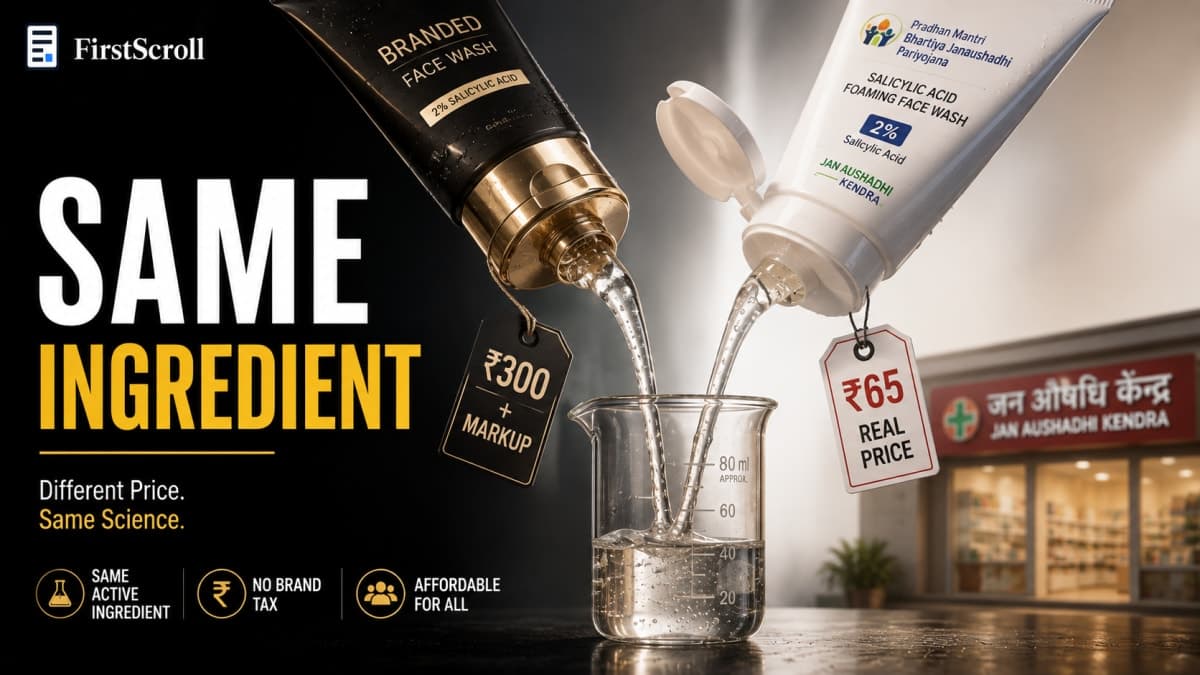
Now look at what just appeared on its shelves: a salicylic acid foaming face wash. For acne. In two strengths.
The government of India, it turns out, has entered the skincare chat. Under the Pradhan Mantri Bhartiya Janaushadhi Pariyojana, the 1% salicylic acid face wash is priced at ₹46.88 and the 2% version at ₹65.63. Comparable branded products with the same active ingredient typically sell for ₹150 to ₹300.
So the question is, why is a government medicine scheme selling face wash, and how can it charge a third of what brands do for the same ingredient?
Start with the second half, because it explains the first. Salicylic acid is not a secret. It's a decades-old, dermatologist-recommended molecule that unclogs pores and manages acne, and it's cheap to manufacture. When you pay ₹300 for a branded face wash, you're mostly not paying for the acid. You're paying for the influencer campaigns, the packaging, the retailer's cut, and the brand's margin stacked on top of a modest manufacturing cost.
This is the exact insight Jan Aushadhi was built on, just applied to medicine first. A branded drug and its generic twin contain the same molecule. The price gap is branding and distribution, not chemistry. The scheme's whole model is to strip those layers out: no advertising budget, no retail markups, just a network of more than 16,000 Kendras selling at close to cost. That model has quietly become a real business, with the scheme's annual sales growing from ₹12 crore in 2015-16 to over ₹2,200 crore by 2024-25.
Skincare is simply the next aisle where the same trick works. India's skincare market has exploded on the back of "actives", ingredients like salicylic acid, niacinamide and vitamin C that customers now recognise by name. But here's the thing about ingredient-literate customers: once you've learned to read the label, the label starts competing with the brand. Jan Aushadhi is betting that a customer who knows what 2% salicylic acid does will happily buy it for ₹65 without the fancy bottle.
The incentives are worth a look too. For the government, this is politics at its cheapest: visible, daily-life affordability with a tiny outlay. For the Kendras, which are run by private operators, fast-moving personal care products bring footfall that medicine alone doesn't. And the earlier launch of a ₹50 moisturising cream suggests this is a deliberate product line, not a one-off.
But there's a twist here. The scheme's superpower, no marketing, is also its ceiling. Skincare is a category where trust is manufactured through marketing, and where "cheap" can read as a warning rather than a bargain on something you apply to your face. Jan Aushadhi's medicines fought the same perception battle for years against a pharma industry that whispered about quality. Face wash will face the same whisper, minus the prescription that forces the trial.
And there's a fair question underneath: should a medicine access scheme spend its shelf space and credibility on cosmetics at all? Officials frame it as moving from curative care toward broader wellness. Critics would call it mission creep. Both can be true.
Either way, the next time a ₹300 face wash ad plays before your video, remember that the government just told you what the ingredients cost. The other ₹235 is the story you're being sold.
Whether India's most image-conscious consumer category can be disrupted by its least image-conscious retailer is something only time will tell.
Until then…
If this story helped you make sense of what you're really paying for, share it with a friend on WhatsApp, LinkedIn or X.