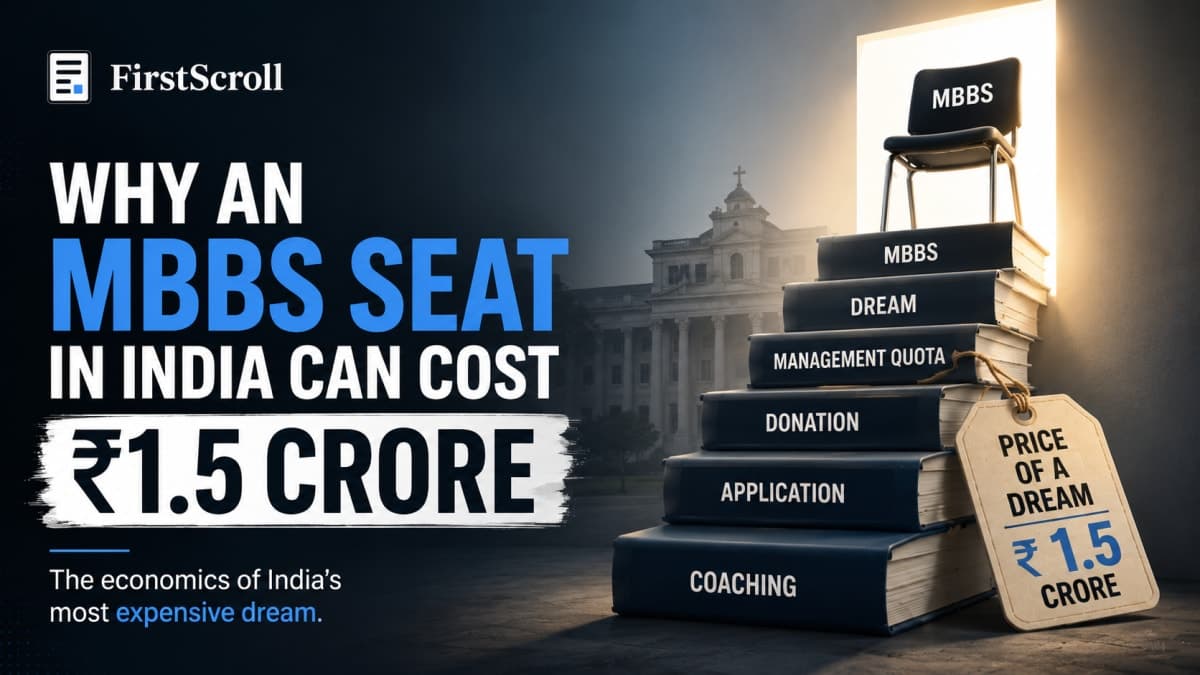
Why an MBBS seat in India can cost ₹1.5 crore
In today's FirstScroll, we look at India's medical education system as what it really is: a business. A market with too few sellers, too many desperate buyers, and a product nobody can refuse. Understand that, and the ₹1.5 crore price tag stops being shocking and starts making perfect, uncomfortable sense.
The Story
Let's start with two price tags for the exact same thing.
A student joins a government medical college. Total cost of the full MBBS degree: ₹6 to 8.5 lakh.
Another student joins a private college in Bengaluru, under what is called the management quota. The fee there is ₹20 to 27 lakh per year. The course runs five and a half years. Add hostel and food, and the family is planning for ₹1.55 to 1.65 crore.
Same syllabus. Same degree at the end. Same job afterwards.
Twenty times the price.
Now, in any normal business, this makes no sense. If your competitor sells the same thing for ₹8 lakh, you cannot charge ₹1.5 crore. Customers would simply walk away.
Unless they can't.
And that one word, "can't", explains this entire market. So let's break it down the way you'd break down any business.
Rule 1: When supply is short, the seller sets the price.
Every business has a balance between how much is available and how many people want it. Tilt that balance far enough, and the seller stops competing and starts dictating.
Here is India's tilt.
Over 20 lakh students write NEET every year. There are only about 1.2 lakh MBBS seats. And only a portion of those are the affordable government ones.
So for every student who gets a cheap seat, many more are left standing outside with a good score and nowhere to use it.
Why doesn't the government just build more colleges? Mostly money. India spends about 1.9% of GDP on public health, below the 2.5% target it set for itself in the National Health Policy 2017. Less spending means fewer government medical colleges and slower expansion.
So the government couldn't meet the demand. Private colleges stepped in to fill that gap.
And that part is not a scandal. It's a normal business response to a genuine shortage.
The problem is what happens next.
Rule 2: A customer who cannot walk away has no power.
In business, your bargaining power comes from your ability to say no.
You can refuse an overpriced phone and buy a different one. You can wait for a sale. You can go without it.
Now look at a medical seat.
You cannot compare and pick a cheaper one, because the cheap ones are already full. You cannot wait for a discount, because there are no discounts. You cannot buy a substitute, because there is no substitute for a medical degree.
And you cannot walk away, because walking away means telling a nineteen-year-old that four years of coaching, sacrifice and 4 am alarms led nowhere.
So the buyer has no leverage at all. And here's the rule that follows:
When a seller controls something scarce that buyers cannot refuse, the price stops being about what it costs to make. It becomes about how much the buyer can bear.
That is the real pricing formula in this market. Not cost plus margin. Pain plus desperation.
Rule 3: Look at how the customer pays, and you see the true cost.
Business becomes real when you look at the cash flow. So let's do the maths on that ₹1.5 crore.
Suppose a family borrows ₹1.4 crore at 10% interest over 15 years.
The EMI works out to roughly ₹1.5 lakh a month. That is about ₹18 lakh a year, every year, for fifteen years. Total repayment climbs towards ₹2.7 crore.
Now ask the obvious business question: can the customer afford this from their earnings?
Almost no fresh MBBS graduate earns anything close to ₹18 lakh a year, let alone enough to live on after paying that EMI.
Which tells you something important. These seats are not really being funded by future income. They are funded by selling land, by emptying retirement savings, by liquidating whatever a family built over generations.
In other words, the price is not set against what a doctor will earn. It is set against what a family already owns.
Rule 4: Rules can cap a price. They cannot fix a shortage.
Regulators saw all this and tried to intervene. Repeatedly.
In 2003, the Supreme Court banned capitation fees as exploitative, and set up a system of merit seats and management seats with committee-approved fees. The goal was to turn secret cash payments into transparent, regulated ones.
In February 2022, the National Medical Commission went further, ordering that fees for 50% of seats in private colleges should match government rates.
The colleges fought it in court. The Madras High Court asked the NMC to reconsider while agreeing it did have the power to regulate fees. Other High Courts paused it in their states. The fight reached the Supreme Court.
But here's the business lesson underneath. A price cap does not remove demand. It just pushes the pressure somewhere else.
Research on the sector points out that vague wording about allowed profits, that phrase "reasonable surplus", plus weak state supervision of management-quota admissions, left room for manipulation. Sting operations kept finding capitation fees alive, two decades after they were banned.
And some workarounds were remarkably creative. In November 2024, the Enforcement Directorate attached assets worth ₹5.34 crore from private colleges in Telangana accused of "seat-blocking". The alleged trick: use top-ranking candidates' credentials to block postgraduate seats, let those seats expire into stray vacancies, then sell them at huge premiums under the management quota.
That is not a teaching strategy. That is inventory management, running a scarce product through an artificial shortage to raise its price.
Rule 5: When quality checks fail, the product itself becomes fake.
Now we reach the part that turns an expensive market into a dangerous one.
Every business selling something people cannot judge for themselves needs an inspector. You cannot personally verify that a medicine is pure or a building is safe, so someone certifies it for you.
For medical colleges, that inspection is everything. It confirms there are real teachers, real patients and real infrastructure. It is the only reason you can trust that the doctor examining you actually learned medicine.
In 2025, a CBI investigation, later flagged by The Lancet, alleged an organised system for defeating exactly these checks.
According to the FIR, inspection dates were leaked in advance. That gave colleges time to arrange bribes for the assessors. Time to bring in "ghost faculty", teachers who did not actually work there, to appear on inspection day. And time to admit fake patients so the wards would look full.
The FIR even describes cloned artificial fingers used to fake the biometric attendance of doctors who were not there.
Fake teachers. Fake patients. Fake fingerprints.
To pass the test that certifies a place is fit to train the people who will one day operate on you.
The FIR named 34 people, including eight Health Ministry officials, doctors on NMC inspection teams, a former NMC Joint Director and a former UGC chairman. Alleged bribes in the central case ran to ₹50 to 60 lakh. Separately, the CBI arrested an NMC assessor for allegedly taking a ₹10 lakh bribe for a favourable report.
These are allegations under investigation, not proven convictions. Courts will decide. In one case, the Karnataka High Court stayed the NMC's seat ban and restored 200 MBBS seats so students would not lose the year.
And this pattern is old. In 2010, the head of the then Medical Council of India was arrested in a bribery case linked to permissions for a private college. He was never convicted, but the arrest ended the MCI and led to the NMC replacing it.
To be fair, the regulator is acting. The NMC has blacklisted assessors and refused seat renewals to several colleges. Most private medical colleges follow the rules, and many are excellent. This is a story about a broken incentive, not about universal guilt.
Who ends up paying the bill.
In business, a cost never disappears. It moves. So follow where this one lands.
The families pay first. They pay in land, savings and fifteen years of EMIs.
The doctors pay next. A graduate carrying that debt starts their career with the decisions already half made for them. Which specialisation pays back fastest. Which city. Whether working in a rural area is financially survivable at all. Idealism becomes a luxury.
Patients pay last. If it cost ₹1.5 crore to train a doctor, that money has to be recovered over a career. A country that makes doctors expensive to produce should not be surprised when treatment becomes expensive to receive.
And merit pays quietly. When part of what decides a seat is what a family can pay, the pipeline narrows to those who can afford it. Somewhere there is a brilliant student who will never wear a white coat, not because they lacked the marks, but because their parents had no land to sell.
So why does an MBBS seat cost ₹1.5 crore?
Not because teaching medicine costs that much.
Because decades of underinvestment created a shortage of affordable seats. That shortage handed enormous pricing power to whoever controlled the seats that were left. And it did so in a market where buyers are emotional, poorly informed, and completely unable to walk away.
Regulation tried to cap the price. The economics kept finding gaps. And in the worst alleged cases, even the quality check itself had a price.
The lesson is one every business person will recognise, though nobody wants to see it here. Price follows power. Whoever controls scarce supply eventually decides what the buyer pays.
Fix the shortage, and the pricing power dissolves on its own. Leave it, and no fee cap will ever decide who can afford the white coat.
Because the price of a medical seat was never set by what it costs to teach.
It is set by what a parent will sacrifice.
Until next time...