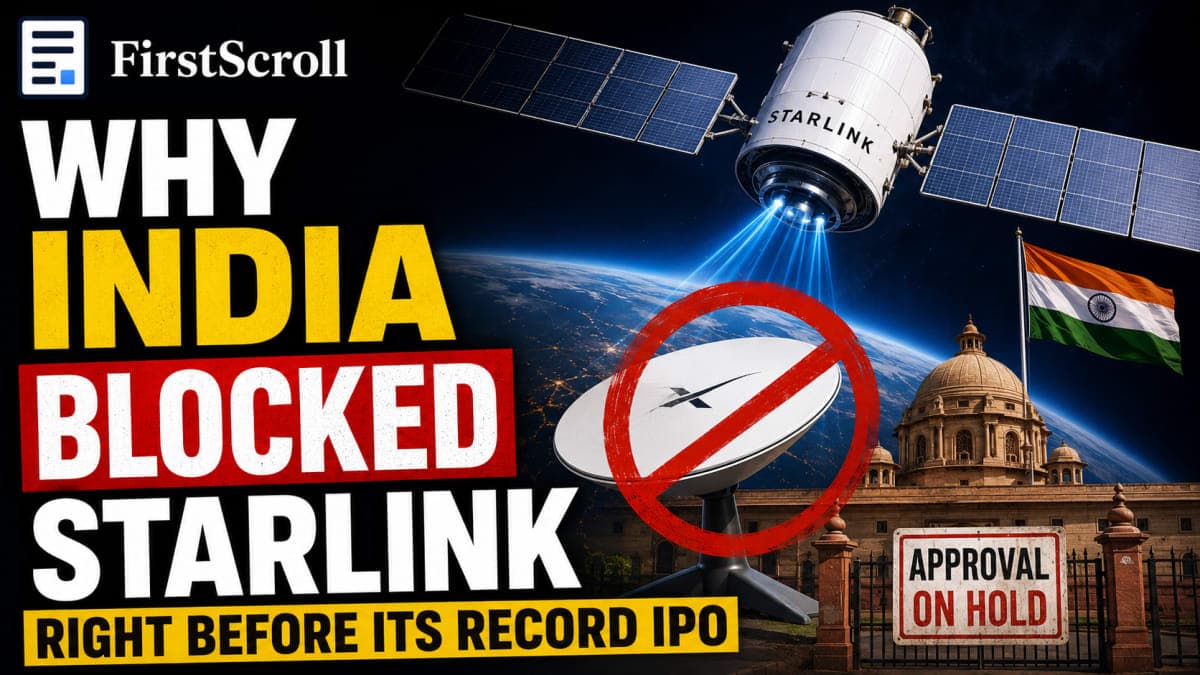
In today's FirstScroll, we unpack the strangest timing in tech right now. Days before SpaceX pulled off the biggest IPO in history, India quietly slammed the door on Starlink. And the reason has almost nothing to do with internet speeds.
The Story
Imagine running a marathon, clearing every checkpoint, and then getting stopped one metre before the finish line. Not because you did anything wrong, but because the referee suddenly wasn't sure he could trust you to follow the rules after you cross.
That, right now, is Starlink in India.
For years, Elon Musk has wanted to beam satellite internet into India, one of the biggest untapped internet markets on the planet. And for years, it looked like it was finally happening. Then, in the second week of June 2026, just days before SpaceX's record-breaking IPO, the whole thing hit a wall.
India effectively froze the final approvals Starlink needs to begin commercial operations. Security agencies under the Ministry of Home Affairs withheld the last clearances. Game paused, one step from the finish.
Now here's what makes this genuinely confusing. Starlink hadn't been rejected at the start. It had already cleared almost everything.
Think about how much it had gotten through. It secured a Unified License with GMPCS authorisation from the Department of Telecom in June 2025. It got approval from India's space regulator IN-SPACe in July 2025, valid until 2030. The DoT even provisionally allocated it spectrum in August 2025. It had signed partnerships with Airtel and Jio. It had even published its India pricing, around ₹8,600 a month with a ₹34,000 hardware kit.
Everything was in place. The marathon was basically run. So why the sudden stop at the finish line?
To understand that, you have to look at something happening thousands of kilometres away. In a war zone.
The Iran problem.
Here's the thing about Starlink that makes it magical and, to governments, terrifying. It beams internet down from satellites in space. That means it works anywhere, even in places where the local government hasn't approved it and can't physically switch it off. There are no cables to cut, no local towers to shut down. The signal just comes from the sky.
That's a miracle if you're a villager with no internet. It's a nightmare if you're a government that suddenly can't control what's connecting inside your own borders.
And that exact nightmare just played out in the open. Reports emerged that Starlink terminals were being used in the recent Middle East conflict involving Iran, even though the service was never licensed in Iran. Read that again. The service operated inside a country that never approved it.
Indian officials saw that and a very uncomfortable question lit up in their heads. If Starlink can run in Iran without permission, what stops it from running in India during a crisis, in ways New Delhi can't control?
The real fear: who's holding the off switch.
This is the heart of the whole story, and it's not really about internet at all. It's about control.
A communications network is critical national infrastructure. During a war, a riot, or a border standoff, a government wants to be absolutely certain it can monitor, regulate, or if needed shut down the networks operating on its soil. With an Indian telecom company, that control is straightforward. With a US-based operator answering to Elon Musk and potentially to competing demands from other governments, it gets murky.
India's concern is essentially about whether it can exercise control over a US-based operator during periods of geopolitical tension. Officials want Starlink to explain how it will guarantee compliance with Indian security rules even when, say, the US government wants something different on the same day.
And India wasn't being vague about its demands. The provisional spectrum grant from 2025 already came with strict strings attached. Starlink had to place its network traffic and monitoring systems physically inside India, get security clearances for foreign nationals, and report regularly to law enforcement. The freeze basically takes those existing security worries and turns them into a hard stop until the company can prove it'll play by India's rules, no matter what's happening globally.
The brutal timing.
Now layer in the IPO. The hold landed just days before SpaceX priced its Nasdaq listing, the largest IPO in human history at nearly $1.8 trillion. SpaceX's entire valuation story rests on Starlink eating the global internet market. And one of the biggest prizes on that map, a country with over 1.4 billion people but only around 950 million internet subscribers, just hung a "not yet" sign on the door at the worst possible moment.
To be fair, Starlink is pushing back hard. Lauren Dreyer, VP of Starlink Business Operations, said the company "remains in active and productive discussions with the Government of India," dismissing the reports as based on unsubstantiated claims from anonymous sources. So depending on who you believe, this is either a hard block or a tense-but-normal final negotiation.
So why did India block Starlink right before its record IPO?
Not because the internet is bad. Not because the pricing was wrong. But because the very thing that makes Starlink revolutionary, that it works from the sky, beyond any local government's physical reach, is exactly what makes a security-conscious country nervous. India looked at what happened in Iran and decided it wasn't going to hand over a chunk of its communications backbone to a foreign operator until it was 100% sure who controls the off switch.
It's a clean collision between two big ideas. On one side, the dream of universal internet for every remote corner of a massive country. On the other, the hard reality that in a dangerous world, a government wants its hands on its own infrastructure.
And for now, in that standoff, national security won. The fastest internet in the world is still parked in orbit above India, waiting for someone to decide it can be trusted to land.
Until next time...