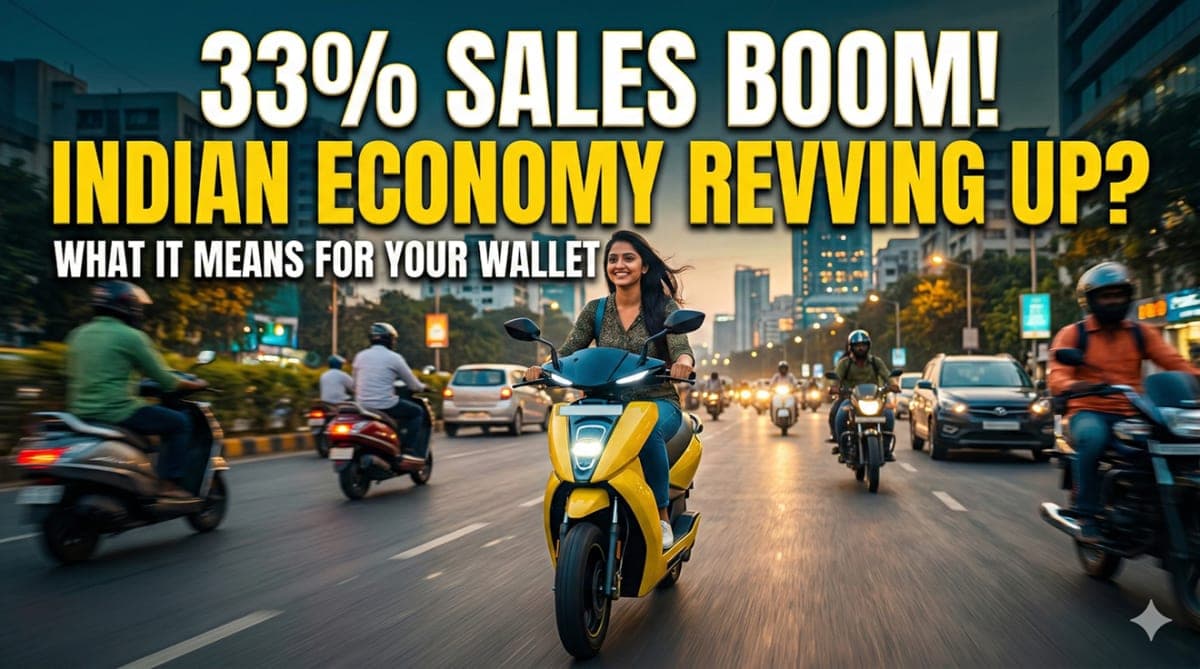
In today's FirstScroll, we unpack the massive 33% surge in two-wheeler sales and what this "two-wheeler boom" tells us about the health of the Indian economy.
The Story
You walk into your local showroom on a Tuesday afternoon, just planning to "look" at that new electric scooter you saw on Instagram. You expect a quiet floor and a bored salesperson. Instead, it's packed. Families are debating colors, students are checking EMI options, and the delivery bay is a revolving door of shiny new wheels. It feels like everyone suddenly decided to upgrade their ride at the exact same time.
Every time we see a spike in two-wheeler sales, history tells us a very specific story. In 2012, it was the rise of the aspirational middle class. In 2021, it was the "revenge buying" after the pandemic. Today, we are seeing a similar pattern, but with a twist. The latest data for February 2026 shows two-wheeler sales haven't just grown hey've exploded, with leaders like Hero MotoCorp reporting a staggering 44% jump in dispatches.
For years, the Indian auto industry followed a predictable path. People bought bikes because they had to, focusing purely on fuel efficiency and "kitna deti hai." But now, the narrative has shifted. We aren't just buying bikes to get from point A to point B anymore. We are buying them because the rural economy is finally waking up, and the urban crowd is making a massive pivot toward Electric Vehicles (EVs).
But wait, how did we get here?
See, two-wheeler sales are the "canary in the coal mine" for the Indian economy. Since two-wheelers are the most affordable entry point into personal mobility, their sales numbers tell us exactly how the average person feels about their wallet. If sales are up, it means people have enough spare cash (or confidence in their future income) to take on a loan.
Think of it like a gym membership. If you're feeling broke, you stick to home workouts. But when you feel like your career is on track and your salary is steady, you finally sign up for that fancy CrossFit class. A 33% industry-wide jump suggests a lot of people are feeling "gym-ready" about their finances.
Now, let's talk about the big drivers. A huge part of this growth is coming from rural India. After a few years of shaky monsoons and high inflation, rural incomes are stabilizing. When a farmer in Vidarbha or a small business owner in Bihar buys a Hero Splendor which saw a 27% rise in sales in recent months it's a signal that the "Bharat" side of the economy is back in the game.
Which brings us to the uncomfortable question is this just about petrol bikes?
Actually, no. A massive chunk of the excitement is coming from the EV segment. Companies like TVS are seeing their electric scooter sales grow by 60% year-on-year. For the uninitiated, the penetration of electric two-wheelers is reaching a tipping point where they are no longer just "tech toys" for the rich; they are becoming the default choice for the daily commute. In fact, electric two-wheeler sales have already crossed the 10 lakh mark in the first 10 months of FY26, and the industry is on track to hit 13.5 lakh units for the full year.
But here's the catch.
While the sales numbers look like a celebration, there's a hidden tension in the data. The Credit-Deposit (CD) Ratio of our banks is currently under the spotlight. This is a measure of how much of a bank's deposits are being lent out as loans. Think of it as how stretched a bank's balance sheet is. If a bank has ₹100 in deposits and lends out ₹80, the ratio is 80%.
Currently, the RBI is keeping a very close eye on this because banks are lending aggressively the system-wide CD ratio has climbed to around 82%, with the incremental ratio nearing 97%. Credit growth is running at 14.4% while deposit growth trails at 12.5%. In simple terms, banks are handing out loans for those scooters and bikes faster than people are putting money into savings accounts. If this continues, banks might have to raise interest rates on deposits to attract more cash, which eventually makes your scooter loan more expensive.
So where does that leave us?
On one hand, the sales boom is fantastic news. It shows that the "bottom of the pyramid" has spending power again. It's a vote of confidence in India's growth story. On the other hand, we have to watch out for the cost of borrowing. The RBI kept the Repo Rate unchanged at 5.25% in its February 2026 meeting worth noting this is already at its lowest since mid-2022 after a cumulative 125 basis points of cuts through 2025. They are maintaining a "neutral" stance, meaning they could go either way depending on how the data looks.
The "So What?" for you is simple. If you've been eyeing a new ride, the market is currently a buyer's paradise with plenty of options and competitive deals. However, keep an eye on those interest rates. While we're currently in a relatively cheap borrowing environment thanks to last year's aggressive rate cuts, the RBI's pause suggests the easy-money phase may have peaked for now. Banks balancing their own books could mean lending rates inch up even without the RBI raising the repo rate.
Ultimately, seeing 33% more people on the road isn't just a traffic problem it's a sign that the Indian engine is revving up again.
Until next time…
The hum of an electric motor is becoming the new soundtrack of India's economic recovery.
If this story helped you understand the auto sales boom, share it with a friend on WhatsApp, LinkedIn, or X.