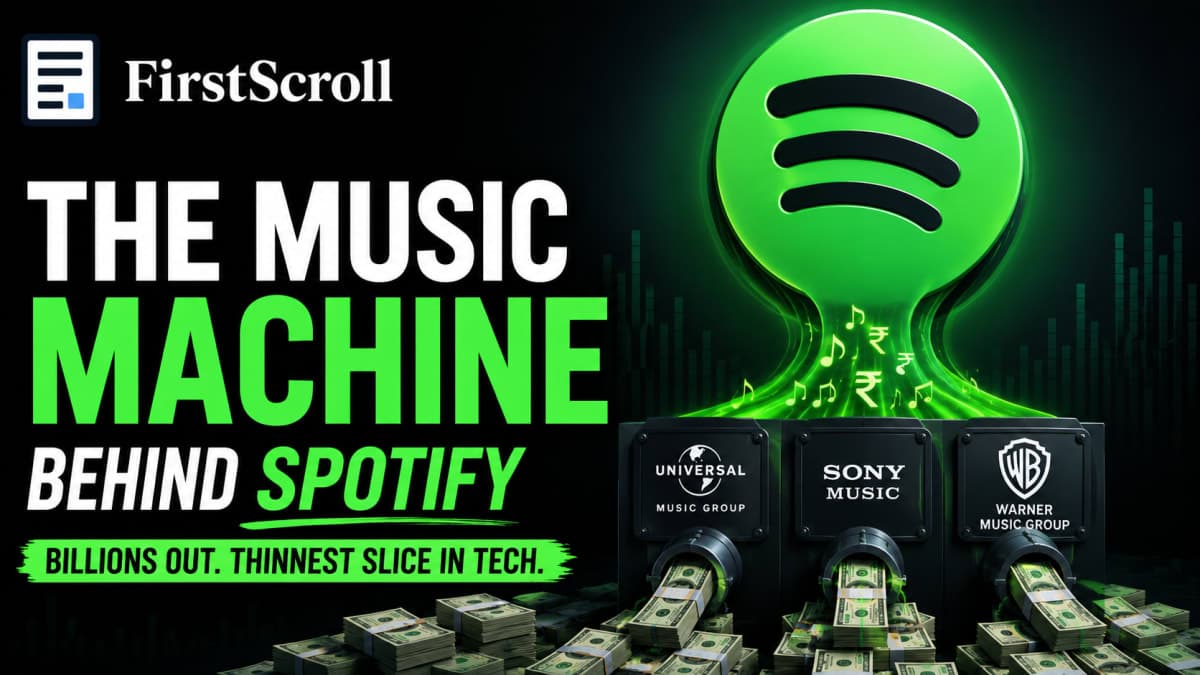
In today's FirstScroll, we open up the world's biggest music app and find a strange machine inside. Spotify has 700+ million listeners, just paid a record $11 billion to the music industry, and took nearly two decades to earn its first annual profit. Why does the platform that plays every song you love keep such a tiny slice of the money? The answer is a business model unlike anything else in tech.
The Story
Spotify looks like a classic tech giant. Hundreds of millions of users. An app on every phone. Total dominance of its market.
So here's the stat that breaks the pattern. In 2025, Spotify paid out a record $11 billion to the music industry, the largest annual payment from any music retailer in history. Its lifetime payouts are now nearly $70 billion.
And yet, for almost its entire life, Spotify itself lost money. Founded in 2006, it didn't post its first full-year profit until 2024, nearly 18 years later. Even now, its gross margin sits around 33%, meaning roughly ₹67 of every ₹100 it earns flows straight back out the door. Compare that to Apple's services at 76%, or Nvidia's chips at 75%. Spotify runs the biggest music platform on Earth and keeps one of the thinnest slices in tech.
How can a company be this dominant and this squeezed at the same time? To understand it, you need to see who really holds the power in music.
The core problem: Spotify doesn't own the thing it sells.
Think about what Spotify actually is. It's a beautiful app, clever recommendations, playlists that read your mind. But the product, the songs, belongs to someone else.
Every stream of every track owes money to the rights holders: the record labels and music publishers who own the recordings and compositions. And here's the brutal part. Around two-thirds of all of Spotify's revenue flows into a royalty pool that goes out to these rights holders. Per industry analysis, the split works out to roughly 30% for Spotify, 56% to the recording side, and 14% to publishing.
So before Spotify pays a single engineer, a single server bill, or a single marketing rupee, most of its money is already gone. It's like running a shop where, for every ₹100 of sales, ₹67 automatically belongs to your suppliers, and then you cover all your own costs from the leftover ₹33.
And it gets worse. Those suppliers aren't small vendors Spotify can squeeze. They're three giants.
The landlords of music: the major labels.
Universal, Sony, and Warner, the three major label groups, control the catalogues Spotify cannot live without. Imagine a restaurant where three companies own nearly all the ingredients in the world. You can build the nicest dining room ever, but every time you renegotiate, the ingredient owners hold the knife.
That's Spotify's permanent position. If the majors pulled their music, the app would be a ghost town overnight. So unlike Netflix, which responded to this exact problem by making its own shows, Spotify can't easily "make its own music". The hits people demand are the hits the labels own. This is why streaming's economics are so different from every other tech business: the platform scaled, but the leverage stayed with the suppliers.
Now here's where the story splits into a strange double tragedy. Because while Spotify keeps a thin slice, many artists feel they get crumbs too.
The other side: why artists are angry anyway.
You'd think $11 billion in payouts would make musicians happy. Many aren't. Spotify has faced sustained criticism from musicians and songwriters over low earnings, and there's a reason both things are true at once.
Spotify doesn't pay artists a fixed rate per stream. It uses a "streamshare" model: all the revenue goes into a pool, and each artist's payout equals their share of total streams. Crucially, Spotify pays the rights holders, usually labels, who then split that money among artists, producers, distributors, and others down the chain. By the time a stream's value trickles through the label's cut and everyone else's share, the artist's portion can feel microscopic.
So the money is genuinely huge in total, 13,800 artists earned over $100,000 and more than 1,500 crossed $1 million in 2025, but it's concentrated at the top and diluted through middlemen below. Spotify gets blamed for a payment chain it only partly controls. Everyone in the system feels underpaid, and in a way, everyone is right.
So how did Spotify finally escape the loss trap?
After nearly two decades of red ink, Spotify has genuinely turned the corner, and how it did it is the interesting part. Since it couldn't change the royalty math on music, it changed everything around it.
First, it went beyond music. Podcasts and audiobooks don't belong to the three majors. Spotify poured money into both, because content with better economics fattens the overall margin.
Second, it raised prices, repeatedly. It has hiked US subscriptions three times in four years, betting that music is such a daily habit that people will grumble and pay. They did.
Third, it built an ads machine. Its ad-supported gross margin jumped from 6% to 15% in a year, turning the free tier from a loss leader into a real business.
And fourth, it got ruthless on costs, cutting staff and discipline-testing every expense.
The result: FY2025 operating income of €2.198 billion at a 12.8% margin, with Q4 gross margin at a record 33.1% and operating income up 47%. Profitable at last. But notice the ceiling: even in its best year ever, Spotify's operating margin is 12.8%. Apple's is near 30%. The royalty machine guarantees Spotify can be successful, but structurally caps how rich it can ever get from music alone.
So, why does Spotify pay billions to artists and keep almost nothing for itself?
Because it built a giant platform on top of content it doesn't own, controlled by three suppliers it can't replace. Roughly two-thirds of every rupee it earns is spoken for before it arrives. That contract made Spotify possible, no labels, no music, no Spotify, but it also made fat profits nearly impossible. Netflix escaped this trap by making its own shows. Spotify couldn't, so it spent 18 years grinding toward profit by building businesses around the music: podcasts, audiobooks, ads, and price hikes.
The lesson hiding in here is one of the sharpest in business: it's not enough to own the platform. What matters is who owns the product flowing through it. Spotify owns the pipes. The labels own the water. And in that arrangement, the pipe-owner works the hardest and keeps the thinnest slice.
Until next time...