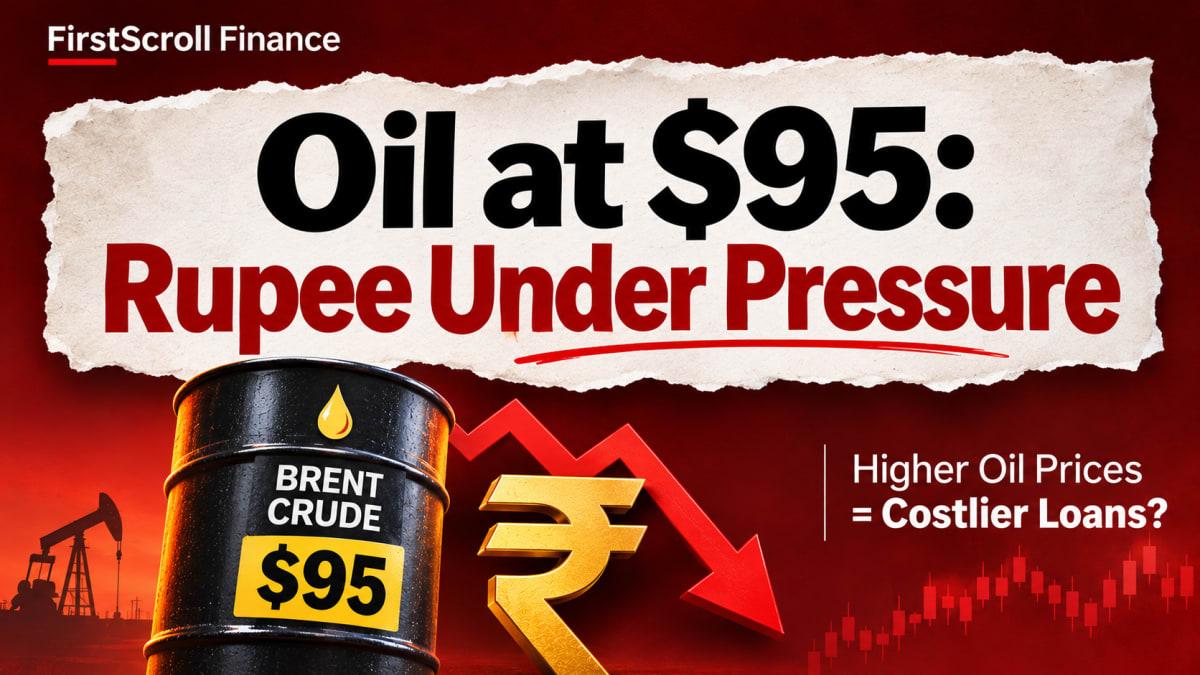
High oil prices act like a massive tax on the Indian economy, draining the country's dollar supply and making everything from home loans to local currency more expensive.
When Brent crude prices climbed above $95 per barrel, India had to spend more dollars to pay for fuel imports. This extra demand for dollars makes the rupee lose value, while fears that inflation will stay high force investors to sell government bonds and expect higher interest rates.
The Story
On a quiet Thursday when American markets were closed for Thanksgiving, the energy markets in the Middle East were anything but peaceful. Geopolitical tensions pushed the price of global oil to levels not seen in months, and the shockwaves travelled instantly to Mumbai’s trading floors.
In the bond market, where the government borrows money to build roads and bridges, the mood turned sour. Prices of government debt fell sharply as traders reacted to the news that Brent crude had topped the $95 mark. For the rupee, which had been enjoying a bit of a honeymoon lately, the news was a bucket of cold water.
Only a short while ago, investors were discussing why the Jio IPO was helping the rupee stay strong by bringing in fresh foreign cash. But as oil prices surged, that momentum evaporated. By the end of the day, the rupee’s recent gains had been partly reversed, and the cost of hedging currency risks had jumped.
Even gold, usually a safe place to hide during trouble, could not escape the gloom. Spot gold prices drifted down to $3,566.99 per ounce. While gold is often used to protect against inflation, it was being crushed by a different force: the fear that the US Federal Reserve would keep interest rates high to fight its own rising prices.
Why is the rupee falling when the economy is growing?
The problem is not that India is doing something wrong internally. It is that India is one of the world's largest buyers of oil, and when the price of a barrel goes up, we have to pay the bill in US dollars.
Think of the Indian economy as a massive household that needs to buy a large portion of its fuel from a neighbor. If the price of that fuel doubles, the household has to sell its own currency to buy the neighbor's currency. This creates a supply-and-demand mismatch: there are too many rupees chasing too few dollars.
When oil prices spike, the Reserve Bank of India (RBI) often has to step in to prevent the rupee from crashing too fast. But the market knows that as long as oil stays near $95, the pressure will remain. This is why currency traders started pushing up what they call forward premiums, which is essentially the extra cost you pay today to secure dollars for the future.
So here's the question: if oil is just a commodity we import, why did it cause a simultaneous crash in the rupee and government bonds?
How does expensive oil break the bond market?
You see, the bond market is not just about debt: it is a giant betting machine on the future of inflation and interest rates. When oil gets expensive, it does not just stay at the petrol pump. It moves into the cost of transporting tomatoes, running factories, and delivering Amazon packages.
The RBI has already been worried about this. Before this oil spike, retail inflation had already surpassed the 6% threshold in October. Now, with oil adding more fire to the engine, the central bank has flagged broad-based food inflation as a major risk.
Now add the second ingredient: when inflation goes up, the value of a fixed-interest bond goes down. If you hold a bond that pays a fixed interest rate, but inflation is also high, your real profit is eroded. So, investors sell their bonds, which causes bond prices to fall and yields to rise. This is a sharp reversal from just a few months ago, when many were celebrating why India's bonds had their best week as yields were dropping.
So who wants what here? The government wants low bond yields so it can borrow cheaply. The RBI wants to keep inflation under control. But global investors? They want to protect their cash. If they see inflation rising in India, they exit the bond market, putting even more pressure on the rupee.
Now, you might wonder why a bond sell-off matters to you. It matters because bond yields are the benchmark for all other loans. If the government has to pay more to borrow, banks will eventually charge you more for your home or car loan. It also hurts your debt mutual funds, which see their returns drop when bond prices fall.
But here's the twist
The timing of this oil spike is particularly brutal because of what is happening in the United States. In September, the US Federal Reserve delivered its first rate hike in three years, and markets now expect another hike next month and more in early 2027.
When US rates go up, the dollar becomes like a high-yield magnet, pulling money out of emerging markets like India. We are caught in a pincer move: expensive oil is pushing dollars out to buy fuel, and high US interest rates are pulling dollars out to buy American bonds. This double drain is what makes the current rupee fall so difficult to stop.
Now to be clear, the RBI is not sitting idle. All eyes are now on the next monetary policy decision scheduled for December 4. Until recently, some experts were debating why the RBI was hiking rates less than its global peers. But with oil at $95 and domestic inflation heating up, that "wait and watch" approach might have to change.
So, is the current market tumble about a weak Indian economy? Not really. It is about a global energy shock meeting a high-interest-rate environment in the US. India is producing enough, but the cost of the "blood" that runs through its economic veins, which is oil, has suddenly become too expensive.
The number to watch next is not the Sensex, but the oil ticker. If Brent stays above $95, the pressure on the rupee and your loan EMIs will only grow. The next major test arrives on December 4, when the RBI must decide whether to protect growth or fight the oil-fed inflation fire.
If this helped you understand why oil prices are rattling the rupee and bonds, share it with a friend on WhatsApp, LinkedIn, or X.