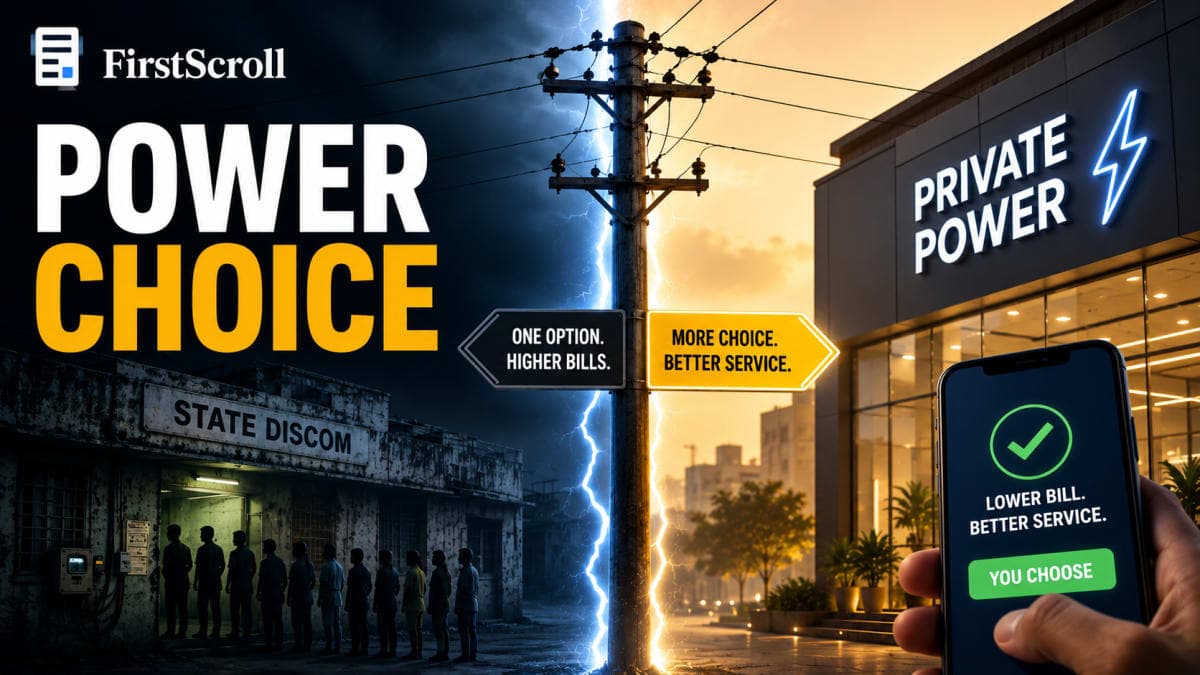
In today's FirstScroll, we break down the new parallel power licence and explain why a company that owns no wires might still end up deciding what your electricity costs.
With that out of the way, let's dive into today's story.
The Story
Look at the wall outside your home. One cable comes in. Behind that cable sits exactly one company with the legal right to sell you electricity, and in most of India that company is owned by your state government.
That arrangement is older than most of the people reading this. The state built the network, the state bills you for the power, and if the supply fails on a summer evening, the state is who you complain to.
Now the Centre wants to change who is on the other end of that cable. Last week, the power ministry's consultative committee discussed a new framework for something called parallel distribution licensing. In plain words, a second company would be allowed to sell you electricity in the same area, over the same wires the state company already built.
And private players are not waiting for the ink to dry. In Haryana, a company called Eleven Power has applied for a licence to distribute power in Gurugram and Nuh, districts currently served exclusively by the state utility. In Karnataka, Tata Power asked for something even bigger, permission to distribute across 19 districts, before withdrawing its application on 3 July after nearly 20 lakh objections landed at the regulator's door.
So here's the question: why would a private company fight this hard to sell electricity over a network it does not own, and why are state utilities fighting this hard to stop it?
You see, distributing electricity has two parts that we usually lump together. There's the network, the poles, transformers and cables that physically carry power to your home. And there's the supply business, which buys electricity in bulk, sells it to you at a tariff, and pockets the difference.
The proposed framework splits these apart. The existing licensee keeps owning and maintaining the network. The new licensee gets to use those wires by paying something called a wheeling charge, essentially rent for the road, the way an airline pays to land at an airport it didn't build. It can also build its own lines where the state regulator permits, but it doesn't have to.
That answers half the puzzle. A private company can enter the business without sinking thousands of crores into poles and cables. The expensive part is already built. What's on sale is the customer.
But which customer? This is where the story turns, because Indian electricity pricing has a secret subsidy running through it, and it's not the one you think.
Industries and commercial establishments in India pay more per unit than it costs to supply them. Farmers and poor households pay less, often far less. The gap is bridged inside the discom's books: the factory's inflated bill quietly funds the farm's discounted one. The polite term for this is cross-subsidy, and it is the financial spine of every state utility in the country.
Now watch what happens when a second seller walks in. The new licensee doesn't want your grandmother's subsidised connection. It wants the factory, the mall, the IT park, the customers who pay above cost. For them, the logic is simple: sign the profitable accounts, pay the wheeling charge, and skip the loss-making ones entirely.
And for the state discom? It keeps the network, keeps the subsidised households and farms it is legally bound to serve, and loses the very customers whose overpayment kept the whole arrangement standing.
This isn't a hypothetical fear dreamed up by unions. But here's the twist: the sharpest warning came from a regulator. In an interim order in May, Haryana's electricity commission itself flagged the possibility of cherry-picking profitable consumers, alongside questions about the applicant's finances and infrastructure. In July it went further, ordering an independent expert committee to examine the application and making the applicant deposit ₹30 lakh towards the panel's own expenses.
Follow the arithmetic one step further and it gets uncomfortable. If the paying customers leave and the subsidised load stays, the shortfall doesn't vanish. It gets recovered from whoever remains, or from the state budget, or from service quality. Competition arrives, and the bill it lowers may not be yours.
Now to be clear, the system being defended is not in great health either. India's state-owned discoms carry deep losses, and as of June 2025 they owed power generators around $6.78 billion, a debt that chokes the entire chain behind your plug point. The power engineers' federation argues that parallel licences would cripple public utilities, and they may be right. But doing nothing has a price too, and consumers are already paying it through tariff hikes and surcharges that patch up discom books.
So, is this competition or cherry-picking with paperwork? Well, the honest answer is that the framework hasn't decided yet. Everything hinges on details still being written: how wheeling charges are set, whether new entrants must serve every category of consumer, and who inherits the subsidy burden when the profitable accounts walk. The Electricity (Amendment) Bill that would formalise much of this is still sitting with a parliamentary standing committee. Whether India gets genuine competition at the plug point or simply a new owner for its most profitable customers is something only time will tell.
Until then…
If this story helped you make sense of the parallel licence debate, share it with a friend on WhatsApp, LinkedIn or X. You might also enjoy our story on BISLERI.