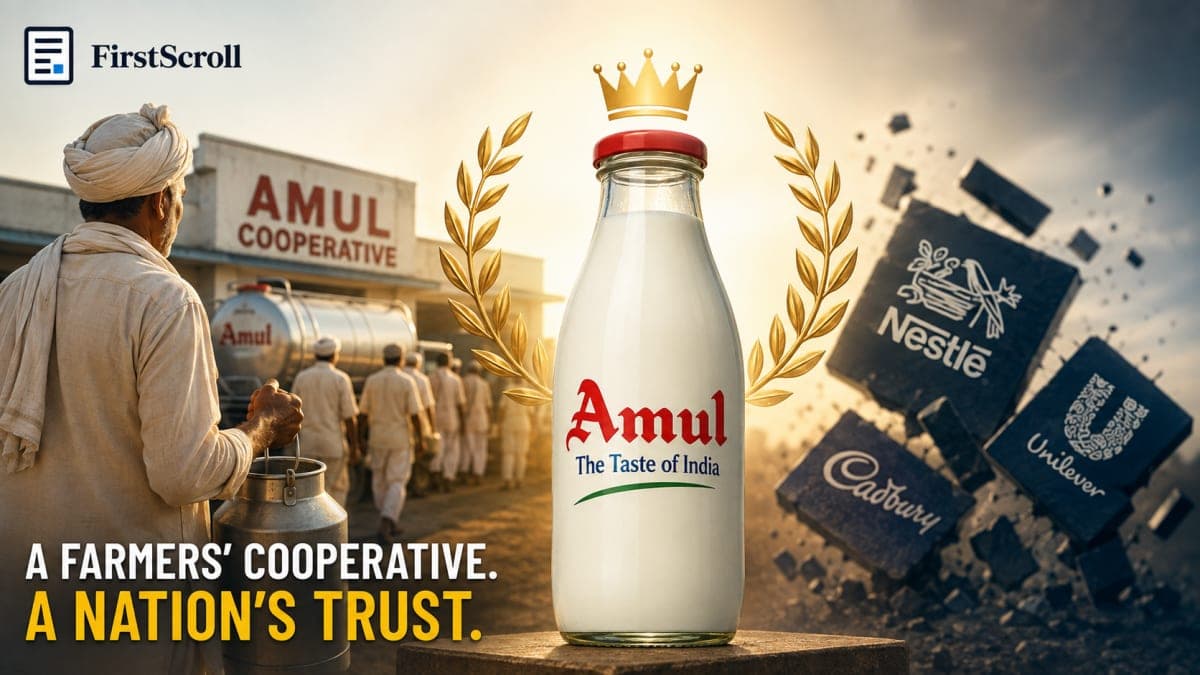
In today's FirstScroll, we break down how Amul beat the multinationals who came for the Indian kitchen, and explain why it never once sold them out.
This one is part business story, part love story, so stay with us. With that out of the way, let's dive into today's story.
The Story
Picture a village in Kaira district, Gujarat, in the 1940s. A farmer wakes before dawn, milks his buffalo, and walks the milk to a collection point. There he hands it to an agent of Polson, the one dairy that mattered for miles around. Polson decides the price. The farmer has no other buyer, so he takes what he is given and walks home.
Polson had something better than a good product. It held a government contract to collect milk from Kaira and ship it to Bombay, a private company sitting on a public monopoly. The farmers did the hard part. Polson set the price and kept the difference.
In 1946, the farmers went to Sardar Vallabhbhai Patel. His advice was blunt: stop selling to Polson and build your own dairy. So they went on strike, poured their milk onto the streets rather than hand it over, and registered their own cooperative that December.
The world would come to know that cooperative by a shorter name. Amul.
Now fast forward to today. In FY26, the Amul brand crossed ₹1 lakh crore in group turnover, up from ₹80,000 crore just two years earlier. Nestlé, Unilever and Cadbury have spent decades fighting for the Indian kitchen, and Amul sits on top of the pile.
Here is the strange part. Amul is still a cooperative, owned by its 3.6 million farmers, with not one share sold to an outside investor.
So here's the question. How did a company owned by farmers, that spends almost nothing on advertising, end up bigger than the multinationals who wrote the textbook on selling food, without ever selling a piece of itself?
You see, a normal company is owned by shareholders who put in money and expect a profit back. A cooperative is different: it is owned by the people who supply it or use it, not by outside investors. That is [how a cooperative works](INTERNAL: what is a cooperative), and it is the key to everything that follows. In Amul's case, the owners are the farmers pouring in the milk every morning. There is no outside shareholder standing at the end of the line, waiting to be paid.
That single difference decides where the money goes. Amul is built in three tiers: village societies own the district unions, and the district unions own the state federation that markets everything under the Amul name. Of every rupee a customer spends, that structure sends the bulk of it back to the farmer.
This is where the loop begins. For the farmer, the logic is simple. Amul can pay more than a private buyer can, because it is not carving out a profit for anyone else. So the farmer stays loyal and pours in more milk.
And for Amul? That loyal, low-cost milk at enormous scale is the whole game. It can price its butter, cheese and milk pouches below what a multinational must charge to keep its own shareholders happy.
There is one more trick. Amul spends under 1% of revenue on advertising. Big consumer goods rivals spend 5% to 10%. The money they burn on noise, Amul quietly hands back to farmers and shaves off the shelf price.
That is the machine. Loyal farmers, cheap milk, low costs, low prices, more loyal farmers. A rival with a fatter budget cannot break the loop, because it cannot pay the farmer more, the shareholder more, and the customer less, all at the same time.
Here is what that looks like on a scoreboard. Amul's marketing federation booked ₹65,911 crore in revenue in FY25. Nestlé India, in the same year, managed about ₹20,077 crore. The cooperative is roughly three times the size of the multinational.
But here's the twist. The model is not a magic wand, and Amul has lost plenty of fights. Take chocolate. Amul launched it in the 1970s and briefly gave Cadbury a real scare, then quietly faded away while Cadbury owned the aisle for decades. Milk is Amul's fortress. Step too far from it, and the moat runs dry.
There is a deeper catch too. The loop only holds if farmers keep getting paid more every year. That is the promise that keeps the milk flowing. But it also means Amul cannot squeeze its own suppliers to fatten margins, and staying a cooperative means it cannot tap the stock market for a quick war chest either. Every rupee of expansion has to be earned, not raised, which makes growth slower than a listed rival's.
Now to be clear, that same discipline is why Amul is still standing while richer rivals wobble. For years it ran ads urging Indians to eat "real ice cream" made from milk, not "frozen dessert" made from vegetable oil, a jab so sharp that Hindustan Unilever dragged it to the Bombay High Court in 2017. Amul is now the country's largest ice cream maker. And in 2026, Kwality Wall's said it would drop palm oil and move its entire range to milk by 2027. The multinational, in the end, started copying the cooperative.
So, is a farmers' cooperative simply a better way to build a food company? Well, that is where it gets complicated. Amul is the product of one place, Anand, one product, milk, and one stubborn man, Verghese Kurien, who ran it for decades and turned the Anand pattern into India's White Revolution. The government now dreams of building more cooperatives like Amul across the country. Whether that lightning can be bottled again, in other crops and other states, or whether Amul was a one-time miracle of the right people in the right village, is something only time will tell.
Until then…
If this story helped you make sense of how a farmers' cooperative out-muscled the multinationals, share it with a friend on WhatsApp, LinkedIn or X. You might also enjoy our story on zepto.