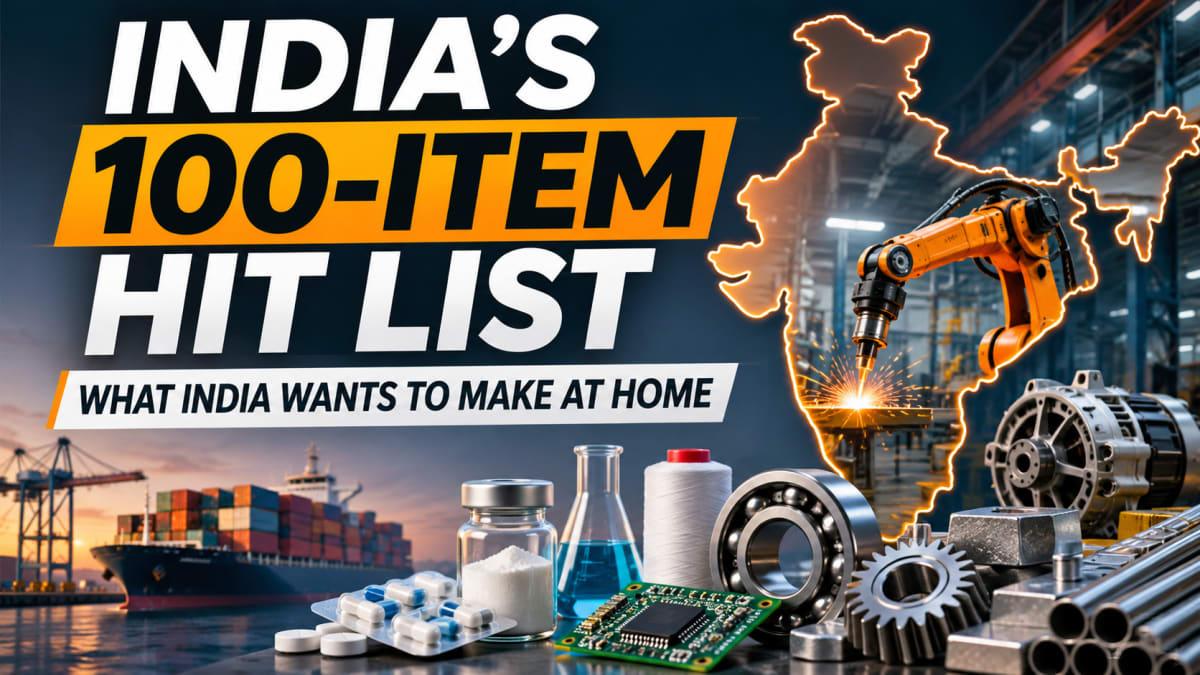
India is moving away from broad "Make in India" slogans to a surgical "hit list" of 100 specific products that the country can no longer afford to buy from abroad.
The short answer: The government wants to slash its $775 billion import bill by identifying 100 critical items, from pharma ingredients to auto parts, for special manufacturing support. By localising these, India aims to stop foreign suppliers from manipulating its supply chains while saving billions in foreign exchange.
The Story
Imagine a machine the size of a multi-story building, eating its way through the earth under Delhi or Mumbai to build a new metro line. These machines are the heavy lifters of India's infrastructure dreams.
Up until now, India has relied heavily on global suppliers for this technology. But this month, the ground shifted. Beijing announced a restriction on exports of tunnel boring machines to countries it considers sensitive, specifically naming India.
This is not just a trade spat. These machines are essential for everything from high-speed rail to high-altitude defense roads. When a single country can turn off the tap for such vital equipment, the entire country's growth schedule is at the mercy of a foreign capital.
Commerce Minister Piyush Goyal reacted quickly, stating that India would not buckle under pressure. Instead, the government is looking to build these machines at home. But it is not just about tunnel diggers.
The Department for Promotion of Industry and Internal Trade (DPIIT) has just completed a massive exercise. They have worked with industry experts to identify a list of 100 high-import items where India is either not manufacturing anything or is making far too little.
And here is the strange part. Even as India's total exports reached $863 billion in FY26, the gap between what we sell and what we buy remains a massive headache for policymakers.
So here's the question: if India is already a global pharmacy and a software giant, why is the government picking a "hit list" of 100 specific products to manufacture at home?
Why is the government picking only 100 specific items?
You see, the problem is not that India doesn't want to make things. It is that "Make in India" was often too broad, like trying to fix a leaky house by repainting every single wall. This new strategy is more like finding the specific pipes that are actually burst.
Think of these 100 items as the "critical spares" in a home toolbox. You might not need to manufacture every single screw or lightbulb in your house, but if you cannot fix a broken fuse without asking a neighbor who might say no, your house stays in the dark.
The government set up six working groups to find these "fuses." They looked at sectors ranging from chemicals and textiles to defense and aerospace. The goal is to ensure that for these 100 items, India is never again at the mercy of another country's export bans.
According to the DPIIT, the 100 items were grouped into these specific categories:
| Working Group Sector | Key Focus Areas |
|---|---|
| Healthcare | Pharma, biotech and medical devices |
| Industrial | Chemicals, petrochemicals, textiles and footwear |
| Mobility | Auto parts, electric vehicles and capital goods |
| Energy | Energy generation and distribution components |
| Infrastructure | Construction equipment and machinery |
| High-Tech | Electronics, defense and civilian aerospace |
Now, why should you care about industrial machinery or chemical intermediates? Because when we have to import sugar and pulses in 2026 just to keep food prices stable, every dollar we spend on machinery is a dollar we cannot spend on essentials. A high import bill eventually weakens the Rupee, which makes your next iPhone or foreign holiday more expensive.
So who wants what here? The government wants to save foreign exchange and protect national security. Manufacturers want a clear signal that if they spend crores on a factory, the government will support them. And for exporters, the focus is on a $2 trillion export target by 2030 to 2031.
This is where the Export Promotion Mission (EPM) comes in. With an outlay of ₹25,060 crore over six years, the government is trying to help smaller companies find new markets abroad while the 100-item list fixes the holes in the domestic market.
Can a targeted hit list really fix the trade gap?
But here's the twist. Identifying a product is the easy part. Building the factory to make it is much harder. The support measures being discussed for the FY28 budget are a mix of fiscal and non-fiscal incentives. This could mean anything from R&D funding to temporary tariff protections.
However, tariffs are a double-edged sword. If India raises taxes on imported machinery to protect a local factory, the construction companies building our metros will see their costs go up. This can lead to a cycle where fixing one problem creates another in a different industry.
We have seen similar challenges before when the government tried to balance trade needs. For instance, you might remember why India extended the RoDTEP scheme to help exporters who were struggling with rising costs. The "hit list" strategy will face a similar balancing act.
Now to be clear, the final call on these incentives rests with the Finance Ministry. The DPIIT has finished the homework, but the actual cash and tax breaks will only be known when the next budget is presented. The government is also trying to use Free Trade Agreements (FTAs) with partners like the UAE and Australia to ensure that even as we build at home, we have places to sell our goods.
So, is the "surgical" strategy about closing India off from the world? Not really. It is about resilience. It is about making sure that the next time a global supplier decides to restrict a machine or a chemical, India's infrastructure projects do not come to a grinding halt.
India is no longer just shouting slogans. It is checking its inventory. Whether these 100 items can be successfully localized will be the real test of India's manufacturing strength in the lead up to 2028.
If this helped the surgical import plan make sense, share it with a friend on WhatsApp, LinkedIn, or X. You might also enjoy our story on why the Rupee is falling despite low oil prices.