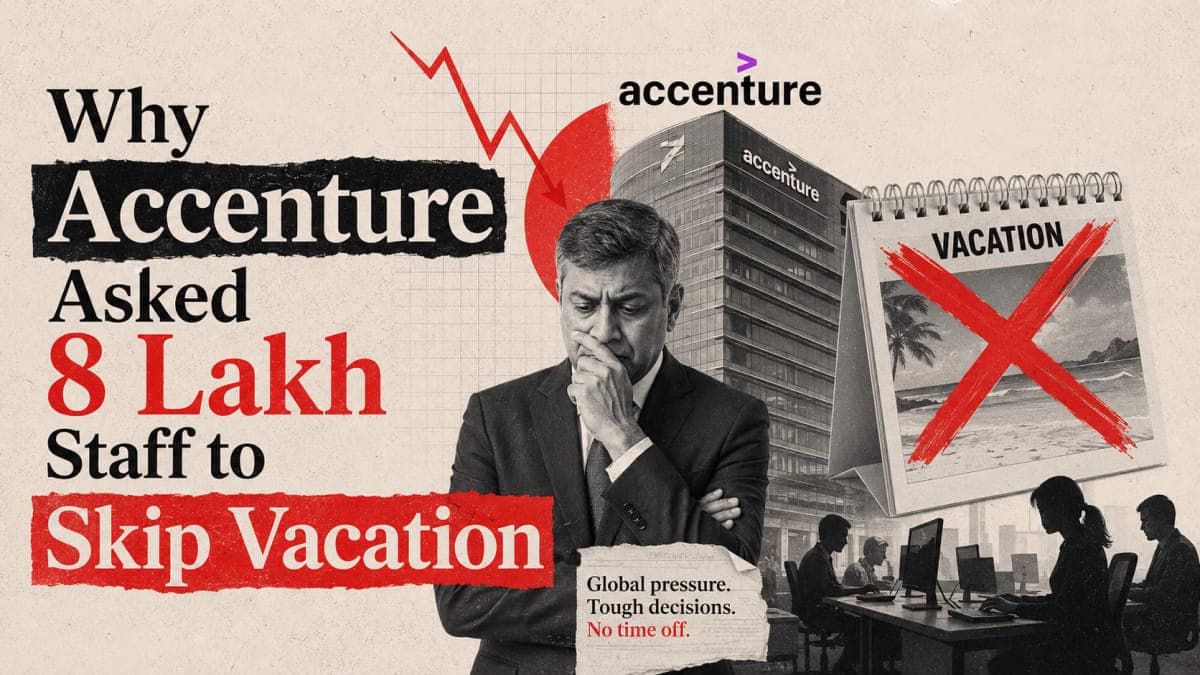
In today's FirstScroll, we break down Accenture's unusual "no vacation" memo and explain why three weeks of August could decide the fate of a $170 billion company.
With that out of the way, let's dive into today's story.
The Story
Imagine you work at one of the world's largest companies. It's August. Half your clients are on a beach somewhere, your inbox is quiet, and you've been eyeing that long-pending family trip.
Then a memo lands from the very top.
Your CEO would like you to postpone that vacation. In fact, the company will make a one-time exception and let you carry your unused leave into next year, just so you keep working through the month. In the memo, CEO Julie Sweet wrote that "our shareholders are counting on us to deliver a strong quarter", and asked everyone to hunt for new sales, small or "mega".
This is Accenture. A company with roughly 799,000 employees, more people than the population of Bhutan. And its boss is personally asking them to skip the summer holidays.
So here's the question: why does a $170 billion giant need three extra weeks of its employees' summer?
The answer starts with a quirk of the calendar. Most companies close their books in December or, in India, in March. Accenture doesn't. Its financial year ends on August 31. So while the rest of the corporate world treats August as nap time, for Accenture it's the final over of the match. Every deal signed before the 31st counts for this year. Every deal signed after belongs to the next.
And in consulting, what you sign matters as much as what you earn. You see, consulting firms track something called bookings: the total value of contracts clients have signed, essentially promises of future work. Revenue is what you bill as you actually do that work, often over years. Bookings are the pipeline, revenue is the tap. If bookings shrink today, revenue dries up two years from now, and investors know it.
Which is exactly why alarm bells went off in June. Accenture reported that new bookings fell 2% in the quarter ended May 31. Worse, it forecast fourth-quarter revenue of $17.75 to $18.4 billion, short of the $18.47 billion analysts were expecting. The stock, already battered, remains down more than 36% this year.
The whiplash is what makes this remarkable. Just one quarter earlier, Accenture was celebrating record bookings of $22.1 billion, including 41 clients signing deals worth over $100 million each. From best quarter ever to please-cancel-your-holidays in about 90 days.
Now the incentives snap into place. For Sweet, this August is the last chance to stuff the pipeline before full-year results, reset the story, and prove the slowdown was a blip. For employees, the trade is a deferred holiday in exchange for, presumably, job security and year-end numbers that keep the layoff conversations away. And for clients? An army of consultants unusually eager to close deals before month-end, which, if you're a client, might just be the best time all year to negotiate.
But here's the twist. While employees are being asked to sacrifice their summer for shareholders, Accenture is spending historic sums on those same shareholders. In June, it raised its buyback program by $2 billion to $7.5 billion, a 62% jump over last year, with $2.3 billion being spent in this very quarter. A [buyback](INTERNAL: share buybacks explained), simply put, is a company purchasing its own shares to support the stock price. So the message reads two ways: employees, please work August; meanwhile, billions flow into propping up the share price directly.
Now to be clear, there's a defensible logic here. Sweet argues the share price doesn't reflect Accenture's position in AI-driven reinvention, and buying your own stock when you believe it's cheap is textbook capital allocation. A vacation rollover is also a fairly gentle ask, not a layoff.
But the memo is a symptom of something bigger. The real question haunting Accenture isn't whether August goes well. It's whether AI is a tailwind for consulting or a threat to it. If AI lets clients do with software what they once hired armies of consultants for, no amount of cancelled holidays fixes that. And that question should keep India awake too: Accenture houses an estimated 3 lakh employees in India, its largest single-country base, and whatever AI does to its model, it does to TCS, Infosys and Wipro next.
So, can 19 working days rescue a fiscal year? We'll know when Accenture reports in September. Whether this August sprint marks a turnaround or just a company running faster on the same treadmill is something only time will tell.
Until then…
If this story helped you make sense of Accenture's August push, share it with a friend on WhatsApp, LinkedIn or X. You might also enjoy our story on why Bharat Forge posted a loss despite 19% growth.